Search This Blog

Friday, April 11, 2025

A WHCA Recruiting Trip to Ft Bliss TX (1968)-Revised


Recruiting Trip to Fort Bliss
Entrance to FT Bliss

Type Of Activity
Personnel Recruiting Trip
Location
Location
Ft Bliss TX
Date of Activity
 Aug 04 1968 to Aug 10 1968
Coordinates


04 Aug 68 to El Paso TX -Ft Bliss Recruiting Trip

WHCA sent recruiting teams to all of the Army, Navy and Air Force training centers in the US trying to find candidates in certain technical MOS’s. I was recruited by WHCA while I was attending Microwave School in Ft. Monmouth NJ.  A team of four members from the organization, all in civilian attire, asked me wide variety of questions for about an hour. Then I was submitted to an intense background investigation necessary to obtain a Top Secret Security Clearance, which was required prior to being assigned to WHCA. This entire process took several months to complete.

In 1968 I was assigned to a four man team to go to Ft. Bliss TX to review, recommend and ultimately select candidates for future WHCA assignments, because Ft Bliss was the HQ for the US Army Air Defense Command there was a large Training Center on the Base. After a cross country airplane flight from Washington DC's National Airport to Chicago's O'Hare International to Dallas and finally to El Paso Airport. We also received meals on every leg of this flight so we ate four times on a flight that took five hours. We arrived in El Paso TX Sunday evening and got settled in our motel. The next morning we met with the Base Commander to obtain full access to all 201 files of the students currently attending any training that was taking place on the base. We were given permission to go to the base personnel unit and were given a contact to meet with so we could get started.

Insignia of the United States Army Air Defense Command

The Air Defense Command's Museum at Ft Bliss

We immediately contacted the personnel unit and began reviewing hundreds of DD-201 files. Each of us separated the records of people that we thought would make good candidates. We then looked at military aptitude scores, current training courses,  education and general backgrounds to make our final decision on who we would interview. The few individuals that remained were first gathered in a group while we explained what we were doing and let them know about WHCA and the process that we would follow to make our final decision and what it would take to qualify. We did give everyone in the room a chance to withdraw from consideration with no questions asked. For the next three days we conducted personal interviews asking many direct questions about their lives and background. As we completed the individual interviews we discussed the merits of each candidate and made our final selections.

We met with the final seven candidates the next day to have them complete the administrative paperwork, which also included the forms needed to perform an extensive background investigation and obtain top secret security clearance. Once they graduated and received their security clearance they would receive their assignment in WHCA.

While I was in Fort Bliss Texas on this recruiting trip the 1968 the Republican National Convention began in Miami Beach FL, and even though there were demonstrators, there were no violent incidents like what would erupt in Chicago in a few months. Richard Nixon the Republican nominee surprised everyone by choosing Maryland Governor Spiro Agnew as his running mate.  I would have never imagined the events that would take place in the next couple of months would forever change the Presidential election process.

Memories of Individual experiences of the WHCA recruiting process

Roger Zabkie remembers that in 1955 when I was near the end of my 30-some weeks of microwave school at Ft Monmouth, two guys in civilian clothes interviewed several people in my class. Three of us were selected for WHASA, WHCA's predecessor. One went to High Point then Mt Weather, one stayed in DC, and I went to Camp David, where I served for five years. No polygraph until three years later.

John Cross In 1965, while I was attending 26 wks. of Microwave Radio Repair training at Fort Monmouth NJ, a WHCA recruiting team was looking for recruits when they graduated from training. I was more than halfway through training when I was pulled out of class for my Interview. After about an hour of rapid fire questions I returned to class. 

The next day I was sent to another meeting with about a dozen people there. We were given the paperwork to fill out for a TS security clearance, since I already had a secret clearance, I had all of the necessary information to quickly fill it out. I was then told about the Poly that would be scheduled in the near future.
 
About a week later I took the Poly. After I was all strapped in, I was asked about twenty five questions (many the same as was asked during my interview) everything was going well until the last question, which was “Have you answered truthfully all of the previous questions” when I answered yes, the machine went wild.

After a short consolation with the administrator I was given the test over and PASSED!

When I graduated from Training, I had not heard anything about my security clearance. I was assigned to a Holding company and given the task of showing up every morning in uniform at Reveille and raising the flag. And then show up again at retreat to lower the flag while hanging around home the whole day. This lasted about three weeks when I received my orders to report to a street address in DC.

From the dozen that had filled out the paperwork only three of us, Chuck Duval(who joined me at Camp David), Marty Schorn who went to Cadre/Creed, and I made it to the agency—a small number considering the pool of 1000 trainees.

Charles Heyman comments I had the same Basic Training experience at Fort Dix NJ, Sept 1965. Initially the first presentation was outdoors. From that 13 of us went on for a second interview and 3 were accepted, I was the only one that actually went on to assignment. I spent four months at Ft. Gordon in switchboard training and a couple of months waiting for security clearance. Steve Weber and I left Ft. Gordon for WHCA about the same time in Feb 1966.

John Tiffen said I was interviewed during Basic Training at Ft. Ord in August or September of 1966. Charlie Graffius was one of the interviewers (can't recall the other person). What Kerry Pinkerton said below was what I was told also, except I don 't recall the part about waiving my AIT school (but then, it's been close to 60 years).

I know of one other guy from my Basic Training company who was chosen and he wound up working the switchboard (can't recall his name right now, either). Didn't get the final word until well into my AIT at Ft. Gordon.

Mark Edwards In 1966 there was no question about bestiality, but I was asked about any homosexual activities.

Donald Cammel When I was recruited their were about 30K Signal Corp Trainees at Fort Gordon in March 67. They screened records and invited about 350 to attend the first hour. After two breaks the number was about 150, and after lunch faded to about 60. During interviews they invited 11 to fill out packets. There ended up being 3 of us coming out the other side of the funnel! The other two people did their tour and got out.

William Sauder I was selected in 67 Ft Benning of the 6 that came for the interview only myself and Newt Shannon who went to work at the switchboard made it all the way through unbelievable odds.

Harland Priddle I enjoyed reading the selection process of the WHCA enlisted staff. Congratulations as one of the very, very few who were selected to serve in WHCA.

I participated on a couple of these recruitment trips. As I recall, we were always looking for a reason not to select based on some preset criteria, some of which made no sense.

My selection to WHCA as Deputy Commander was a result of General, Director of Hdqtrs Air Force Communications at the Pentagon recommending me to current WHCA Commander, Col Al Redman, later BG Redman, who I served with at the Joint Chiefs 1965-1968. Al was only the 3rd Commander since WHCA established in 1942, Replacing MG Jack Albright.

Needless to say, this was the best Air Force assignment with an outstanding group during historical times--Pres Nixon trips to China and USSR 1972.

I took the Poly from CWO Corky Dever (I think--he worked for CWO Len Stephens). I loved my Angus show animal and we didn't own any sheep, so I was clean and passed the Poly.

General Redman later ask my opinion about taking the Poly in about 73 and I said it was probably a good criteria for WHCA, just to show we were a cut above other assignments, but doubt if it had any value in identifying security threat people.
 
WHCA did use infiltrated people in comm center as I recall and did have a few successes, but this was also discontinued later.

AND NOW YOU KNOW THE REST OF THE STORY

Kerry Pinkerton When I was in basic in 69, WHCA personnel came to Ft Benning and looked at 40,000 trainees AFQT scores looking for category 4s that had enlisted. Iirc, that was an IQ over 120. Then then looked at other stuff and decided who to invite for an interview. There were 80 of us at the interviews. 8 made it through the day after the windowing process. .
The windowing process consisted of being told we'd 

1. Have to waive our schools
2. Couldn’t have ever been arrested even if later released.
3. Couldn't have more than 3 tickets.
4. Couldn't have ever had sex with a family member or an animal.
5. Couldn't have ever smoked pot or taken drugs.
6. Had to pass a polygraph. 
7. Failing the poly meant you were turned back to the army, which meant you were going to be dragging an M14 through the jungle.

Jerry Nichols and I ( both went to AV), and Bruce Mills (radio) made it to the agency. Pretty small group out of 40k.
I heard that not too many years later, they had to drop the pot requirement. And then at some point I heard that they dropped the poly and WHCA was on their way to becoming just another assignment.

Mike Ebbing adds the recruiting team came to Ft. Campbell, KY, around February of 1970. As I recall, a group of close to 500 attended the first day. Only 75 were invited back on the 2nd day. Not sure how many packets were issued but I do know only 3 of us made final cut.  All recruited for Signal, and we headed to Ft. Gordon for switchboard school. Terry Brewer and Dennis Munger both got their clearances and orders for WH Signal a couple months before me. When I reported to WHCA HQ in Georgetown, I was told I would also be at WH Signal. The next day, they changed their mind and assigned me to Camp David switchboard. I remained close friends with both Dennis & Terry. I spent my 2 weeks of Signal training (one week at Terry's apt in Arlington and another week at Dennis' apartment (also in Arlington). Karen and I stayed with them at the WHCA Xmas parties as well!

Gary Paul My experience was similar at Ft Knox in '72. They went through about 10,000, 201 files, interviewed 75, and picked up 1. A very lucky day for me.

Charles Easter In Apr or May of 1973, I was working in the Comm Center at Wright Patterson, AFB, when word came down that there was a recruiting team from Washington DC that was going to hold a briefing at the base theater, and I was asked if I wanted to go. I almost said no, as I had no desire to go to DC, so why bother, but I changed my mind and went, mostly just to get out of the comm center for a while. Anyway the base theater was pretty well filled up and we listened to what they had to say. I don't remember how the weeding went, but I ended up having a face to face interview with the recruiters. After the interview they asked if selected would I be interested in going to DC to work in the White House.  I couldn't turn that offer down, so of course I said yes. 

So after all the paperwork was processed, I was told that I would have a hold put on my records and could not be reassigned until I was either accepted or denied. About 5-6 months later I got the call that I was accepted. As far as I can remember, only myself and Eugene Edgerson were the only ones selected from that group. Glad I was at work that day and glad that I decided to go to the briefing.

John Harris My time in the service was 78-93 and of course long after the draft ended. The recruiting team scanned about a thousand records at Fort Polk and interviewed about 50. They picked up four of us. I never saw a poly.

Chris Morgan recalls that Dave Lytle recruited him from Fort Gordon in early fall, 1980, the theater was packed and only 2 of us were selected. During the interview with Dave, he apologized for having to ask me if I ever had sex with an animal. I asked him if anyone ever said "yes". There was no response.

Richard LePere In 1981 there was recruiting team in Germany. We were invited into the NATO HQ Theater in Heidelberg. The theater was filled with troops standing in the aisles, and along the back wall. Mark Schmidt was on that trip. We received the security briefing before breaking for lunch. When we returned, there were 13 people left in the theater. The 13 were whittled down to 5. Of the 5, that were selected to go to WHCA, only 3 went to WHCA and made it through training. 

Dave Meyers (AF) was my training NCO, and Ricky K. Harris and I went through training together at Signal 015, with the Western Electric 608D cord Swbd. I still have the color coded training paper mockup of the 608D cord switchboard. Each day we started with the switchboard mockup, practicing calls. Then we moved onto the crash position for movements and EA crash conferences, Echo/Fox, Crown Control Radio Console. Then after lunch we were put on one of the Controller positions, with Dave sitting next to us to monitor our call processing. After about a week, an SAO sat in between us, and we moved onto the paging system, the IBM database for name lookups. The EA procedures were hammered into our heads, along with the authentication codes for authorizing a non-secure EA conference call across non-dedicated 1FB circuits. I was told that I had to go through every level of training, including being trip Swbd Lead certified within 12 months, and that included stateside and overseas qualified. Best job ever!
 
Barry Bracken I wish I would have paid more attention to events that happened early in my career. I was a "buck sergeant" stationed at the Cheyenne Mountain Complex in Colorado Springs in 1982. I got a call from my first shirt one afternoon telling me that he did not know what I had done, but I better be in my service dress when reporting the next day to the Pete Field Base Theater. Pat Bell is the only one I can remember being on the recruiting team - she was the one that did the interview. I got a call a couple of weeks later asking me if I would be willing to come to WHCA without my clearance being completed to work on a "special project". I said yes and PCS'd a week or so later on just a message, no orders...quite an experience. I think I only had to have one person call the "special" number on the message. I only heard one side of the conversation; it was pretty much "oh....yes sir....yes sir...thank you." 

I arranged for my buddy to ship my HHGs and the wife and I drove across the country; her in our car packed to the hilt and me on my motorcycle. I was assigned to the special projects office, affectionately known as Albertson's Animals, and started work building the REVCON coaches.

I echo the sentiments of those that say they were lucky to have an opportunity to come to WHCA. Every job I have had since leaving the USAF has been because of a WHCA Alum vouching for me.

Jill Beatty Andershonis Chris Woodard and I were the only 2 to complete the process at Pearl Harbor in 84(?). The Chapel at PH started out full and the questions were the same during the weeklong process that included a photo and fingerprints. Questions weren’t really much different than what I was used to for security updates.

Marlene Chiatovich Mika I was a recruiter '95-'00 those questions were still asked during interview - crazy answers sometimes!

The poly was gone, the pot question was back .

Jeff Massa I was at HQ Air Force Personnel and got a call one day asking if I would be interested in working at WHCA (I didn't even know about the White House Communications Agency), I asked what it was and said sure. A couple of days later I was interviewed by several people over the next 2 days. During the interview I asked them how that got my name, I was told that if I got the assignment, they would let me know. # months later that offered me the assignment (which I accepted), once I got to WHCA I asked again how they got my name, and I was told that the person who would know was no longer at WHCA. I still don't know how they found me, but I was glad they did!

Larry Bethea I was stationed at Andrews AFB communications center, when I was ordered to attend a briefing. I'd guess about 60 Airman attended the briefing, 5 of us stayed and 2 of us joined WHCA. I got the same questions, no Poly. In fact I held TS clearances for over 30 years and never had a Poly. As a DOD Contractor I considered working for the CIA and heard they required a poly. Then I heard they fail 80% without question and for no reason creating the illusion of the cream of the crop. I declined so I didn't have to answer for a failed poly.

In today’s environment recruiting is done online by downloading an application to serve. WHCA is currently accepting applications from personnel on active duty in the grades of E4 with less than eight years in service (on a case-by-case basis) and grades of E5 to E6 with less than 15 years in service. for a 5 year tour, but must serve for a minimum of 3 years, for all branches. Currently there is a recruiter assigned to each branch of the service with a defined application process for each branch.


Tuesday, March 25, 2025

Presidential Aircraft Air Force One SAM 96970, 26000 27000, 28000, 29000 and Bridge Aircraft-Revised


Presidential Aircraft 

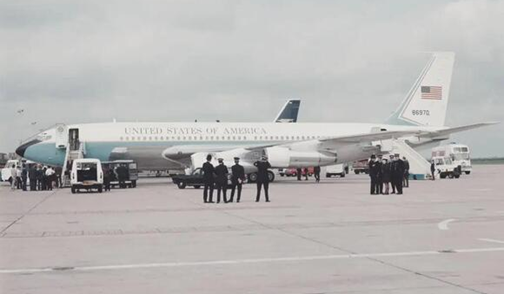
Air Force One 96970, 26000 and 27000 (1962-2001)

Type Of Activity
Presidential Transport
Location
Location
Worldwide
Date of Activity
 Oct 1962 to  June 2001
Coordinates
33°40′34″N 117°43′52″W

President Dwight Eisenhower became the first US president to travel by jet when he flew on a new Air Force One plane in 1959. Eisenhower's Boeing 707 Stratoliner, nicknamed "Queenie," featured a section for telecommunications, room for 40 passengers, a conference area, and a stateroom, The jet, known as SAM (Special Air Missions) 96970, was customized to meet the needs of the president and White House staff.

In 1959, the Boeing 707-153 known as SAM 96970 became the new presidential aircraft, replacing the propeller-powered C-121C Super Constellation used by President Dwight Eisenhower. SAM 96970 was part of the VC-137 series of planes.

In 1962, a newer VC-137C plane replaced it as the primary presidential aircraft, but it still transported vice presidents and other VIPs. The SAM 96970 remained part of the presidential fleet until 1996.

The new primary presidential aircraft number SAM 26000, was a specially configured Boeing 707-353B with the Air Force designation C-137C.

The SAM 96970, SAM 26000 along with SAM 27000 are the most Iconic presidential aircraft to date. All the C-137C's were  part of a fleet of aircraft maintained by the Military Airlift Command's 89th Military Airlift Wing, Andrews Air Force Base, Md.

When the president is aboard either aircraft, or any other Air Force aircraft, the radio call sign "Air Force One" is used for all communications and air traffic control identification purposes.

Principal differences between the C-137C and the standard Boeing 707 aircraft are the electronic and communications equipment carried by the presidential aircraft, and its interior configuration and furnishings. Passenger cabins are partitioned into several sections: a communications center, the presidential quarters, and a staff/office compartment. There is limited seating for passengers, including members of the news media.

Background

Aircraft SAM 26000 is the most famous and widely known Air Force aircraft. It joined the presidential fleet on Oct. 12, 1962.

Originally painted red the Kennedys had the aircraft redesigned
 into the iconic blue it is today

In May 1963, on a trip to Moscow with a U.S. delegation, aircraft SAM 26000 set 14 speed records, including the Washington to Moscow record of 8 hours, 38 minutes, 42 seconds.

President Kennedy and the First Lady arrive at a rally in Houston

This was the same  aircraft  in  which President John F. Kennedy flew  to  Dallas, Texas, on Nov. 22, 1963, and in which his body was returned to Washington, D.C., following his assassination.

LBJ becomes President aboard SAM 26000


Lyndon B. Johnson was  sworn into office as the 36th president of the United States on board the aircraft at Love Field  in Dallas the same  day.  This  aircraft  was  also used to return President Johnson's  body  to Texas following a State funeral in Washington, D.C., Jan. 24, 1973.

LBJ visits Vietnam in 1965 unannounced while attending the Manila Summit Conference

In 1967, Don Cammel was departing Camp David for Andrews AFB to await departure of AF-1 to the LBJ Ranch. He was a month shy of 21 years old, and really didn't understand the magnitude of flying on AF-1 as a passenger with the President on board. He blinked when Lady Bird was asking if anyone played Bridge, so he ended up became her partner in the back Suite for a Bridge game enroute to the Ranch (landed at Randolph AFB). He still remembers that first trip TDY like it was yesterday. During the Bridge game, He was so focused on the cards, he never saw the President walk past their table multiple times. 

President Richard M. Nixon used aircraft SAM 26000 extensively during the first four years of his administration. 

Air Force One at El Toro MCAS while visiting San Clemente

My first experience in working with SAM 2600 was while I was assigned to San Clemente in 1970 our detachment worked all of the arrivals and departures at El Toro,  We plugged in the ramp phone and  the other circuits into the nose of SAM 2600 for the onboard telephones to connect the aircraft to the San Clemente switchboard.  When the President departed we disconnected all of the phones.

His most widely  heralded trips included the around-the-world trip in July 1969, to the Peoples Republic of China in February 1972, and to the  Union of Soviet Socialist Republics in May· of that same year.

President Nixon dubbed SAM 2600 the Spirit of 76 a short time before leaving for Beijing

Aircraft SAM 27000 has established its own history and reputation. This aircraft was accepted by the Air Force on Aug. 4, 1972 and was placed into service after nearly 200 hours of service testing and evaluation. It was first used by President Nixon on Feb. 8, 1973.

President Gerald R. Ford first used aircraft SAM 27000 on Aug. 19, 1974, when he flew from Andrews Air Force Base to Chicago to address the Veterans of Foreign Wars convention. 

President Ford arrives in Chicago Note: The state of the art Ramp Phone

He later traveled overseas on a 7-day State visit to the Far East and visited Tokyo and Osaka, Japan,  Seoul, Korea, and Vladivostok, Russia.

President Ford on one of his overseas trips on SAM 27000 in 1975

Also, in May 1975, he made his first trip to Europe, visiting Belgium, Spain, Austria, and Italy. In July and August 1975, President Ford returned to Europe to visit the Federal Republic of Germany, Poland, Finland, Hungary, and Yugoslavia. He flew to France in November 1975; and to the Peoples Republic of China, Indonesia, and the Philippines in December 1975.

President Jimmy Carter made his first trip aboard aircraft SAM 27000 on March 16, 1977

President Carter visited three states, including New York where he addressed the United Nations General Assembly when he first used SAM 27000. His first overseas trip was made to England and Switzerland in May 1977. In December 1977 and January 1978, President Carter flew to Poland, Iran, India, Saudi Arabia, Egypt, France, and Belgium. He flew to Venezuela, Brazil, Nigeria and Liberia in March 1978; Panama in June 1978; the Federal Republic of Germany in July 1978; Israel in March 1979; Austria, Japan, and Korea in June 1979; and Italy, Yugoslavia, Spain, and Portugal in June 1980.

On Feb. 19, 1981, President Ronald W. Reagan first flew in aircraft SAM 27000 for a  brief trip to Santa Barbara, Calif. He returned to Andrews Air Force Base, Md., on Feb. 22, 1981. In March 1981, President Reagan flew to Canada.

President Reagan stops by the Communications Center aboard SAM 27000


President Reagan aboard SAM 27000

Ronald Reagan was SAM 27000's most frequent flyer, flying longer and farther than all the other presidents who flew on it, traveling more than 675,000 miles aboard it. Reagan used Air Force One to travel to all parts of the world to pursue his ambitious diplomatic goals, taking three trips to Asia, six to Europe, and twelve trips to foreign places in the Western Hemisphere. Reagan flew to three of his four summit meetings with Soviet Leader Mikhail Gorbachev aboard SAM 27000: Geneva, Reykjavík, and Moscow (one was held in Washington, D.C.).

The Reagans' last flight aboard the plane was on January 20, 1989, when the now-former President and First Lady flew back to California.

SAM 27000 at the Reagan Library

The Presidential Aircraft SAM 27000 with the Air Force designation C-137C. was officially retired in  2001. 

President Richard Nixon first used the Presidential Aircraft SAM 27000 in 1972, when he made his historic trip to China and famously his final trip to his San Clemente, California home following his resignation in 1974.

President Ronald Reagan sent predecessor President Jimmy Carter to West Germany to greet the 52 American hostages freed from Iran in 1981.

Reagan used Air Force One more than any other president, registering over 660,000 miles aboard the plane.

President George H.W. Bush was the last to use the SAM 27000 model as a primary means of transportation, and President George W. Bush was the last to use it as Air Force One when he and First Lady Laura Bush flew to TSTC Waco Airport in 2001.

The Presidential Aircraft SAM 26000 with the Air Force designation C-137C. was officially retired in  1998 and is on display at Wright-Patterson AFB, near Dayton OH while SAM 27000 has been on display at the Ronald Reagan Presidential Library in Semi Valley CA since 2005

The cockpit of Sam 2700 included seats for a pilot, copilot, flight engineer, and guest or auxiliary crew member.

The Cockpit of SAM 27000 USAF VC-137C

The plane's maximum speed was 590 miles per hour. The top speed of the current Air Force One, the VC -25A, is 630 miles per hour.

The communication station featured state-of-the-art radio and communication equipment.  

Communications Operator using Kleinschmidt terminal

From the plane, the president could reach the White House Situation Room and the National Military Command Center and send secret communications.

Across from the communication station, the briefcase containing codes to initiate a nuclear strike was kept locked in a safe.

Known as the " nuclear football ," every president since Eisenhower has been accompanied by the briefcase at all times. The safe also held military communication center codes.

In the forward galley, crew members prepared food and drinks for the president and other crew members or White House Staff. The two galleys on Air Force One included ovens, refrigerators, and open-burner stovetops. Drink dispensers also served coffee, water, and other beverages.

The forward galley
 
The aft galley served food and drinks to senior staff and the press. Like the forward galley, the aft galley was furnished with kitchen appliances and drink dispensers.

The Aft galley      

A narrow hallway led to Air Force One's meeting areas, where Presidents met with their staff, received briefings, and took phone calls while traveling on Air Force One, earning it the nickname of the "flying Oval Office."

A hallway on Air Force One

The presidential conference room featured more space for larger meetings. The seating booth featured seat belts in case of rough air. White House staffers and cabinet members who joined the president on trips sat in the staff seating area.

The staff seating area looked the most like regular economy cabin seats while members of the press sat further back on the plane. The staff seating area looked the most similar to regular economy cabin seats.

White House staffers and cabinet members who joined the president on trips sat in the staff seating area.

The WH Staff and cabinet seating area

A separate secretary station provided more workspace for staff. The workstation was outfitted with a lamp and typewriter.

 A typical secretary station

The Presidential stateroom on Air Force One

The Presidential stateroom room

The stateroom room included its own private bathroom. The private bathroom was much more spacious than the lavatories used by the flight crew and members of the press.

Stateroom private lavatory


An aft  lavatory for the flight crew and members of the press

Retired in 1996, SAM 96970 now on display at the Museum of Flight in Seattle. SAM 970 was a VC-137 series used by Eisenhower as well as Presidents John F. Kennedy, Lyndon Johnson, and Richard Nixon as their primary aircraft.

The Presidential Aircraft SAM 26000 with the Air Force designation C-137C. was officially retired in  1998 and is on display at Wright-Patterson AFB, near Dayton OH. Served Presidents  Kennedy, Johnson, Nixon, Ford, Carter, Reagan, George H.W. Bush and Clinton. 

SAM 27000 a modified C-137C served Presidents Nixon, Ford, Carter, Reagan, and George H.W. Bush. 

SAM 27000 has been on display at the Ronald Reagan Presidential Library in Semi Valley CA since 2005.

                                                     Specifications of SAM 27000

 Primary function: Presidential Transportation

Prime contractor: The  Boeing Company

Thrust: 18,000 lb. each engine

Power plant/manufacturer: Four Pratt & Whitney JT3D-3B turbofan engines

Dimensions: wingspan 145 ft 9 in, length 152 ft 11 in, height 42 ft 5 in

Speed: 540 mph

Ceiling: 42,000 feet

Range: 7,140 miles

Load: up to 50 passengers

Crew: 18

Maximum takeoff weight: 336,000 lb.

Status: Retired at Ronald Reagan Presidential Library

The New Presidential 747s

SAM 28000

SAM 29000

For more than three decades, the two Boeing VC-25A aircraft known by their military serial numbers SAM 28000 and SAM 29000 have represented the most recognizable aircraft in the world. Although the call sign Air Force One applies to any U.S. Air Force aircraft carrying the President, these two specially modified Boeing 747-200Bs became synonymous with the presidency itself.

Delivered in 1990, the aircraft replaced the aging Boeing 707-based presidential fleet and introduced unprecedented capabilities in communications, security, endurance, and survivability. Together, they have flown millions of miles, carried six presidents, and served during some of the most historic moments in modern American history.

The U.S. Air Force selected the Boeing 747-200B to replace the VC-137 (707) fleet because of its greater range, larger cabin, improved reliability, and ability to function as a true airborne White House.

SAM 28000

  • Aircraft Type: Boeing VC-25A
  • Air Force Serial: 82-8000
  • Delivered to USAF: August 1990
  • Entered Presidential Service: September 6, 1990
  • First Presidential Flight: President George H. W. Bush
  • Current Status: Active service

SAM 29000

  • Aircraft Type: Boeing VC-25A
  • Air Force Serial: 82-9000
  • Delivered to USAF: December 1990
  • Entered Presidential Service: March 26, 1991
  • Current Status: Active service
Presidents Served

Between them, SAM 28000 and SAM 29000 have transported every U.S. president since 1990:

  • George H. W. Bush
  • Bill Clinton
  • George W. Bush
  • Barack Obama
  • Donald Trump
  • Joe Biden

Each aircraft alternates as the primary presidential transport, with the other maintained in ready status as a fully capable backup.

Historic Missions

George H. W. Bush

SAM 28000 made its debut carrying President Bush on September 6, 1990, only weeks after Iraq invaded Kuwait. The aircraft soon became a key component of presidential travel during Operations Desert Shield and Desert Storm.

Bill Clinton

During the 1990s the aircraft became frequent visitors around the globe, supporting peace negotiations, NATO summits, humanitarian missions, and domestic travel.

George W. Bush

Perhaps the most dramatic mission occurred on September 11, 2001, when one of the VC-25As served as the President's secure airborne command post following the terrorist attacks. The aircraft provided protected communications while national leaders determined the nation's response.

Barack Obama

The aircraft flew countless international missions, including Obama's historic visit to Cuba in 2016 and numerous G-20 and NATO summits.

Donald Trump

The VC-25As supported extensive domestic and international travel, including diplomatic meetings across Europe, Asia, and the Middle East.

Joe Biden

The aircraft continued their worldwide missions while preparations began for the next-generation VC-25B fleet.

Flying White House

Although externally similar to a commercial Boeing 747-200B, each VC-25A is extensively modified.

Capabilities include:

  • Secure worldwide communications
  • Military command-and-control systems
  • Hardened electronics
  • Electromagnetic pulse protection
  • Air-to-air refueling capability
  • Medical operating room
  • Conference facilities
  • Presidential office
  • Staff workspaces
  • Sleeping quarters
  • Self-contained baggage and cargo handling

These features enable the President to govern the nation from virtually anywhere in the world.

Final Presidential Flights

Unlike their predecessors, SAM 28000 and SAM 29000 have not yet been permanently retired.

As of 2026:

  • SAM 28000 remains in active service.
  • SAM 29000 remains in active service, although retirement will follow the introduction of the new VC-25B fleet.

Their final official Air Force One flights have not yet occurred.

Looking Ahead

The VC-25A fleet is expected to be replaced by two Boeing 747-8-based VC-25B aircraft. Once those aircraft enter full operational service, SAM 28000 and SAM 29000 will conclude more than three decades of presidential service.

Their successors will continue the Air Force One mission, but the two VC-25As will forever be remembered as the aircraft that carried America through the end of the Cold War, the Gulf War, the September 11 attacks, the Global War on Terror, and into the twenty-first century.

 New Design of Future Presidential Aircraft

After a U.S. Air Force C-32A tail number 99-0003 emerged with a fresh paint scheme which was recently spotted by aviation enthusiasts departing Greenville Majors Airport, where the fleet regularly receives maintenance, upgrades, and overhauls from L3Harris—replacing the long-standing egg-blue and white livery—U.S. government sources confirmed the design, originally proposed by Donald Trump, will become the standard for American VIP aircraft, including those used as Air Force One.

The paint scheme is based on the one unveiled by President Trump in 2019, during his first term. It was designated under that administration as the new livery for the VC-25B aircraft that will in the future serve as the primary ‘Air Force One’ aircraft, but this decision was later overturned by President Biden’s administration. No definitive comment had been made so far in President Trump’s second administration to say that the decision would be reversed again.

SAM (Special Air Missions) 99-0003, a US Air Force VC25B

The next chapter for Air Force One has begun. The US Air Force announced that its new VC-25B "Bridge" aircraft has arrived at Joint Base Andrews, home of the Presidential Airlift Group, and started its commissioning flights, the final step before it can carry the President.

Freshly painted in a red, white, and blue livery, the modified Boeing 747-8 will serve as an interim presidential aircraft. Its job is to ease the pressure on the two aging VC-25As SAM 28000 and SAM 29000, which have flown as Air Force One since 1990, as their heavy maintenance cycles grow longer. It will bridge the gap until Boeing's purpose-built VC-25Bs arrive later this decade.

The Air Force calls commissioning flights the aircraft's "final exam." They allow the White House team to confirm the jet is fully mission-capable and to lock in the protocols needed to safely transport the President. Once complete, the aircraft is officially commissioned into the executive airlift fleet, joining the existing VC-25As and the smaller C-32.

Air Force One is getting a MAJOR makeover! Look at this side-by-side comparison below. The iconic blue-and-white Air Force One we’ve seen for decades is being replaced by this bold red, white, and blue design. But here’s what most people don’t realize… The new Air Force One isn’t just a paint job. It’s based on the larger Boeing 747-8, making it about 20 feet longer than the current VC-25A aircraft.

Freshly painted in a striking red, white, and blue livery, the modified Boeing 747-8 will serve as an interim presidential aircraft. Its mission is to relieve the growing operational burden on the two aging VC-25A aircraft that have served as Air Force One since 1990. As those aircraft require increasingly lengthy maintenance periods, the new VC-25B will help ensure uninterrupted presidential airlift capability until Boeing delivers the purpose-built next-generation VC-25Bs later this decade.

The Air Force describes the commissioning flights as the aircraft's “final exam.” During this rigorous testing phase, aircrews, maintenance personnel, and White House support teams verify that every system is fully mission-capable and that all procedures required for presidential travel are in place. Upon successful completion, the aircraft will officially join the executive airlift fleet alongside the current VC-25As and the smaller C-32 aircraft.

“The safety and security of the commander in chief is our highest priority,” said Secretary of the Air Force Troy Meink. Air Force Chief of Staff General Ken Wilsbach emphasized the significance of the achievement, stating, “Many thought it could not be done, but the United States Air Force was able to execute and provide a secure, reliable airborne command post on an accelerated timeline.” While the VC-25B "Bridge" aircraft is intended as a temporary solution, its arrival marks an important milestone in the continuing evolution of presidential airlift. As the iconic VC-25As approach four decades service, the new aircraft will help ensure that the President retains access to a secure, dependable, fully capable flying White House wherever duty calls.

Trump confirmed that he would be taking the new jet to the NATO summit in Ankara, Turkey, in July and indicated he would be returning to China "at some point," presumably a reference to the Asia-Pacific Economic Cooperation summit that China is hosting in November. His return from the Group of 7 summit in France this week was the last planned trip aboard the old Air Force One, he said.

 With its arrival at Andrews, the Bridge aircraft is now one step from joining the fleet.

The Interim 747

An interim presidential aircraft—registration N7478D, formerly operated by the Qatari royal family—is also expected to receive the new scheme. Because the VC-25B’s service entry has slipped from 2024 to roughly 2028, this converted jet may be the only 747 in the colors flown during Trump’s presidency.

The U.S. Air Force expects the Boeing 747 gifted by the government of Qatar to begin flying as an interim Air Force One (the callsign used when the U.S. President is on board) as early as summer 2026. Officially designated as “VC-25 bridge aircraft,” the 747 is intended to temporarily supplement the aging VC-25A fleet while the long-delayed VC-25B replacement program continues to slip. Configuration differences between the interim aircraft and the VC-25B remain unclear, but both will lack the aerial refueling capability of the VC-25A fleet. Publicly, that capability has never been used operationally and was reportedly considered too risky even during the Sept. 11, 2001 attacks. For training, crews instead maintain proficiency aboard the Boeing E-4B Nightwatch.

While a certain level of advanced communications and self-defense capability will be required regardless, it’s unlikely that the interim aircraft will come close to meeting the standards of the VC-25B in these areas. Some have raised the notion that the interim aircraft may only serve Presidential travel within the United States, to mitigate the potential effects of any shortfalls in capability. Overseas trips would, until replacements are ready, continue to be flown by the venerable VC-25As.

That arrangement would preserve flight hours on the aging aircraft—especially useful given frequent presidential travel to Mar-a-Lago and incidents such as the January diversion to Davos for the World Economic Forum (WEF). The President was quickly transferred from the VC-25A, which had reportedly suffered a “minor electrical issue”, to a C-32A to resume his journey.

SAM (Special Air Missions)  99-0003, a US Air Force VC25B

The retrofitted Boeing 747-8 became the next Air Force One and has now entered service. The aircraft made its inaugural flight on Wednesday, July 1, with a trip to North Dakota for the opening of the Theodore Roosevelt Presidential Library, part of the nation's 250th anniversary events. Converted in just ten months from a Boeing 747-8i originally gifted by the Emir of Qatar, this interim Air Force One platform features President Trump's preferred red, white, and blue livery replacing the 60-year-old Kennedy-era baby blue scheme and boasts advanced communication setups including Starlink, alongside high-end protective defense mechanisms.

While the aircraft will soon begin flying presidential missions as the largest and longest-range Air Force One variant to date, it is intended as a temporary bridge to augment the executive fleet alongside the existing VC-25A and C-32 fleets until Boeing delivers the long-delayed, permanently configured VC-25B models. 

The presence of this advanced technology on Air Force One underscores the importance of secure and reliable communications for the President during official travel.


Return to Contents I