Ever since its inception, and officially formed by the War Department on 25 March 1942 during the Roosevelt Administration, the mission of WHCA was to provide primer communications for the President of the United States,
The Unit was activated under the Military District of Washington to provide normal and emergency communications requirements in support of the President. Initially named the White House Signal Detachment (WHSD) consisting of 32 people provided mobile radio, teletype, telephone, and cryptographic aids in the White House and at the Presidential Retreat Shangri-La, now known as Camp David.
WHSD wasn’t even a real agency for the first three months of its life. Rather, it was an unofficial collection of the U.S. Army whose low-profile mission was to provide secure lines of communication for the president during World War II. Officially activated in March 1942, WHSD has since undergone two name changes and a couple of shifts in oversight. During the Eisenhower administration WHSD was renamed the White House Army Service Agency (WHASA)
In June of 1962, a review of the organizational arrangements by which the Communications needs ln the White House were being met and the review suggested certain changes involving Department of Defense support. It was believed that these changes would facilitate the White House operations. The White House Communications Agency (WHCA), as it has been known since 1962, is a “joint service agency” staffed by all branches of the armed forces, as well as a handful of civilians. Recruiting qualified personnel was always a huge problem, because of the sensitive nature of the assignment WHCA formed recruiting teams and sent them to many bases in the US and overseas,
I reported into Ft. Monmouth and started training as a Microwave Radio Repairman in April 1965. Several weeks before I completed training, I was interviewed by a recruiting team from the White House Communications Agency (WHCA). Normally these teams were comprised of an Trip Officer and three enlisted members knowledgeable of the MOS’s needed by the Agency. After reviewing hundreds of 201 files, a handful of students were selected to be interviewed. I returned the next day and was told that I had been selected.
Passing a polygraph examination was required and your background needed to be squeaky clean and have ZERO deceptions with your answers, you can't get offended or flinch even when they ask you insane questions about your character or lifestyle. I remember the first time through the test I had no deceptions, and the examiner asked the last question “have you told the truth to all of the previous questions”? Well the machine went wild, so after some consultation with the examiner, I re-took the test and passed.
Then an extensive background investigation was conducted, even for those of us who already had security clearances, my WHCA contact told me that only 1 of 3 make it through the screening.
Reportable items included within the Interview , but are not limited to, were as follows:
-Adverse involvement with law enforcement agencies to include arrests, fines, speeding tickets and parking tickets
-Negative Counseling or Uniform Code of Military Justice (UCMJ) punishment
-Security Incidents/Infractions
-Court Summons
-Credit judgments, bankruptcy filings, repossessions, or late payments
-Association with foreign nationals (not previously reported or a change in contact relationship/frequency)
-Foreign Travel (NLT 30 days prior to travel)
-Change in marital status -Legal name change
The background investigation actually took about six months with Investigators interviewing references and traveling to my hometown talking to my neighbors
I was ultimately selected and was transferred to WHCA in Washington DC. It was November of 1965 when my experiences with WHCA began.
When I reported for duty in 1965 WHCA had a total of 450 people assigned. I quickly found out that it was a very unique organization, no uniforms, civilian status, and an assignment that was unlimited in length.
There was a different set of rules for the old timers who were there . They served the President with excellent service longevity which seemed more valuable then. The term “WHCA Baby” was coined for homesteaders. Many folks arrived from AIT as E-3’s and stayed an entire career. Only a few were promoted to E-9, many hit ceiling at E-8 and had choice to return to Army and attend SGM Academy, but many deserving troops just retired and moved on to great second careers . I ended up serving nine years at four duty stations, but I know serval people who served twenty years in WHCA.
Civilian status is a very interesting situation when you are told to “blend in” and you are assigned to a military installation. It was my honor to serve in WHCA for over nine years, and although I worked on a Naval Support Facility, Coast Guard Station, Marine Corp Air Station, and Air Force Base, I was never required to wear a uniform.
Today uniform policy differs from section to section as members are required to wear uniforms while they are at their duty station. However, when traveling on a support trip, civilian attire is worn.
WHCAs mission has constantly grown over the years by adding new responsibilities such as the Photo Lab, the Audio/Video Section, the Carpenter Shop (building all Presidential podiums), AG, Financial, Transporters, Logisticians, Sheet Metal workers, Multimedia Specialists, and Intelligence, Finance, Logistics, and Military Intelligence fields, as well all other activities as directed by the White House Military Aides Office (WHMO). By 1990 the Agency had grown to over 1000 service members and civilians.
WHCA would constantly send out four men recruiting teams to various military installations worldwide looking for potential personal with needed MOS’s. Military training schools were prime targets for finding qualified targets. Recruiting qualified individuals had become so difficult that recruitment became a priority. WHCA produced video’s like this one, Ready To Receive, as an attempt to stimulate interest in active units within all branches of the military and Reserve units. Soliciting applications became the preferred way of recruitment in WHCA.
 |
WHCA Headquarters Building (Front Entrance)
WHCA Headquarters Building (Rear Entrance)
|
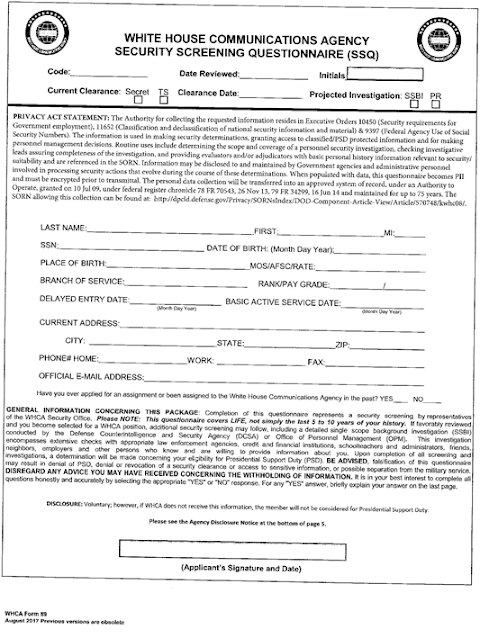
a 5 year tour. But people would leave early do to dropping packets for varies things. Now it's policy to stay at WHCA for a minimum of 3 years, for all branches. Currently there is a recruiter assigned to each branch of the service with a defined application process for each branch.A typical Army Application package would contain:
- Application (SSQ)
- Last three NCOERs or Counseling Statements
- Last three APFT (with body fat worksheet if applicable)
- Current SRB
Over the decades, WHCA’s mission has grown significantly. What began as a low-profile communications unit now encompasses a wide range of services supporting the president, vice president, National Security Council, First Family, and White House staff. This includes setting up secure communications, videotaping key presidential moments for the National Archives, providing stenographic services for press briefings, and managing logistics for presidential appearances.
By 1978, WHCA had reached a peak staffing level of over 1,000 personnel. Although downsizing efforts reduced the agency to about 850 members, it remains the largest organization under the White House Military Office (WHMO), with a budget exceeding $120 million during the Clinton administration. Despite this, WHCA operated largely under the radar, with minimal oversight from both the Department of Defense (DoD) and White House leadership.
Scandals, Oversight, and “The Coffees”
In the 1990s, WHCA faced increased scrutiny due to its involvement in videotaping Democratic National Committee (DNC) fundraisers and informal White House coffees. This controversy erupted after WHCA, following Senate inquiries into campaign finance practices, delayed the release of video footage, sparking accusations of obstruction. The tapes documented President Bill Clinton’s interactions with major donors, raising questions about WHCA’s role in preserving politically sensitive moments.
Critics argued that WHCA’s presence at these events blurred the line between its communications mission and political activities. Some speculated that WHCA’s expanded duties were a byproduct of bureaucratic mission creep, with the agency taking on additional roles to justify its budget and staffing levels. Others noted that Clinton may have become so accustomed to constant video documentation that he failed to question WHCA’s ubiquitous presence.
Former White House Deputy Chief of Staff Harold Ickes acknowledged the ambiguity surrounding WHCA’s activities, admitting in congressional testimony that White House staff rarely noticed the agency’s video crews. He also described WHCA as part of the White House Military Office, a unit with a long history of classified projects, including the construction of presidential bomb shelters and secret taping systems used by past presidents.
A History of Secret Funds and Loose Oversight
WHCA’s overseer, the White House Military Office, controlled a secret fund during the Eisenhower, Kennedy, Johnson, and Nixon administrations. This fund, purportedly for security-related expenses, was sometimes used for questionable projects, including renovations to presidential properties and the installation of President Lyndon B. Johnson’s and President Richard Nixon’s secret recording system. WHCA personnel were often assigned to these classified tasks, highlighting the agency’s role as a tool for executive discretion.
Following revelations about this secret fund in the 1980 book Breaking Cover by former WHMO Director Bill Gulley, the Reagan administration promised reforms, but questions about WHCA’s management persisted. In the 1990s, congressional inquiries and audits by the DoD’s Inspector General revealed issues such as unaccounted property, excessive equipment leases, and mission overreach.
A History of Secret Funds and Loose Oversight
WHCA’s overseer, the White House Military Office, controlled a secret fund during the Eisenhower, Kennedy, Johnson, and Nixon administrations. This fund, purportedly for security-related expenses, was sometimes used for questionable projects, including renovations to presidential properties and the installation of President Lyndon B. Johnson’s secret recording system. WHCA personnel were often assigned to these classified tasks, highlighting the agency’s role as a tool for executive discretion.
Following revelations about this secret fund in the 1980 book Breaking Cover by former WHMO Director Bill Gulley, the Reagan administration promised reforms, but questions about WHCA’s management persisted. In the 1990s, congressional inquiries and audits by the DoD’s Inspector General revealed issues such as unaccounted property, excessive equipment leases, and mission overreach.
Despite WHCA’s considerable size, WHCA has operated with little attention from either its Defense Department or White House masters. The agency’s basic tasks have been reviewed only three times since its inception, and it escaped formal audit until a DOD IG audit was completed in November 1995.
The initial attempts to conduct oversight of this 900-person, $100 million-a-year White House-directed agency were made by Congress in 1994. Those attempts were met with repeated delays and White House stonewalling. Early 1995, after meetings with the White House Counsel's office, GAO, and the Department of Defense IG's office, Congress finally received the approval to have an IG's investigation done going back 5 years.
WHCA was annually performing $7.8 million worth of tasks beyond the scope of its mission; it was unable to account for more than half a million dollars’ worth of agency property; and it was paying close to $800,000 to lease superfluous equipment.
This report on phase one of the audit cited “no evidence of significant theft or significant waste” in WHCA, but noted several areas in need of “management attention.”
The DODIG’s report concluded that WHCA's budgets have gone largely unreviewed. Its annual performance plan has failed to meet DOD standards. Its acquisition planning has violated DOD regulations and resulted in wasteful purchases.
Finally, the DODIG concluded that WHCA is providing the White House with services and equipment which are outside way, outside of the scope of its mission of telecommunications support to the President of the United States.
Congressional Inquiry and the Road Ahead
Despite these findings, WHCA’s operations remain shrouded in secrecy due to their classification as matters of “presidential protection.” Efforts by the Government Accountability Office (GAO) to investigate WHCA were blocked by the White House, which cited national security concerns. Congressional Republicans pushed for further hearings resulting with Congressional hearings conducted on May 16 and June 13, 1996.
In conclusion the committee recommended, both a comprehensive audit and a more formal, explicit delineation of responsibilities were long overdue for WHCA. Although management controls were generally satisfactory, there were deficiencies in several areas that needed attention. More systematic oversight is important in the future to assist WHCA in being as efficient and effective as possible. The DOD IG will work closely with DISA and WHCA to make sure that the problems found in the audit get fixed. but WHCA’s low-profile history and classified status may limit what can be uncovered.
While WHCA continues to support the president with essential communications services, its evolving mission, political entanglements, and history of minimal oversight raise ongoing questions about transparency, accountability, and the proper scope of its activities.
The April 1996 phase-two report concluded that WHCA was receiving “little or no oversight of budgeting, acquisition planning, and organizational effectiveness,” and recommended that the DoD’s oversight role be strengthened.
WHCA has been a deep, dark hole over at the White House into which there has been spending nearly $100 million annually without any executive branch oversight. It has also become a pot of money devoted to many things-kind of a miscellaneous pot of money-that have nothing to do with telecommunications or the President.
The White House Communications Agency has had a totally unique mission, and the staff who serves there perform their duties exceptionally well and have done so for more than 50 years and for 11 Presidents, both Democrats and Republicans.
Among these:
The DOD IG’s report concluded that WHCA's budgets have gone largely unreviewed. Its annual performance plan has failed to meet DOD standards. Its acquisition planning has violated DOD regulations and resulted in wasteful purchases.
Finally, the DOD IG concluded that WHCA is providing the White House with services and equipment which are outside way, outside of the scope of its mission of telecommunications support to the President of the United States.
The executive summary is copied below with complete report available at Audit Report on White House Communications Agency. (Report No. 96-033) and Audit Report on White House Communications Agency Phase II. (Report No. 96-100)
Transcript of Congressional hearings conducted on May 16 and June 13, 1996 Oversight of theWhite House Communications Agency
INSPECTOR GENERAL
DEPARTMENT OF DEFENSE
400 ARMY NAVY DRIVE
ARLINGTON. VIRGINIA 22202·2884
November 29, 1995
MEMORANDUM FOR DIRECTOR, WHITE HOUSE MILITARY OFFICE
UNDER SECRETARY OF DEFENSE (COMPTROLLER)
ASSISTANT SECRETARY OF DEFENSE (COMMAND,CONTROL, COMMUNICATIONS AND INTELLIGENCE)
DIRECTOR, DEFENSE INFORMATION SYSTEMS AGENCY
COMMANDER, WHITE HOUSE COMMUNICATIONS AGENCY
SUBJECT: Audit Report on White House Communications Agency
(Report No. 96-033)
We are providing this report for review and comment. We performed the audit in response to a request from Congress and the Deputy Secretary of Defense. We considered management comments on a draft of this report in preparing the final report.
The recommendations in Findings A and B relate to a reallocation of funding between parts of the DoD budget and the budget for the Executive Office of the President. Finding A questions the appropriateness of DoD, through the White House Communications Agency, funding audiovisual, stenographic and news wire services and photographic equipment for the White House. Finding B covers the provision of .White House Communications Agency support and equipment to the Secret Service. Although the Secret Service is required by law to reimburse an agency providing the support, the Secret Service has not done so. Several DoD appropriations and Secret Service appropriations would be affected by the recommendations. Thus, we suggest early consultation with the Office of Management and Budget and the Under Secretary of Defense (Comptroller) so those changes, if agreed to, could be implemented in the President's FY 1997 budget.
DoD Directive 7650.3 requires that all recommendations be resolved promptly. Management comments were responsive to all recommendations except the recommendation to specify services to be provided by the White House Communications Agency and to transfer funding, managing, contracting, and purchasing of audiovisual, news wire, and stenographic services and camera equipment to the Executive Office of the President. We request that the Assistant Secretary of Defense (Command, Control, Communications and Intelligence) reconsider his position and provide additional comments by January 12, 1996.
We have not completed our audit of all aspects of White House Communications Agency activities. We started work on the final phase of the audit and expect to provide a draft report in early 1996. The issues we plan to review during the final phase include the organization and staffing of the White House Communications Agency, acquisition planning, management of telecommunications equipment and services, and controls over selected financial activities.
Office of the Inspector General, DoD
November 29, 1995
Report No. 96-033
(project No. 5RD-5027)
White House Communications Agency
Executive Summary
Introduction. The Chairman, House Committee on Government Reform and Oversight; the Chairman, House Subcommittee on National Security, International Affairs, and Criminal Justice, Committee on Government Reform and Oversight; and the Deputy Secretary of Defense requested the audit. The Deputy Secretary of Defense emphasized that this review should be as thorough as possible of all White House Communications Agency (WHCA) activities in the last 5 years.
Audit Objectives. The audit objective was to review all activities at the WHCA, the authorities and management controls under which the activities are conducted, and various nonspecific allegations of mismanagement and waste. The adequacy of the management control program will be discussed in a subsequent report.
Audit Results. We found no evidence of theft or significant waste of resources in this phase of the audit. However, the following areas need management attention.
o During FY 1995, WHCA and DoD funded about $7.8 million for services and equipment that are not within the scope of the WHCA telecommunications mission as presently defined and should be funded by the Executive Office of the President (Finding A).
o WHCA was not reimbursed for permanent support to the Secret Service, as required by law, and understated support costs reported to Congress by $3.2 million. The Secret Service did not reimburse about $4.3 million for support and, because DoD absorbed support costs, the. The Secret Service budget was augmented by that amount. WHCA is expected to provide permanent support valued at $7.0 million during FYs 1996 through FY 2001 for which DoD should be reimbursed by the Secret Service (Finding B)..
o WHCA managers did not maintain control over repair parts inventories, and contracting officer's representatives did not document maintenance data. Therefore, WHCA can neither ensure the adequacy or accountability of repair parts inventories nor determine the cost-effectiveness of maintenance contracts (Finding C).
o WHCA lacked accountability for nonexpendable property on hand and had excess expendable supplies valued at about $226,000. Property valued at about $577,000 was not accounted for and is at risk for potential waste or loss. Further, by reducing the requisition objective for expendable items and by eliminating excess expendable items with no demand histories, $226,000 could be put to better use during FY 1996 (Finding D).
o The inventory of base communications equipment and services is neither complete nor accurate. Consequently, the inventory could not be audited, and WHCA could neither review and revalidate communications requirements nor assess the cost effectiveness of configurations for equipment and services. Further, WHCA is at risk of paying for unneeded equipment and services (Finding E).
o WHCA paid for leased, long-haul telecommunications circuits and equipment that were no longer required. If the circuits are terminated, about $759,000 can be put to better use during FYs 1996 through 2001 (Finding F).
o WHCA did not validate bills for long-haul telecommunications equipment and services before verifying that the bills were accurate. As a result, WHCA had no assurance that payments ceased for terminated services or that payments would not be initiated for services ordered but not installed. If effective procedures are implemented, about $294,000 could be put to better use during FYs 1996 through 2001(Finding G).
Summary of Recommendations. We recommend that management take the following corrective actions.
o Specify the services. that WHCA is to provide to the Executive Office of the President. Transfer responsibility for funding, managing, contracting, and purchasing of audiovisual, news wire, and stenographic services and camera equipment to the Executive Office of the President.
o Specify the permanent and temporary support provided to the Secret Service and determine which is reimbursable or non-reimbursable, specify billing procedures, and bill the Secret Service for reimbursable support provided during FY 1995 and continue to bill for all future reimbursable support.
o Fully implement the existing maintenance management system, turn in excess. repair parts, update lists of equipment under maintenance contracts, and use vendor service reports to assess the cost-effectiveness of maintenance contracts.
o Record identified property in the property book, establish the control point for receiving all property, perform monthly reconciliations of the document register, annually review requisition objectives, and turn in excess property.
o Establish a complete and accurate inventory of short-haul equipment and services, and maintain required inventory records.
o Initiate action to terminate unneeded long-haul circuits and equipment, establish the required review and revalidation program for equipment and services and establish a complete inventory of equipment and services.
o Establish procedures to verify the accuracy of Customer Cost and Obligation Reports on a monthly basis.
Management Comments. The Assistant Secretary of Defense (Command, Control, Communications and Intelligence) submitted joint comments for himself; the Director, DISA; and the Commander, WHCA. The Assistant Secretary concurred in all recommendations except for the recommendation to specify the services that WHCA is to provide to the White House and to transfer responsibility for funding, managing, contracting, and purchasing of audiovisual, news wire, and stenographic services and camera equipment to the Executive Office of the President. See Part I for a summary of management comments and Part III for the complete text of management comments.
Audit Response. As a result of information from management, we deleted one recommendation (Finding D) regarding property accountability. The Assistant Secretary's comments are not responsive regarding the recommendation related to specifying WHCA services and transferring these responsibilities. We maintain that WHCA should not fund the costs of audiovisual, news wire, and stenographic services and photographic equipment for the White House absent clearer direction to do so. We do not question the President's need for the services, contracts, or equipment provided by WHCA, and we recognize the legal authority of the President to issue an Executive Order to specify the services WHCA is to provide. However, as a DoD organization, WHCA is governed by DoD Directive 4640.13 in providing telecommunications services and the functions now performed and funded by WHCA go beyond telecommunications services as defined in that Directive. We request that the Assistant Secretary of Defense (Command, Control, Communications and Intelligence) reconsider his position and provide additional comments in response to the final report by January 12, 1996.
Oversight of the White House Communications Agency |
|
Type of Activity | IG audit of Communications Support |
Location |
Location | Washington DC |
Date of Activity | May 16, 1996, June 13 1996 |
Coordinates | 38°53'51.2"N 77°02'20.9"W |
When I arrived in WHCA in the mid-1960's, the term "Ranch" was the LBJ Ranch in Texas. Since then, we have had Santa Barbara and Crawford. Nixon was still the king of compounds, had three if you count Key Biscayne, San Clemente, and the other private retreat at Grand Cay, in the Bahamas. The WHCA budget to support Walkers Cay, Grand Bahama Island, and Grand Cay, along with the NASA sub-cable from the Cape to GBI was off the charts.
The large remote Detachments from the days of LBJ, Nixon, Reagan started to become flags for Congressional budget oversight. Those jobs and slots were justified based on disbursement of assets for quick response, and on paper were to eliminate TDY travel when the President went home for weekend! The permanent building leases, alarms, Long Lines, TTY, vehicles, maintenance, all added up and the original planned savings was almost non-existent.
There is little history on the actual budget for the Nixon compound built on Grand Cay with relay sites at Walkers Cay, Grand Bahama Island, and overseas cable head at Cape Canaveral. I would guess we spent more on the Bahamas retreat than actual costs of Key Biscayne. There was also another Coral Reef house owned by Bebe Rebozo in the Card Sound area that had many government "improvements". After Nixon and Key Biscayne and San Clemente, the budgets were under more oversight for future Presidents.
The White House Communications Agency is formally charged with providing telecommunications and other similar services to the President, First Lady, and staff. It has existed since the late 1940's, when it had a trivial budget and a staff of 30 people. Today, the White House Communications Agency has over 900 employees and over a $100 million budget.
The initial attempts to conduct oversight of this 900-person, $100 million-a-year White House-directed agency were made by Congress 2 years ago in 1994. Those attempts were met with repeated delays and White House stonewalling. Early last year, after meetings with the White House Counsel's office, GAO, and the Department of Defense IG's office, Congress finally received the approval to have an IG's investigation done going back 5 years.
WHCA has been a deep, dark hole over at the White House into which there has been spending nearly $100 million annually without any executive branch oversight. It has also become a pot of money devoted to many things-kind of a miscellaneous pot of money-that have nothing to do with telecommunications or the President.
The White House Communications Agency has had a totally unique mission, and the staff who serves there perform their duties exceptionally well and have done so for more than 50 years and for 11 Presidents, both Democrats and Republicans.
The DODIG’s report concluded that WHCA's budgets have gone largely unreviewed. Its annual performance plan has failed to meet DOD standards. Its acquisition planning has violated DOD regulations and resulted in wasteful purchases.
Finally, the DODIG concluded that WHCA is providing the White House with services and equipment which are outside way, outside of the scope of its mission of telecommunications support to the President of the United States.
Congressional hearings conducted on May 16 and June 13, 1996
The following individuals testified
HENRY L. HINTON, JR., ASSISTANT COMPI'ROLLER GENERAL NATIONAL
SECURITY AND INTERNATIONAL AFFAIRS DIVSION
ROBERT J. LIEBERMAN, ASSISTANT INSPECTOR GENERAL FOR AUDITING
DEPARTMENT OF DEFENSE
COL. JOSEPH J. SIMMONS IV, COMMANDER
WHITE HOUSE COMMUNICATIONS AGENCY
EMMETT PAIGE, JR., ASSISTANT SECRETARY OF DEFENSE
(COMMAND, CONTROL, COMMUNICATIONS, AND INTELLIGENCE)
Oversight of the White House Communications Agency, was the topic of these particular hearings that grew out of a Department of Defense Inspector General's investigation and the efforts by Congress to have the General Accounting Office investigate the allegations of waste and mismanagement at the White House communications Agency.
In fact, this was only the second hearing ever on the White House Communications Agency, with the previous hearing being held before the House Defense Appropriations Sub committee in 1977. Also, this is the first-ever audit of the agencies 55-year history.
The DOD IG’s audit review primarily focused on FYs 1991 through 1995, but we did examine some documentation dated as far back as 1967 and as recent as FY 1996.
There were several areas of concern identified and without further correction and White House commitment, the problems will continue:
- $577,000 worth of missing equipment will remain unaccounted for.
- $300,000 software packages will be purchased yet sit unopened.
- $294,000 will be paid for services never provided.
- $784,000 in illegal contracts will continue to be let.
- $4.9 million unusable communications trailers will continue to be purchased.
- $2.1 million maintenance contracts will continue to be sole sourced to WHCA friends in total violation of Federal contracting law.
- services quoted at $35,000 will be billed at $91,000, and those bills will be paid.
- $14.5 million in outstanding obligations will remain unvalidated.
There is a clear need for reform according to the DOD IG. Operational control of WHCA remains at the White House, and the White House is uncommitted to reform and unwilling to discuss change.
The DOD Inspector General reported on issues beyond those that were noted in their preliminary work.
For example, the Inspector General reported that WHCA's inventory of short-haul telecommunications equipment and services, such as circuits and maintenance, was neither complete nor accurate because WHCA failed to record some of the equipment and services, terminate the equipment from the inventory, or update costs. The Inspector General's April 1996 report found that WHCA had made little progress in correcting deficiencies identified in its earlier November 1995 report and the inventory remained auditable.
The DOD Inspector General's detailed examination identified $7.8 million in services (audiovisual, news wire, and stenographic services) and the procurement of camera equipment that the Inspector General found were outside of WHCA's mission.
For example, WHCA's Audiovisual Unit provides flags at presidential events, develops, and prints photographs of the President and First Lady, and mounts and frames photographs. WHCA also provides stenographic services for the White House Office of the Press Secretary. WHCA has tried unsuccessfully since 1971 to transfer funding for these services to the White House or the General Services Administration, but the White House has prevented the transfer.
Also, the White House deploys Department of Defense moneys to fund an elaborate frame shop in the basement of the White House, which frames any staffer's pictures. It funds stenographic services, audiovisual services, photos and emblems, podiums, and other non-telecommunications expenditures. WHCA's activities are undertaken pursuant to a number of laws and regulations.
These activities range from providing communications support, such as nonsecure voice, secure voice, and recorded communications, to other support, including automated data processing and construction of presidential podiums. The IG did not determine the cost of the activities or how they were funded and reported since the White House would not release the necessary documents.
The DOD Inspector General's detailed review disclosed that since 1991, WHCA had provided communications support to the Secret Service on a non-reimbursable basis and failed to report to the Office of the Secretary of Defense all costs for providing communications support to the Secret Service. WHCA had not charged the Secret Service for the support because a 1989 WHCA and Secret Service memorandum of agreement did not clearly delineate reimbursable and non-reimbursable communications support to be provided. As a result, from 1990 to 1995, the Secret Service did not reimburse DOD for annual communications support totaling $4.3 million and Congress was not informed of communications support totaling $3.2 million that WHCA had provided to the Secret Service. Because DOD absorbed costs of support to the Secret Service, the Secret Service's budget was augmented by $4.3 million.
The DOD Inspector General's detailed review disclosed that WHCA expended $4.9 million on a mobile communications system known as the Air Transportable Integrated Communications System (ATICS) that did not meet operational needs. According to the WHCA "Enterprise Architecture Document, February 3, 1995, WHCA had planned to use the mobile communications system to provide telecommunications support on most Presidential trips. WHCA specified that the mobile communications system must fit on C- 141 and C-5 aircraft but did not consider the additional equipment normally carried on the aircraft. As a result, the mobile communications system and all WHCA equipment needed to support the President do not fit on one C-141 air craft. In addition, the design of the communications system does not allow WHCA personnel to operate efficiently. Because it was determined that the communications system did not meet all operational needs, WHCA did not exercise contract options to purchase additional communications systems .
DETAILS OF THE DOD IG AUDIT REPORTS
First report: Report No. 96-033, November 1995:
Finding A - About $7.8 million in services and equipment provided to the White House were not within the scope of the White House Communications Agency telecommunications mission as presently defined and should be funded by the Executive Office of the President.
Response: A Memorandum of Agreement between the White House Office of Management and Administration and Assistant Secretary of Defense, Command, Control Communications and Intelligence validated and expanded DISA's functional oversight over the White House Communications Agency to include responsibility for funding managing, contracting, and purchasing of audiovisual, news wire, and stenographic services and camera equipment to the Executive Office of the President. DISA will sample services provided to determine if these services are as provided for in the Memorandum of Agreement.
Finding B - The White House Communications Agency was not reimbursed for permanent support to the Secret Service, as required by law, and understated support costs to Congress by $3.2 million. The Secret Service did not reimburse about $4.3 million for support and, because DoD absorbed support costs, the Secret Service budget was augmented by that amount.
Response: This finding was addressed in a Memorandum of Understanding between the White House Communications Agency and the Secret Service was revised to specify permanent and temporary support provided to the Secret Service and which support is reimbursable or non-reimbursable. DISA will review the support provided to the Secret Service to make sure it agrees with the provisions of the revised Memorandum of Understanding. It should be noted that a change of the DoD Appropriation Act of 1996 has changed all support to the Secret Service to be on a non-reimbursable basis.
Finding C - The White House Communications Agency managers did not maintain control over repair parts inventories and contracting officer's representatives did not document maintenance data.
Response: DISA will review the management of maintenance operations and verify that the White House Communications Agency has fully implemented the existing maintenance management system, turned in excess repair parts, updated lists of equipment under maintenance contracts, and used vendor service reports to assess the cost-effectiveness of maintenance contracts.
Finding D - The White House Communications Agency lacked accountability for non-expendable property on hand and had excess expendable supplies valued at about $226,000. Property valued at about $577,000 was not accounted for and is at risk for potential waste or loss.
Response: DISA will evaluate the White House Communications Agency's procedures for receiving property and recording it in the property book. DISA will also perform tests necessary to determine if information in the property book is accurate and current.
Finding E - The inventory of base communications equipment and services is neither complete nor accurate. Consequently, the inventory could not be audited, and White House Communications Agency could neither review and revalidate communications requirements nor assess the cost effectiveness of configurations for equipment and services.
Response: DISA will determine if the White House Communications Agency has implemented efficient and effective procedures to conduct a complete ana accurate inventory of short-haul equipment and services and to maintain required inventory records.
Finding F - The White House Communications Agency paid for leased long-haul telecommunications circuits and equipment that were no longer needed.
Response: DISA will ensure that the White House Communications Agency terminates unneeded long-haul circuits and equipment and establishes a review and revalidation program for equipment and services.
Finding G - The White House Communications Agency did not validate bills for long-haul telecommunications equipment and services before verifying that the bills were accurate.
Response: DISA will verify that the White House Communications Agency has established effective bill validation procedures to make sure that payments would not be made for terminated services or services ordered but not installed.
Second Report: Report No. 96-100, April 29, 1996:
Finding A - DISA exercised limited administrative, financial, and operational oversight responsibility for the White House Communications Agency.
Response: This process has been streamlined in the March 1996 Memorandum of Agreement that I signed, specifying the oversight responsibility for the White House Communications Agency. DISA will evaluate procedures established to ensure that DISA provides the required administrative, financial, and operational oversight of the White House Communications Agency.
Finding B - The White House Communications Agency did not comply with contracting and payment procedures and did not estab1ish duties and responsibilities to ensure the most cost-effective methods of leasing telecommunications equipment and services.
Response: The White House Communications Agency is holding discussions with the Defense Information Technology Contracting Office (DITCO), an operating unit of DISA (regarding contracting support) and with the Defense Finance Accounting Service - Pensacola (regarding payment functions). Interim procedures have been established with the U.S. Army Information Systems Command to ensure that a for mal contract is in place before communications vendors provide telecommunications equipment and services to WHCA. DISA will monitor these actions for proper implementation and later follow-up to see if the actions correct any reported deficiencies.
Finding C - The White House Communications Agency could not validate outstanding unliquidated obligations totaling $14.1 million for telecommunications equipment and services. Of note, the $14.5 million figure has been reduced to $4.5 million today.
A March 1996 memorandum of agreement between the White House Office of Management and Administration and the Assistant Secretary of Defense for Command, Control, and Communications and Intelligence again assigned these functions and the associated funding to WHCA.
The DOD IG’s audit was performed in two phases, with two reports, because of the volume of audit tests required to review all WHCA activities, the lack of previous coverage, and the need to report initial audit results in a timely manner. We had a positive working relationship during the audit with WHCA and the other organizations involved, and the DOD IG obtained access to all information that was requested.
OVERALL ASSESSMENT
The audit found that WHCA did a superior job in accomplishing its operational mission of supporting the Office of the President. It also found no evidence of theft, or gross malfeasance, and management controls were generally adequate. However, the audit did identify areas that needed improvement and opportunities to cut future operating costs. Some of the problems that were identified, such as duplicate payments, unneeded circuits, and invalid unliquidated obligation balances, are similar to what we have found at many other DoD organizations. WHCA funds the contract for the stenographers, they do not control the stenographers. In addition to developing and printing photographic film, WHCA pays for camera equipment used by the White House photographers. We estimated that providing such services and equipment that are not usually considered telecommunications cost the DoD about $7.8 million in FY 1995.
CONCLUSION
In conclusion, both a comprehensive audit and a more formal, explicit delineation of responsibilities were long overdue for WHCA Although management controls were generally satisfactory, there were deficiencies in several areas that needed attention. More systematic oversight is important in the future to assist WHCA in being as efficient and effective as possible. The DOD IG will work closely with DISA and WHCA to make sure that the problems found in the audit get fixed.
Besides the obvious improvements in procedures for accountability and oversight, the stipulations in the Memorandum of Understanding represent some profound changes and a great opportunity. The previous relationships were somewhat limiting, because of the distinction made between operational support and oversight by all members of the team, including the White House, DoD, DISA, and WHCA. That distinction has changed, with this Administration permitting, for the first time, the DoD Inspector General to perform a thorough review of the operations and administrative functions of WHCA. The reinforced and well-defined relationship between the WHCA and DISA provides an opportunity to optimize the suite of capabilities and services provided to the White House. The Director, DISA, can use the expertise and the capabilities developed to support the President. This will ensure a continuous capability for our National Command Authorities that has served the country well over the last thirty-three years.
The Reagan Presidential Library |
 | Main Entrance to the Reagan Library
|
|
Type Of Activity | Visiting the Reagan Presidential Library |
Location |
Location | Simi Valley CA |
Date of Activity | May 6 2012 |
Coordinates |
|
In May of 2023 my son (Robert) and I flew to Los Angeles to tour the Reagan Presidential Library in Simi Valley, even though I was no longer a member of WHCA, much of the communications used in 1980 had not changed since I left the Agency in 1973. There was a working teleprompter that I checked out, a Camp David exhibit, and Reagan Ranch (Rancho del Cielo) exhibit. It was a real pleasure to tour the museum and the Air Force 1 Pavilion, Where I could once again, see the oval Office, Air Force One (27000), Marine One, and the Presidential Limo.
The Ronald Reagan Presidential Library and Museum, is a prominent and well-regarded institution dedicated to the life and legacy of the 40th President of the United States. The Reagan Presidential Library is a must-visit for anyone interested in American politics and history. It offers a comprehensive look at Ronald Reagan's life, presidency, and the significant events that occurred during his time in office.
THE REAGAN PRESIDENTIAL LIBRARY AND MUSEUM
 |
| Main Entrance |
 |
| Entering the Library with the statue of President Reagan at the entrance |
The Ronald Reagan Museum houses a vast collection of artifacts, documents, and interactive exhibits that provide insights into Ronald Reagan's personal and political life. from his early years to his Hollywood career, his time as Governor of California, and his two terms as President We were able to explore various aspects of his presidency, from his economic policies to his stance on foreign affairs. There are 18 galleries that pay tribute to America’s 40th president and his accomplishments by capturing his patriotic spirit, his respect for individual liberty, his belief in global democracy and his support of economic opportunity.
 |
| Views of the surrounding area from the Reagan Library |
The Museum is situated on a stunning hilltop location with picturesque views of the surrounding area. The setting alone is worth the visit, as it provides a serene and peaceful atmosphere. The Reagan Library rests on a majestic hill overlooking the breath-taking topography of Southern California. The 100-acre campus, with picturesque views reaching out to the Pacific Ocean, lush gardens, and a serene setting, pays tribute to one of the nation’s most liked leaders.Teleprompter, Camp David & Rancho del Cielo Exhibits
 |
| I had to try using the Teleprompter |

Bob chose to take a horse ride at Rancho del Cielo
Ronald Reagan always loved the outdoors and made sure to make time for nature during his presidency. Camp David and Rancho del Cielo, his two retreats while in office, allowed for the president to relax and ride his beloved horses. Rancho del Cielo, also known as the Western White House, was the private residence of President and Mrs. Reagan located in the Santa Ynez Mountains of California.  |
| My home for five years |
 |
The Camp David Exhibit |
Camp David is a presidential retreat, its facilities maintained today by the US Navy Seabee’s. Camp David was built during the Roosevelt administration and allowed for seclusion while still having quick access to the White House in Washington. The President could also host heads of state and other guests in a secluded and peaceful environment.
I was assigned to WHCA at Camp David for five years as a microwave radio technician installing and maintaining the M/W, FM radio and telephone systems necessary for daily operations at the facility, as well as supporting the President and USSS when visiting the site.
The Oval Office
The Reagan Library offers a full-scale replica of the Oval Office during the Reagan presidency. Featuring Ronald Reagan's Oval Office desk, this exhibit allowed us to step into the Oval Office and get a sense of what it was like for the President during the time he occupied the office.
 |
| Ronald Reagan's Oval Office desk |
 |
Replica of Ronald Reagans Oval Office |
Air Force One Pavilion: One of the most popular exhibits at the Reagan Library is the Air Force One Pavilion. Opening in 2005, the Air Force One Pavilion features multiple historic Presidential transportation exhibits and the Annenberg Discovery Learning Center, and it is the highlight of the Library. The Air Force One Pavilion at the Reagan Library is one of Southern California’s “must-see” destinations!
The upper floor of this three-floor exhibit starts with the Mezzanine Gallery. The Museum highlights President Reagan’s face-to-face diplomacy with world leaders on economic relations, strategic relations, and arms control as he travels on Air Force One. The Secret Service and their role in protecting the President while he travels displays on a gallery wall on this level.
 |
Air Force One Pavilion
SAM (Special Air Mission) 27000, better known as Air Force One, flew 444 missions and carried seven presidents from 1972 to 2001.
President Richard Nixon first used the plane in 1972, and famously traveled to his San Clemente, California home following his resignation in 1974.
President Ronald Reagan sent predecessor President Jimmy Carter to West Germany to greet the 52 American hostages freed from Iran in 1981.
Reagan used Air Force One more than any other president, registering over 660,000 miles aboard the plane. President George H.W. Bush was the last to use the SAM 27000 model as a primary means of transportation, and President George W. Bush was the last to use it as Air Force one when he and First
Lady Laura Bush flew to TSTC Waco Airport in 2001.
SAM 27000 was retired to the Ronald Reagan Presidential Library and Museum in 2001. See it through the years in today’s gallery. |
 |
Telephone Access Panel in the Nose of AF1
|
There is a small access door in the nose of 27000 where we would plug in the two telephone lines for the aircraft and the ramp phone, a four prong plug, upon all arrivals and unplug at departures.
The second floor of the Pavilion focuses on the history of Air Force One, Explore a 120’ mural which represents all 22 aircraft that has ever flown a U.S. president. It also showcases the Stan Stokes’ mural, History of the Flying White House, featuring aircraft from FDR’s Dixie Clipper to the current Boeing 747.
 |
| Air Force One Pavilion |
 |
We are about to start our tour of AF-1 |
The Air Force One Pavilion, allowed us to step aboard the actual Air Force One aircraft a Boeing 707 that was used by President Reagan during his time in office.
 |
| AF-1’s Cockpit |
 |
| 27000’s (Angel) Radio Room |
The tour gave me a chance to see the Radio Room again, where I had spent so many hours on the ground communicating with 26000 and 27000 from various trip sites around the world, while I was with WHCA It's a unique and immersive experience that gives you a sense of what it was like to travel as the President of the United States and see the many places where he spent time working, meeting with advisors, and relaxing with his family.
 |
The President’s office aboard Air Force One |
This Flying White House, tail number 27000, served seven U.S Presidents from 1973 to 2001, including Presidents Nixon, Carter, Ford, Reagan, George H.W. Bush, Clinton, and George W. Bush. For Ronald Reagan, this was the plane in which he hand-wrote many of his speeches, signed important legislation and even officially started the Daytona Beach, Florida NASCAR race via phone.
But the Air Force One Pavilion is about more than just his plane. The lower floor of the Pavilion also has the Marine One Gallery, which showcases President Lyndon Johnson’s Marine One helicopter.
 |
The Cockpit of Marine One |
 |
The interior of Marine One |
We were able to tour the actual Marine One helicopter that flew President Johnson.
 |
| Marine One |
 |
| I am standing near the phone jack on Marine One |
I have a lot of history with this chopper. When I was with WHCA during LBJ’s and Richard Nixon’s presidency, I would plug in the telephone lines at many arrivals and departures including President Nixon’s at the Western White House in San Clemente.On the Lower Floor It has a presidential motorcade featuring President Reagan’s 1984 parade limousine, and a secret service suburban as part of an exhibit on presidential motorcades, which rounds out the Presidential transportation exhibits. The presidential limousine is always preceded by the lead car, LAPD used a normal police vehicle, a standard equipped 1982 Chevrolet Impala converted for this purpose. LAPD has also been using two lead Kawasaki motorcycles to provide additional protection for presidential motorcades since 1976.
 |
| LAPD lead car and lead motorcycles |
 |
| The USSS’s follow-up Vehicle |
The Secret Service motorcade follow-up vehicle, also known as the "Halfback", is a specially outfitted Chevrolet Suburban that follows the President's limousine in the motorcade. It is staffed by Secret Service agents who are responsible for providing additional security to the President and their family.
President Reagan’s parade limousine also known as Stagecoach, was a modified 1984 Cadillac Brougham d'Elegance that is heavily armored, and has a 76 millimeter higher roof, a telephone system, rear bumper platforms and grab bars for security agents as well two special headlights, which were only intended to illuminate the flags waving on the front fender standard holders.
 |
| President Reagan’s parade limousine |
We were able to walk around the Limo and could see the vehicle up close, but not close enough to see if the FM radios were installed. The USSS used these radios for the security measures in place for the President's transportation. The limousine did have the phones installed in the rear seat.
 |
President Reagan’s personalized license plate |
The Ronald Reagan Ballyporeen, Irish Pub
The Ronald Reagan Pub is located at the Ronald Reagan Presidential Library and Museum in Simi Valley, California. It is a popular spot for visitors to the library, and is known for its casual atmosphere and pub fare. Experience the actual Irish pub from Ballyporeen, Ireland when he visited on a diplomatic trip in 1984 which now sits within the Pavilion and serves as the Library’s snack shop. The entire interior was dismantled (bar and all!) and shipped to California to become the Ronald Reagan Pub which sits under the wings of Reagan's retired Air Force One.
Visitors can also enjoy refreshments in the “Ronald Reagan Pub” - an actual Irish pub which was donated to the Library from Reagan’s ancestral Irish village of Ballyporeen, Ireland.
 |
Entrance to the Ronald Reagan Irish Pub |
The Ronald Reagan Pub is a great place to relax and have a drink or a meal after visiting the library. The food is good, the drinks are cold, and the service is friendly.
 |
| Taking a break at the Ronald Reagan Irish Pub |
 |
Time to rest and enjoy a brew |
BERLIN WALL
This exhibit showcases a section of the Berlin Wall, a powerful symbol of the Cold War era. Visitors can learn about Reagan's role in bringing about the end of the Cold War and the fall of the Berlin Wall.
 |
| A section of the Berlin Wall |
The Iron Curtain took shape following World War II as a fortified border between the nations of Eastern and Western Europe. But as an idea, the Iron Curtain stood for the profound division between communism and democracy, oppression, and freedom. The Soviet Union dominated life on the eastern side of the border and enforced its brand of communism in its satellite states. Ronald Reagan took on the enormous challenge of bringing down the Iron Curtain.
Since receiving the Wall, President Reagan’s wish has come true many have visited the Wall at the Reagan Library and learned its lesson of freedom and democracy for all.
Reagan's Memorial:
Located on the library's grounds, the memorial site is the final resting place of President Reagan and First Lady Nancy Reagan. It offers a peaceful and reflective space for visitors to pay their respects.
 |
| The Ronald Reagan Memorial at the Reagan Library |
Ronald Wilson Reagan passed away on June 5, 2004, at the age of 93. His death induced an outpouring of respect, grief, and honor. Mourners around the world left flowers and trinkets at makeshift memorial sites. The former President laid in repose here at his Presidential Library on June 7-8, 2004. His casket then laid in state in the U.S. Capitol from June 9-11, 2004. Over 200,000 mourners made the journey to say their final goodbye to the former president. Dignitaries from 165 nations attended the public funeral held at the Washington National Cathedral. President Reagan was laid to rest during a private funeral service at sunset on June 11, 2004, at the Ronald Reagan Presidential Library and Museum.

The Memorial Site is on the western portion of the Library Campus and is adjacent to the Library’s piece of the Berlin Wall and the replica of the White House South Lawn. The Memorial Site looks out toward the Pacific Ocean. Since I visited the grave site in 2012, Nancy Reagan was laid to rest beside President Reagan.
 |
| Remembering President Ronald Reagan and the First Lady Nancy Reagan |
Overall, the Reagan Presidential Library and Museum is a must-see for anyone interested in American history and politics. The museum's exhibits are informative, engaging, and well-presented. Visitors of all ages can learn something new about Reagan and his time in office.
Ronald Reagan's trip to ancestral home in Ballyporeen, Ireland in 1984
by Marty Williams
Ballyporeen 12
This didn’t happen on St Paddy’s Day, but it is my favorite Irish memory of my favorite Irish President. At the Economic Summit, in London, in June of 84, I was working the switchboard the morning after President Reagan arrived from Ireland. At just the time that the Trip Officer (TO) was bringing the White House Communications Agency (WHCA) Commander (CDR) through the Switchboard area, the Boss’s line rang in to my console. (For non-operators, when the Boss’s line went off you heard a loud, annoying, stress inducing, modulating tone), the pencil comes up and you start taking notes. With the Reagans two things could happen. One, Mrs. Reagan, could be calling. if she was, the conversation was going to be short, the information would be given quickly, and there would be no opportunity to have it repeated. The call might go something like this: “Crestview 5-4724” (click) and we’re done. You had better have gotten it all. (yes, that’s how folks did phone numbers in the old days).
Now if it were the Boss, it would most likely be a long conversation that could take a meandering route to what he wanted. Anything said along the way could be the call information and would need to be written on the Presidential Call Log for the archives. Obviously, I had the full attention of the CDR and T.O. The call went something like this: “Hello, Signal (the designator for the WHCA Switchboard). I have an unusual request for you, I probably shouldn’t bother you with it, I mean I asked my staff to take care of it yesterday, but I guess it didn’t happen. Well anyway, yesterday, when I was in Ballyporeen, Ireland, I was there because my grandfather came from there, so it was a kind of homecoming, well, there was this young woman I met there, she was a nurse who took care of war wounded in Baghdad. She was there for a homecoming too. I told my staff I wanted to talk some more to her, but I guess they didn’t come through. Her last name was (ok, here comes some help) Clancy.(some help) that would make her name (ok, here we go) Nurse Clancy. (Ahh) I shouldn’t bother you with this, its just too hard.” “Not a problem sir” “Well ok, give it a try”
So i went into action. The CDR and TO were giving me “the look”. I figured I needed information in another country. So I got on to the international operator. They got me to an Ireland information operator. And she got me to the Ballyporeen Switchboard operator. Yes, I said switchboard. The town still had an operator. I asked how many Clancy’s there were in town. She had about 30 listings for Clancy. But the most popular one was the Clancy Pub. I figured if anyone might know, a small-town pub might be a good place to start.
 |
| President Reagan enjoys a Brew at the Pub |
I had her put me through. In a full brogue the proprietor answered. I explained that it was the White House calling and that President Reagan had met a Nurse Clancy the day before and wanted to talk to her again. I asked if he might know a Clancy who was a Nurse for war wounded in Baghdad who was home for a visit. “Sure and I do! It’s my daughter Margaret. MARGARET! Get your arse down here, the President of the United States wants to speak to you!” Margaret got on the phone, and I gave her a quick briefing. Then I called the president back. “Hello” “Mr. President, about your call to Nurse Clancy” “Oh, I know, that was too hard. Don’t worry about it. Thanks for trying” “Mr. President, do you still want to talk to her?” “Well yes” “Well sir, her name is Margaret and she’s on the line. Go ahead please”. Total time request to connect, less than six minutes. As he chatted with her, I realized I didn’t have a number for the log. So I retraced the call and got the Ballyporeen operator again. She gave me the number. Ballyporeen 12. The TO and CDR were duly impressed. A few minutes later the call came down and the boss called in again. “That was amazing, how did you do that?” “Magic Sir”. And though it may not qualify as “saving the day” it was an Oh Yeah! moment… Was privileged to have many of those over the years, but this is one of my favorites.
The Nixon Library and Birthplace |
|
Type Of Activity | Nixon Presidential Library |
Location |
Location | Yorba Linda CA |
Date of Activity | Est, 1990 |
Coordinates | |
The Richard Nixon Presidential Library and Museum is located in Yorba Linda, California and houses the Nixon Presidential Materials (textual, photographs, sound, and moving images), Nixon White House Tapes, Nixon pre- and post-Presidential Materials, as well as the Museum, Birthplace, and Helicopter.
The museum is housed in a 52,000-square-foot building in the suburbs of Yorba Linda. Opening its doors in 1990, this complex was established to celebrate former President Nixon's accomplishments as a peacemaker and an international statesman. From the humble farmhouse built by his father in 1912, to priceless gifts from heads of state, to the peaceful memorials of the President and Mrs. Nixon, the museum and its beautifully landscaped grounds and gardens trace the long road from Richard Nixon's past.
The entire facility underwent a $15 million renovation in 2016, and reopened on October 14 2016. The Library now features updated, multimedia museum exhibits; aimed at bringing the country’s 37th president closer to younger generations less familiar with his groundbreaking trip to China or the Watergate scandal. the complex is jointly operated by NARA and the Richard Nixon Foundation.
 |
| Wall mural of former President Richard Nixon in the lobby area of the Richard Nixon Presidential Library and Museum |
President Nixon's Oval Office
In the Nixon Library is a replica of the Oval Office in the White House, where President Nixon made many of his most crucial decisions.
 |
| President Nixon’s Oval Office |
The Apollo Exhibit
The Space Race gallery connects Nixon to NASA's missions. There's an Apollo 16 space suit reproduction, dehydrated pork and scallops astronaut food, and gift lunar landing cufflinks.
 |
| Apollo 11 display at the Nixon Library and Museum |
 |
| The Moon Walk 1969 |
When Apollo 11 landed on the moon I was in New Delhi India preparing for President Nixon’s arrival on his first world tour since taking office in 1969. Since the Janpath Hotel in New Delhi did not have a radio or TV I had to read about its success in the Newspaper the next day.
A phone used by Nixon to call the Apollo 11 astronauts after they landed on the Moon may be on display (it occasionally goes on tour), along with a contingency speech drafted by speechwriter William Safire in case of a disastrous ending of the mission.
 |
The phone used by Present Nixon to call the Apollo 11 astronauts
|
The China Exhibit
The Library has extensive presentation on Nixon’s historic trip to China. The San Clemente CCT was sent to Guam where the President an staff spent overnight relaxing prior to the flight to mainland China. My team made up the core manpower to support the visit and provided all of the equipment . We set up the switchboard and Comm. Center in the Hotel that we were staying, the B/C/S FM base stations and URT-28 HF Radio Equipment was temporarily installed at Anderson Air Force Base, Agana Guam.
The President arrived on Guam and spent the night at the residents of Rear Adm. Pugh Residence, Commander of the U.S. Naval Forces, Mariana Islands. While the President was on the mainland we were held in reserve for any Personnel sickness or equipment malfunction, The team spent two weeks there without incident before we returned to San Clemente.
 |
President Nixon’s arrival in China
|
 |
| President Nixon is greeted By Chinese Premier Zhou Enlai |
President Nixon's Presidential Limo
The U.S. government limousine used by President Nixon throughout his presidency, a customized 1969 Lincoln Continental
 |
Stagecoach the President's Limousine
|
President Nixon’s “Sea King” helicopter
One of the museum’s highlights is President Nixon’s “Sea King” helicopter. The helicopter was in the presidential fleet from 1961 to 1976, transporting Presidents Kennedy, Johnson, Nixon, Ford, and many foreign heads of state and government. The Sea King was operated and maintained by the Army and when the President was on board it was “Army One. Army One flew President Nixon to the Western White House on the day he resigned. In 1976 President Jimmy Carter, as a cost cutting move, disbanded the Army’s Executive Flight Detachment and Army One was retired. Former White House helicopter pilot LTC Gene Boyer found where Army One was mothballed and led a team of volunteers that restored the helicopter for the Nixon Presidential Library.
 |
| Army One |
Richard Nixon's Birthplace
Behind the museum is the birthplace, which was constructed by Nixon’s father using a home-building kit and restored to appear as it was in 1910.
 |
| President Richard Nixon’s Birthplace |
President Nixon’s Birthplace is located in a slightly secluded setting east of the main building, in a grove of trees. It is a 1+1⁄2 story Craftsman-style bungalow, with a gabled roof and clapboarded exterior. The house was built in 1910 on family ranchland; President Nixon was born there the following year. He and his family stayed there until 1922, when they moved to Whittier, California
 |
| The front entrance |
 |
| The Rear on the Birthplace |
 |
The piano on which Richard Nixon learned to play.
|
 |
In the Kitchen as it was in 1910
|
The Presidents Bedroom
The Nixon Memorial Garden.
The original farmhouse where President Nixon was born is just a few steps away from his final resting place in the Nixon Memorial Garden.
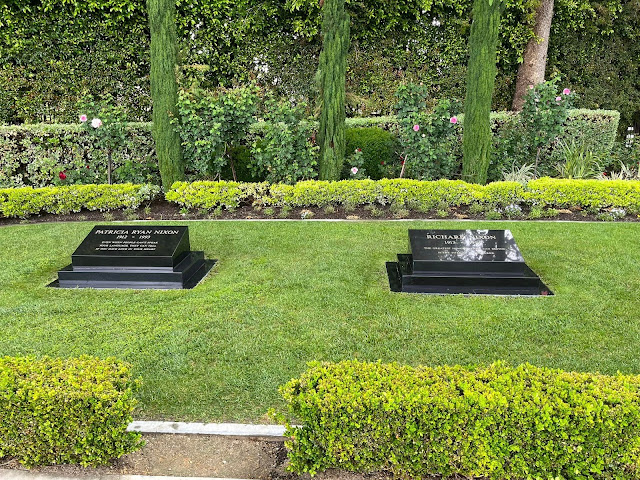
President and Mrs. Nixon are buried on the grounds, just a few feet from his birthplace
 |
| President Richard Nikon’s headstone |
 |
| First Lady Patricia Nixon’s headstone |
In 2023 there was a reunion of past and present members of the White House Communications Agency at the Nixon Presidential Library and Birthplace and these photographs were taken by Marty Williams during a tour.
Trump Presidential Library |
 | | Proposed design of Donald Trump Presidential Library in Miami FL |
|
Type of Activity
| Planning of Presidential Library |
| Location |
Location
| Miami FL |
Date of Activity
| 30 Mar 2026 |
Coordinates
| |
Trump Presidential Library Foundation announces new design
Eric Trump, a trustee of the Donald J., said he worked for six months with his team to create a lasting tribute to his father’s legacy as a transformative leader, successful developer, and champion of American greatness.
"The Donald J. Trump Presidential Library is officially here."
"Over the past six months, We have poured our hearts and souls into this project with my incredible team at Trump"
 |
Renderings of Trump Presidential Library
|
 |
| Renderings of Trump Presidential Library |
"This landmark on the water in Miami, Florida will stand as a lasting testament to an amazing man, an amazing developer, and the greatest President our Nation has ever known.  "
"
"These images have never been seen by the public — until today. Enjoy!"
Eric described it as one of the most "beautiful buildings ever built,” an “icon on the Miami skyline,” and visible for miles into the Atlantic.
 |
| Renderings of Trump Presidential Library |
 |
| The Main Entrance to the Trump Presidential Library |
The site sits on the water in Miami, Florida, next to the historic Freedom Tower on Biscayne Boulevard.
The Freedom Tower once served as a federal processing center for Cuban refugees escaping communism, lining up with Trump’s strong stance against socialism and his support for freedom-loving immigrants who embrace American values.
 |
| Library Lobby complete with AF-1 (SAM 28000) and a gold escalator |
Florida Governor Ron DeSantis and the state Cabinet unanimously approved turning what was a parking lot owned by Miami-Dade College, to the foundation, with the land ultimately deeded for $10 in February 2026.
The deed requires construction of a presidential library, museum, and/or center to start within five years.