The Nixon Library and Birthplace | |
 | |
Type Of Activity | Nixon Presidential Library |
Location | |
Location | Yorba Linda CA |
Date of Activity | Est, 1990 |
Coordinates | |
The museum is housed in a 52,000-square-foot building in the suburbs of Yorba Linda. Opening its doors in 1990, this complex was established to celebrate former President Nixon's accomplishments as a peacemaker and an international statesman. From the humble farmhouse built by his father in 1912, to priceless gifts from heads of state, to the peaceful memorials of the President and Mrs. Nixon, the museum and its beautifully landscaped grounds and gardens trace the long road from Richard Nixon's past.
According to the Nixon Library, “The Nixon presidential materials collection contains approximately 4,000 separate recordings of broadcast video, nearly 4,500 audio recordings, 30,000 gifts from foreign heads of states, American citizens, and others, 300,000 still photographs, 2 million feet of film, 46 million pages of documents, and 3,700 hours of recorded presidential conversations.”
 |
| The U-shaped museum has a reflecting pool in the middle. |
 |
| Wall mural of former President Richard Nixon in the lobby area of the Richard Nixon Presidential Library and Museum |
Richard Nixon’s Birthplace
 |
| The front entrance to President Richard Nixon’s Birthplace |
President Nixon’s Birthplace is located in a slightly secluded setting east of the main building, in a grove of trees. It is a 1+1⁄2 story Craftsman-style bungalow, with a gabled roof and clapboarded exterior. The house was built in 1910 on family ranchland; President Nixon was born there the following year. He and his family stayed there until 1922, when they moved to Whittier, California
The Rear on the Birthplace
The piano on which Richard Nixon learned to play.


The Nixon's Living Room

In the Kitchen as it was in 1910 The Presidents Bedroom


The library provides a comprehensive timeline of Nixon's life and political career. It outlines his rise through the ranks of politics, from his early days in Congress to his time as Vice President under Dwight D. Eisenhower and eventually his presidency.
 |
| Exhibit displays the events leading to the 1968 presidential election |
 |
| The Kennedy assignation in 1963 |
.jpg) |
| LBJ and the Vietnam War |
After Robert Kennedy was assassinated in 1968 the USSS assigned protective details to party nominated or independent candidates and for the first time WHCA supported the USSS at every Presidential and Vice Presidential candidates rallies.
After several months of moving from city to city in this role, I found myself in California on election night. On that momentous occasion, I had the privilege of attending the election victory party for the nominee, Richard Nixon, held at the Century Plaza Hotel. The following morning, the nation awoke to the news that Richard Nixon had been declared the President-elect of the United States
President Nixon's Oval Office
In the Nixon Library is a replica of the Oval Office in the White House, where President Nixon made many of his most crucial decisions.
 |
| President Nixon’s Oval Office |
 |
| Replica of the Table behind the Presidents desk |
 |
| Replica Exit to the West Colonnade and Rose Garden |
 |
| Apollo 11 display at the Nixon Library and Museum |
 |
| The Moon Walk 1969 |
When Apollo 11 landed on the moon I was in New Delhi India preparing for President Nixon’s arrival on his first world tour since taking office in 1969. Since the Janpath Hotel in New Delhi did not have a radio or TV I had to read about its success in the Newspaper the next day.
A phone used by Nixon to call the Apollo 11 astronauts after they landed on the Moon may be on display (it occasionally goes on tour), along with a contingency speech drafted by speechwriter William Safire in case of a disastrous ending of the mission.
 |
| The phone used by Present Nixon to call the Apollo 11 astronauts |
The Western White House
A re-creation of President Nixon’s study at La Casa Pacifica immerses guests in the life of the working Western White House in San Clemente. In 1972 I was assigned to the Western White House.
 |
| Re-creation of the Presidents study at his home at San Clemente |
 |
| The San Clemente Compound |
The library also highlights Nixon's domestic and foreign policy achievements. It explores his efforts to establish relations with China, and his role in ending the Vietnam War, his domestic policy initiatives, such as the creation of the Environmental Protection Agency (EPA) and the implementation of wage and price controls.
 |
President Nixon’s arrival in China |
 |
| President Nixon is greeted By Chinese Premier Zhou Enlai |
 |
The China exhibit exit (visiting the Great Wall) |
Vietnam Exhibit Captured: Shot Down In Vietnam opened at the Nixon Library on May 24, 2023
 |
| Nixon Library’s Viet Nam Exhibit |
 |
| Many US ground troops were also captured and imprisoned |
For as many as eight long years, the Vietnam POWs stayed true to their mission and survived behind bars. They communicated through codes and raps on prison walls. They were unbelievably brave and resisted enemy tortures. Their families knew little of their fate. The peace agreement was formally signed on January 27, 1973.
 |
| With the Paris Peace Accords, 591 U.S. prisoners of war came home to their families when the war ended in 1973. |
 |
| Operation Homecoming |
The Celebration of a joyful homecoming was held in a circus tent! On May 24, 1973 President and Mrs. Nixon hosted the largest dinner in White House history in honor of the Vietnam POWs. For the occasion, a colorful tent borrowed from a circus and larger than the White House itself was built on the South Lawn and the entertainment included some of the biggest Hollywood stars of the day including Sammy Davis, Jr., Bob Hope and John Wayne.
Nixon’s landslide victory in the 1972 campaign provides a portal into the next gallery. A captured moment in time, scenic balloons hang frozen mid-fall above the path, and directly ahead guests hear words from Nixon’s second inaugural address,
 |
| Exhibit of 1972 Nixon/McGovern Election |
 |
| Map of Electoral College in the landslide 1972 election |
The President and his family visited Key Biscayne the day after the election to relax and celebrate the overwhelming victory! The Family along with Mr.’s Rebozo and Abplanalp spent the weekend aboard the Coco Lobo III and visiting the Ocean Reef Club at Key Largo FL. The President then returned to Washington to start his second term.
Watergate
The Watergate scandal is a central focus of the library's exhibits. It provides a detailed look at the events surrounding the break-in at the Democratic National Committee headquarters and the subsequent cover-up that led to Nixon's resignation. This section includes audio recordings, documents, and news footage that shed light on this dark chapter in American history.
The exhibit explores the personalities, actions, and intentions at the heart of the Watergate scandal, chronicles the events beginning in June 1971, with the leak of the Pentagon Papers and ending with President Nixon’s public explanations of Watergate after he left office. The content of the Watergate exhibit that opened at the Nixon Library in 2011 remains.
 |
| The Watergate Exhibit |
 |
| Exhibit of the locations where microphones were placed to record conversations in the Oval Office, Camp David, and other locations |
The U.S. governments limousine on display was used by President Nixon throughout his presidency, a customized 1965 Lincoln Continental. This Lincoln Continental limousine was used by Presidents Johnson, Nixon, Ford, and Carter.
After the assassination of President Kennedy, additional armor and a fixed hard roof was added to the car, and it was used by Lyndon Johnson until it was replaced by two 1965 Lincoln Continental Executive limousines.
 |
Stagecoach the President's Limousine |
 |
The rear of the vehicle with retractable platforms and hand holds |
Army One

.jpg)
In 1976 President Jimmy Carter, as a cost cutting move, disbanded the Army’s Executive Flight Detachment and Army One was retired. Former White House helicopter pilot LTC Gene Boyer found where Army One was mothballed and led a team of volunteers that restored the helicopter for the Nixon Presidential Library.
The Nixon Memorial Garden.
Beyond the exhibits, the library boasts lovely grounds that include beautiful gardens, a reflection pool, and a memorial site where Richard and Pat Nixon are buried.
When Richard Nixon died on April 22, 1994, he became the first U.S. president to have resigned from office, yet he received full state funeral honors. Although his resignation complicated tradition, President Bill Clinton approved the honors in recognition of Nixon’s later role as an elder statesman.
Nixon had planned many details of his funeral in advance, including the Scripture readings and music. One notable choice was “Battle Hymn of the Republic,” requested despite his Quaker background. More than 50,000 mourners viewed his body in the Capitol Rotunda. His mahogany casket, lined with white silk, reportedly contained a handwritten note from his daughter Julie that read, “You are the light of my life.” The military honor guard included members of all five service branches, a rare joint tribute. Gerald Ford, Nixon’s successor and the president who pardoned him, delivered an emotional eulogy. The ceremony reflected the nation’s complicated willingness to honor a deeply controversial figure.
Nixon died four days after suffering a stroke. In a 1978 speech at Oxford University, he acknowledged his flaws but predicted that history would judge his accomplishments kindlier. In many ways, that proved true.
Although Watergate severely damaged public trust in government, some parts of Nixon’s record have gained greater appreciation over time. His foreign policy achievements included opening relations with China and reshaping diplomacy with the Soviet Union. Domestically, he signed major legislation such as the National Environmental Policy Act, the Clean Water Act, and the Endangered Species Act. His administration also created the Environmental Protection Agency, established Amtrak, and authorized the Occupational Safety and Health Administration.
At the same time, Watergate left a lasting stain on his legacy. The cover-up, more than the break-in itself, deeply eroded Americans’ trust in government, and its effects are still felt today.
Even so, Nixon’s overall legacy is often seen as more complex than a single scandal. Like most presidencies, it is best understood as a mix of failures, achievements, and long-term consequences. In retirement, several later presidents sought his advice on foreign affairs.
Nixon and his wife, Pat, are buried at his birthplace in Yorba Linda, California, which is also home to the Richard Nixon Presidential Library and Museum.
The original farmhouse where President Nixon was born is just a few steps away from his final resting place in the Nixon Memorial Garden.
 |
| President and Mrs. Nixon are buried on the grounds, just a few feet from his birthplace |
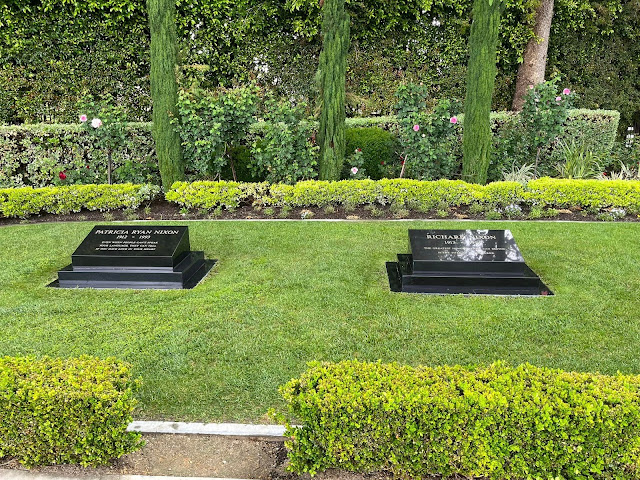 | ||
Their final resting place in the Nixon Memorial Garden.
|

 |
| First Lady Patricia Nixon’s headstone |
In conclusion, the Nixon Presidential Library and Birthplace offers a comprehensive and informative experience for visitors interested in the life and presidency of Richard Nixon. It provides a balanced portrayal of his achievements and challenges, and the exhibits are well-curated to offer historical context and perspective. Whether you are a history enthusiast or simply curious about this period in American politics, the library is worth a visit for its educational value and the opportunity to explore the legacy of one of the nation's most complex presidents.
Even though I have never toured the Nixon Presidential Library and Birthplace, I have personal experiences participating in many actives that occurred while I supported President Nixon during my time served with the White House Communications Agency.
No comments:
Post a Comment