Air Force One 96970, 26000 and 27000 (1962-2001)
|
|
Type Of Activity
|
Presidential Transport
|
Location
|
|
Location
|
Worldwide
|
Date of Activity
|
Oct 1962 to
June 2001
|
Coordinates
|
33°40′34″N 117°43′52″W
|
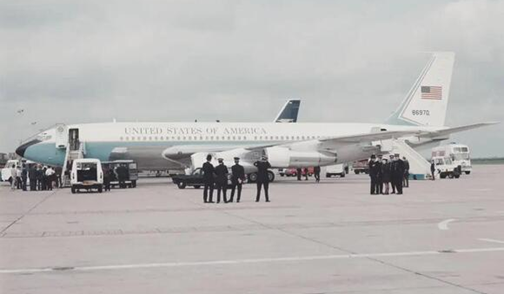
President Dwight
Eisenhower became the first US president to travel by jet when he flew on a
new Air Force One plane in 1959. Eisenhower's Boeing 707 Stratoliner,
nicknamed "Queenie," featured a section for telecommunications, room
for 40 passengers, a conference area, and a stateroom, The jet, known as SAM
(Special Air Missions) 96970, was customized to meet the needs of the president
and White House staff.
In 1962, a newer
VC-137C plane replaced it as the primary presidential aircraft, but it still
transported vice presidents and other VIPs. The SAM 96970 remained part of the
presidential fleet until 1996.
The new primary
presidential aircraft number SAM 26000, was a specially configured Boeing
707-353B with the Air Force designation C-137C.
The SAM 96970, SAM 26000
along with SAM 27000 are the most Iconic presidential aircraft to
date. All the C-137C's were part of a fleet of aircraft maintained by the
Military Airlift Command's 89th Military Airlift Wing, Andrews Air Force Base,
Md.
When the president is aboard either aircraft, or any other
Air Force aircraft, the radio call sign "Air Force One" is used for
all communications and air traffic control identification purposes.
Principal differences between the C-137C and the standard
Boeing 707 aircraft are the electronic and communications equipment carried by
the presidential aircraft, and its interior configuration and furnishings.
Passenger cabins are partitioned into several sections: a communications
center, the presidential quarters, and a staff/office compartment. There is
limited seating for passengers, including members of the news media.
Background
Aircraft SAM 26000 is the most famous and widely known Air Force aircraft. It joined the presidential fleet on Oct. 12, 1962.
 |
Originally painted red the Kennedys
had the aircraft redesigned into the iconic blue it is today |
 |
| President Kennedy and the First Lady arrive at a rally in Houston |
 |
| LBJ becomes President aboard SAM 26000 |
 |
| LBJ visits Vietnam in 1965 unannounced while attending the Manila Summit Conference |
 |
| Air Force One at El Toro MCAS while visiting San Clemente |
His most widely heralded trips included the around-the-world trip in July 1969, to the Peoples Republic of China in February 1972, and to the Union of Soviet Socialist Republics in May· of that same year.
 |
| President Nixon dubbed SAM 2600 the Spirit of 76 a short time before leaving for Beijing |
 |
| President Ford arrives in Chicago Note: The state of the art Ramp Phone |
 |
| President Ford on one of his overseas trips on SAM 27000 in 1975 |
 |
| President Jimmy Carter made his first trip aboard aircraft SAM 27000 on March 16, 1977 |
 |
| President Reagan stops by the Communications Center aboard SAM 27000 |
 |
| President Reagan aboard SAM 27000 |
 |
| SAM 27000 at the Reagan Library |
President Richard Nixon first used the Presidential Aircraft SAM 27000 in 1972, when he made his historic trip to China and famously his final
trip to his San Clemente, California home following his resignation in 1974.
President Ronald Reagan sent predecessor President Jimmy Carter to West Germany
to greet the 52 American hostages freed from Iran in 1981.
Reagan used Air Force One more than any other president, registering over 660,000 miles aboard the plane.
President George H.W. Bush was the last to use the SAM 27000 model as a primary means of transportation, and President George W. Bush was the last to use it as Air Force One when he and First Lady Laura Bush flew to TSTC Waco Airport in 2001. The
Presidential Aircraft SAM 26000 with the Air Force designation C-137C. was officially retired
in 1998
and is on display at Wright-Patterson AFB, near Dayton OH while SAM 27000 has
been on display at the Ronald Reagan Presidential Library in Semi Valley CA
since 2005 |
The cockpit of Sam 2700 included seats for a
pilot, copilot, flight engineer, and guest or auxiliary crew member.
 |
| The
Cockpit of SAM 27000 USAF VC-137C |
The communication
station featured state-of-the-art radio and communication equipment.
 |
| Communications Operator using Kleinschmidt terminal |
From the plane, the president could reach the White House Situation Room and the National Military Command Center and send secret communications.
Across from the
communication station, the briefcase containing codes to initiate a nuclear
strike was kept locked in a safe.
Known as the " nuclear football ," every president since Eisenhower has been accompanied by the briefcase at all times. The safe also held military communication center codes.
In the forward galley, crew members prepared food and drinks for the president and other crew members or White House Staff. The two galleys on Air Force One included ovens, refrigerators, and open-burner stovetops. Drink dispensers also served coffee, water, and other beverages.
 |
| The forward galley |
 |
| The Aft galley |
 |
| A hallway on Air Force One |
The staff seating area
looked the most like regular economy cabin seats while members of the press sat
further back on the plane. The staff seating area looked the most similar to
regular economy cabin seats.
White House staffers and cabinet members who joined the president on trips sat in the staff seating area.
 | ||
| The WH Staff and cabinet seating area A separate secretary station provided more workspace for staff. The workstation was outfitted with a lamp and typewriter.
|

 |
| The Presidential stateroom on Air Force One |
 |
| The Presidential stateroom room |
 |
| Stateroom private lavatory |
 |
| An aft lavatory for the flight crew and members of the press |
Retired in 1996, SAM 96970 now on display at
the Museum of Flight in Seattle. SAM 970 was
a VC-137 series used by Eisenhower as well as Presidents John F. Kennedy,
Lyndon Johnson, and Richard Nixon as their primary aircraft.
The Presidential Aircraft SAM 26000 with the Air
Force designation C-137C. was officially retired in 1998 and is on display at Wright-Patterson AFB, near Dayton
OH. Served Presidents Kennedy, Johnson, Nixon, Ford,
Carter, Reagan, George H.W. Bush and Clinton.
SAM 27000 a modified C-137C served Presidents Nixon, Ford, Carter, Reagan, and George H.W. Bush.
SAM 27000 has been on display at the Ronald Reagan Presidential Library in Semi Valley CA since 2005.
Primary function: Presidential Transportation
Prime contractor: The Boeing Company
Thrust: 18,000 lb. each engine
Power plant/manufacturer: Four Pratt & Whitney JT3D-3B turbofan engines
Dimensions: wingspan 145 ft 9 in, length 152 ft 11 in, height 42 ft 5 in
Speed: 540 mph
Ceiling: 42,000 feet
Range: 7,140 miles
Load: up to 50 passengers
Crew: 18
Maximum takeoff weight: 336,000 lb.
Status:
Retired at Ronald Reagan Presidential Library
The New Presidential 747s
 |
| SAM 28000 |
 |
| SAM 29000 |
For more than three decades, the two
Boeing VC-25A aircraft known by their military serial numbers SAM 28000
and SAM 29000 have represented the most recognizable aircraft in the
world. Although the call sign Air Force One applies to any U.S. Air
Force aircraft carrying the President, these two specially modified Boeing
747-200Bs became synonymous with the presidency itself.
Delivered in 1990, the aircraft
replaced the aging Boeing 707-based presidential fleet and introduced
unprecedented capabilities in communications, security, endurance, and
survivability. Together, they have flown millions of miles, carried six
presidents, and served during some of the most historic moments in modern
American history.
The
U.S. Air Force selected the Boeing 747-200B to replace the VC-137 (707) fleet
because of its greater range, larger cabin, improved reliability, and ability
to function as a true airborne White House.
SAM 28000
- Aircraft
Type: Boeing VC-25A
- Air
Force Serial: 82-8000
- Delivered
to USAF: August 1990
- Entered
Presidential Service:
September 6, 1990
- First
Presidential Flight:
President George H. W. Bush
- Current
Status: Active service
SAM 29000
- Aircraft
Type: Boeing VC-25A
- Air Force Serial:
82-9000
- Delivered to USAF:
December 1990
- Entered Presidential Service: March 26, 1991
- Current Status: Active service
Between them, SAM 28000 and SAM
29000 have transported every U.S. president since 1990:
- George
H. W. Bush
- Bill Clinton
- George W. Bush
- Barack Obama
- Donald Trump
- Joe
Biden
Each aircraft alternates as the
primary presidential transport, with the other maintained in ready status as a
fully capable backup.
Historic Missions
George H. W. Bush
SAM 28000 made its debut carrying
President Bush on September 6, 1990, only weeks after Iraq invaded Kuwait. The
aircraft soon became a key component of presidential travel during Operations
Desert Shield and Desert Storm.
Bill Clinton
During the 1990s the aircraft became
frequent visitors around the globe, supporting peace negotiations, NATO
summits, humanitarian missions, and domestic travel.
George W. Bush
Perhaps the most dramatic mission
occurred on September 11, 2001, when one of the VC-25As served as the
President's secure airborne command post following the terrorist attacks. The
aircraft provided protected communications while national leaders determined
the nation's response.
Barack Obama
The aircraft flew countless
international missions, including Obama's historic visit to Cuba in 2016 and
numerous G-20 and NATO summits.
Donald Trump
The VC-25As supported extensive
domestic and international travel, including diplomatic meetings across Europe,
Asia, and the Middle East.
Joe Biden
The aircraft continued their
worldwide missions while preparations began for the next-generation VC-25B
fleet.
Flying White House
Although externally similar to a
commercial Boeing 747-200B, each VC-25A is extensively modified.
Capabilities include:
- Secure worldwide communications
- Military command-and-control systems
- Hardened electronics
- Electromagnetic pulse protection
- Air-to-air refueling capability
- Medical operating room
- Conference facilities
- Presidential office
- Staff workspaces
- Sleeping quarters
- Self-contained
baggage and cargo handling
These features enable the President
to govern the nation from virtually anywhere in the world.
Final Presidential Flights
Unlike their predecessors, SAM
28000 and SAM 29000 have not yet been permanently retired.
As of 2026:
- SAM
28000 remains in active service.
- SAM
29000 remains in active service,
although retirement will follow the introduction of the new VC-25B fleet.
Their final official Air Force One
flights have not yet occurred.
Looking Ahead
The VC-25A fleet is expected to be
replaced by two Boeing 747-8-based VC-25B aircraft. Once those aircraft enter
full operational service, SAM 28000 and SAM 29000 will conclude more than three
decades of presidential service.
Their successors will continue the
Air Force One mission, but the two VC-25As will forever be remembered as the
aircraft that carried America through the end of the Cold War, the Gulf War,
the September 11 attacks, the Global War on Terror, and into the twenty-first
century.
New Design of Future Presidential Aircraft
After
a U.S. Air Force C-32A
tail number 99-0003 emerged with a fresh paint scheme which was recently spotted by
aviation enthusiasts departing Greenville Majors Airport, where the fleet
regularly receives maintenance, upgrades, and overhauls from L3Harris—replacing the long-standing egg-blue and white livery—U.S.
government sources confirmed the design, originally proposed by Donald Trump,
will become the standard for American VIP aircraft, including those used as Air
Force One.
The paint scheme is based on the one unveiled by President Trump in 2019, during his first term. It was designated under that administration as the new livery for the VC-25B aircraft that will in the future serve as the primary ‘Air Force One’ aircraft, but this decision was later overturned by President Biden’s administration. No definitive comment had been made so far in President Trump’s second administration to say that the decision would be reversed again.
 |
| SAM (Special Air Missions) 99-0003, a US Air Force VC25B |
The next chapter for
Air Force One has begun. The US Air Force announced that its new VC-25B
"Bridge" aircraft has arrived at Joint Base Andrews, home of the
Presidential Airlift Group, and started its commissioning flights, the final
step before it can carry the President.
Freshly painted in a
red, white, and blue livery, the modified Boeing 747-8 will serve as an interim
presidential aircraft. Its job is to ease the pressure on the two aging VC-25As
SAM 28000 and SAM 29000, which have flown as Air Force One since 1990, as their
heavy maintenance cycles grow longer. It will bridge the gap until Boeing's
purpose-built VC-25Bs arrive later this decade.
Air Force One is getting a MAJOR
makeover! Look at this side-by-side comparison below. The iconic blue-and-white
Air Force One we’ve seen for decades is being replaced by this bold red, white,
and blue design. But here’s what most people don’t realize… The new Air Force
One isn’t just a paint job. It’s based on the larger Boeing 747-8, making it
about 20 feet longer than the current VC-25A aircraft.

Freshly painted in a striking red, white, and blue livery,
the modified Boeing 747-8 will serve as an interim presidential aircraft. Its
mission is to relieve the growing operational burden on the two aging VC-25A
aircraft that have served as Air Force One since 1990. As those aircraft
require increasingly lengthy maintenance periods, the new VC-25B will help
ensure uninterrupted presidential airlift capability until Boeing delivers the
purpose-built next-generation VC-25Bs later this decade.
The
Air Force describes the commissioning flights as the aircraft's “final exam.”
During this rigorous testing phase, aircrews, maintenance personnel, and White
House support teams verify that every system is fully mission-capable and that
all procedures required for presidential travel are in place. Upon successful
completion, the aircraft will officially join the executive airlift fleet
alongside the current VC-25As and the smaller C-32 aircraft.
“The safety and security of the commander in chief is our highest priority,” said Secretary of the Air Force Troy Meink. Air Force Chief of Staff General Ken Wilsbach emphasized the significance of the achievement, stating, “Many thought it could not be done, but the United States Air Force was able to execute and provide a secure, reliable airborne command post on an accelerated timeline.” While the VC-25B "Bridge" aircraft is intended as a temporary solution, its arrival marks an important milestone in the continuing evolution of presidential airlift. As the iconic VC-25As approach four decades service, the new aircraft will help ensure that the President retains access to a secure, dependable, fully capable flying White House wherever duty calls.
Trump confirmed that he
would be taking the new jet to the NATO summit in Ankara, Turkey, in July and
indicated he would be returning to China "at some point," presumably
a reference to the Asia-Pacific Economic Cooperation summit that China is
hosting in November. His return from the Group of 7 summit in France this week
was the last planned trip aboard the old Air Force One, he said.
With its arrival at Andrews, the Bridge
aircraft is now one step from joining the fleet.
The Interim 747
An interim presidential
aircraft—registration N7478D, formerly operated by the Qatari royal family—is
also expected to receive the new scheme. Because the VC-25B’s service entry has
slipped from 2024 to roughly 2028, this converted jet may be the only 747 in
the colors flown during Trump’s presidency.
The U.S. Air Force expects the Boeing 747 gifted by the government of Qatar to begin flying as an interim Air Force One (the
callsign used when the U.S. President is on board) as early as summer 2026.
Officially designated as “VC-25 bridge aircraft,” the 747 is intended to
temporarily supplement the aging VC-25A fleet while the long-delayed VC-25B
replacement program continues to slip. Configuration
differences between the interim aircraft and the VC-25B remain unclear, but
both will lack the aerial refueling capability of the VC-25A fleet. Publicly,
that capability has never been used operationally and was reportedly considered
too risky even during the Sept. 11, 2001 attacks. For training, crews instead
maintain proficiency aboard the Boeing E-4B Nightwatch.
While a certain
level of advanced communications and
self-defense capability will be required regardless, it’s unlikely that the
interim aircraft will come close to meeting the standards of the VC-25B in
these areas. Some have raised the notion that the interim aircraft may only
serve Presidential travel within the United States, to mitigate the potential
effects of any shortfalls in capability. Overseas trips would, until
replacements are ready, continue to be flown by the venerable VC-25As.
That arrangement would preserve flight hours on the aging aircraft—especially useful given frequent presidential travel to Mar-a-Lago and incidents such as the January diversion to Davos for the World Economic Forum (WEF). The President was quickly transferred from the VC-25A, which had reportedly suffered a “minor electrical issue”, to a C-32A to resume his journey.
 |
| SAM (Special Air Missions) 99-0003, a US Air Force VC25B |
The retrofitted Boeing
747-8 became the next Air Force One and has now entered service. The aircraft made
its inaugural flight on Wednesday, July 1, with a trip to North Dakota for the
opening of the Theodore Roosevelt Presidential Library, part of the nation's
250th anniversary events. Converted in just ten
months from a Boeing 747-8i originally gifted by the Emir of Qatar, this
interim Air Force One platform features President Trump's preferred red, white,
and blue livery replacing the 60-year-old Kennedy-era baby blue scheme and
boasts advanced communication setups including Starlink, alongside high-end
protective defense mechanisms.
While the aircraft will
soon begin flying presidential missions as the largest and longest-range Air
Force One variant to date, it is intended as a temporary bridge to augment the
executive fleet alongside the existing VC-25A and C-32 fleets until Boeing
delivers the long-delayed, permanently configured VC-25B models.
The presence of
this advanced technology on Air Force One underscores the importance of secure
and reliable communications for the President during official travel.
No comments:
Post a Comment