Search This Blog

Tuesday, February 11, 2014

UPDATE: The Presidential Communications Car "CRATE" (1951-1974)

                             
UPDATE:WHASA/WHCA 
Communications Railcar “Crate”

General Albert J Myer USA 87325 with Morn Car USA 89426

Type Of Activity
Communications support
Location
Location
New Cumberland Army Depot
Date of Activity
 1951 thru 1974
Coordinates
  38°53′52″N 77°02′11″W

After the Presidential Railcar Ferdinand Magellan was retired and acquired by the Gold Coast Railroad Museum in 1958, Crate and the Staff Car (Morn) were sent to storage at the New Cumberland Army Depot Just across the river from Harrisburg PA., where it was maintained by the Camp David Communications Detachment until sometime in 1974.

Built out of an old hospital car in 1951, the General Albert J. Myer (labeled POTUS 1), USA 87325 the communications car, this car replaced the older ‘Car 1401′ which always accompanied the presidential train the Ferdinand Magellan. Following the Myer was the Morn (labeled POTUS 2), USA 89426 which was also built from a hospital car and was the living quarters for the personnel of the Myer. It included a small kitchen, bunk beds, a small bathroom with a shower and a living area.

Crate in St Louis in 1961 
  
There is a series of photos on the Kennedy Library website, dated November 1961 taken at Union Station St. Louis MO showing WHASA personnel preparing Crate for a trip by President Kennedy to the Army Navy Football game in Philadelphia, in December 1961. (No explanation as to why Crate was in MO although it was probably a training/test run prior to the actual trip.) There are also Photos of Crate at the 13th Street Station in Philadelphia dated December 2nd 1961.

WHASA/WHCA personnel from Camp David continued to maintain the communications equipment, through the late 60’s. The last time that I saw Crate was on July 27, 1966 when we returned from an overnight trip to Union Station in Washington D.C. Shortly after I was assigned to Cannonball just outside Mercersburg Pa.

It wasn't until a couple of years ago when I started communicating with people that I had served with in WHCA that we tried to find out what had happened to Crate.  One person remembers going up to the Depot in PA from Camp David to work on Crate in the fall of 1967. Another person says that during the “Fuel Crises” of 1973, they went up to the Depot to look at the cars for a possible rail trip by President Nixon to Key Biscayne FL. The trip was eventually made by commercial Airline. No one that we talked to seemed remember or know when Crate was decommissioned or where it was today!

Recently I received a comment on my blog from an anonymous contributor identifying the whereabouts of Crate today along with several pictures. Several people were involved with supplying information relative with the suggested time line that follows. This is what we believe what happened To Crate!

Crate remained in service and functional until it was stripped of all of the Communications equipment and retired from Presidential Service sometime in 1974. It is believed that the Communications Car (Myer) USA 87325 went to Ft. Belvoir VA and of the Staff Car (Morn) USA 89426 was sent to Ft. Eustis TX.  It is not known why Crate was split up or what if any was the Army’s intended use of these cars.

In 1978 Crate the Communications Car USA 87325 (POTUS 1) was purchased by NASA Kennedy Space Center Railroad System

As part of the effort, in 1978, KSC purchased an old Army Signal Corps communications car (U.S. Army 87325) for use as an office/tool room.  This car was constructed during World War II as a hospital car and remodeled in 1950 as the “Presidential Communications Car” and accompanied the “Ferdinand Magellan” armored Presidential Pullman whenever the U.S. President travelled by train. (POTUS 1) U.S. Army 87325, which became NLAX 150 upon its purchase by NASA, the car was retrofitted for duty by the newly hired railroad crew, which became part of the new Transportation Operations team within KSC. “KSC to Start Rail Operations,” Spaceport News, March 17, 1978: 1-3.

NASA disposed of General Albert J Myer USA 87325 in 1987, and it was acquired by the Gold Coast Railroad Museum. The museum was also informed about several other hospital style cars that were in Ft Eustis VA and they were also available. While the museum was at Ft Eustis they discovered that the Staff Car (Morn) USA 87325 was found!  The Gold Coast Railroad Museum acquired both the Myer and Morn cars and Crete was re-united in FL at the GCRM! The paperwork relative to the acquisition of Crate was completed by the Florida Division of Surplus Property.

Work was progressing on these cars when Andrew hit in 1992. Andrew caused extensive damage to the Gold Coast Railroad Museum and to the cars that they were restoring. FEMA claimed that they would put all non-profits back to their pre-Andrew condition. Myer, Morn, the Jim Crow combine, and Hospital car 89436 were selected to go to Steamtown for repairs.

Rather than give the museum funds to restore the Myer and Morn, they along with a Hospital Car #89436 and a Combination “Jim Crow Car” were sent to the National Park Service Steam Town Park in Scranton PA for restoration. Patrick McKnight, Historian/Archivist for Steam Town Park said that the Hospital Car and Jim Crow car were restored and returned to the GCRM. The Myer and Morn were not restored, due to a lack of funds and documentation of what the interiors of the Myer and Morn looked like. The communications equipment would have been removed when the cars were taken out of service, and NASA modified the interior when they purchased the Myer in 1978. The cars were placed in storage for several years until there was an Executive order issued to either donate or sell the Myer and Morn to the Hollywood Railroad Station Museum Inc.

Meyer COMM Car at GCRM just prior to Andrew  (1992)

Morn Staff Carat GCRM just prior to Andrew  (1992)

In 2001 The Hollywood Railroad Station Museum Inc. stepped in and got the Myer and Moen donated to them through an Executive order for a train to commemorate Dorothy Walker Bush (The mother and grandmother of the two Bush Presidents, and FL Governor Jeb Bush) dubbed the “Dorothy Walker Bush Great Floridian 2000.” The train was to consist of the Myer, Morn and 3 other cars. Grants were received from the State of Florida for the project, but little to no restoration was ever done.  Presidential train gets on track - South Florida Business Journal Published Aug 15, 2005, 12:00am EDT UPDATED: Aug 11, 2005, 4:28pm EDT

In 2005, Tony Campos, project director at the Hollywood Railroad Station Museum, was tasked with creating a train to commemorate Dorothy Walker Bush dubbed the “Dorothy Walker Bush Great Floridian 2000.” The train was to include the 1924 FEC Engine 253, the Myer and Morn, a mail car used in Buffalo Bill’s Wild West show, a “Jim Crow” segregation-era car, and the Direct Orient Express ice cream parlor. He was granted $375,000 by the Florida Division of Historical Resources and was expected to have the cars ready for display by June 2006.

In 2006, Campos acknowledged the restoration wasn't going to be completed on-time and cited hurricanes, a break-in, sketchy historical documents, lack of grant money, and a PBS documentary crew’s delay in filming the project. In October 2006, the Florida Division of Historical Resources sent a letter to Campos asking about the expenditures of the grant money. Campos then disappeared; he never responded, he didn't answer phone calls and is was hardly ever at his office at the station. It was requested he return the money or face legal action. The project director was eventually arrested for misappropriation of funds. He’s since been arrested and is thought to be out on parole as of this writing.

The Cars remain on a rail siding in Miami. Technically they are still owned by the Hollywood Railroad Station Museum, however; neither the museum nor the Florida East Coast Railroad has any interest in restoring them.  Dorothy Walker Bush Great Floridian 2000 – Florida's Forgotten Past  Published on August 19, 2013 by Bullet

What’s left of the failed project now sits rotting away behind a South Florida warehouse. Among them are two train cars thought to be presidential trains cars, with the names (POTUS 1) and (POTUS 2) stenciled on the sides of cars, sit on wood blocks at the front of the tracks.

Myer Communications Car USA 87325 POTUS 1 (2005)

Staff Car (Morn) USA 89426 POTUS 2 (2005)

According to this article Crate which consists of (POTUS 1) the Albert J Myer communications car and (POTUS 2) is the Morn Staff car sits on a railroad siding in Miami. No one that I have talked that actually was aboard Crate can remember if the cars that we maintained were actually labeled POTUS 1 or POTUS 2); however, a closer look at all of the photographs from this article and others that have been published leads me to conclude that the cars identified as POTUS 1 and POUTS 2 are likely to be Crate. Update: POTUS Train Cars Identified  Published on November 7, 2013.  By Bullet 

Myer Communications Car USA 87325 POTUS I (1961)

Myer Communications Car USA 87325 POTUS I  (2013)

By comparing the window pattern of the car identified as POTUS I, it is probably the communications car USA 87325. A close look at the HF antenna system unique to the communications car was a special system designed by Collins Radio. This was a complex system for the time. The overhead pictures of the antenna system on the cars in service in the 1960,s (below) and the car identified as POTUS I today appear to be the same.

In service Antenna System Myer Communications Car USA 87325 (1961)

In service Antenna System Myer Communications Car USA 87325 (1961)

Antenna insulator found next to Myer Communications Car USA 87325 POTUS 1 

Remains of the Antenna System Myer Communications Car USA 87325 (2013)

Interior pictures of  POTUS 1 and POTUS 2 that were used to try to identify the Radio Room and the Staff/Lounge areas was difficult but, I believe the picture below is of the Radio Room.

Ron Danielson in the Radio Room (1961)

Radio Room (1961)

Aisle looking from the Comm room door towards the vestibule end of the car (2005)

Radio Room (2005)

I believe that the POTUS 2 (Morn) can be identified as the Staff/Lounge car from the interior pictures that were provided by the article.

Staff Car (Morn) USA 89426 POTUS 2 (1961)

Staff Car (Morn) USA 89426 POTUS 2 (2005)

Some interior photos of Crate at Union Station in St Louis (1961) found in the JFK Library were also used in the comparison. These are the only known photos of the interior of the Staff/Lounge Car.

Staff sleeping area looking toward Lounge Area (1961)

Lounge area looking towards the restroom, deep freezers, and kitchen.(2005)

Lounge area (1961)

Lounge Area (2005)

Since no one is interested in restoring these two railcars, the fate of Crate appears to be the salvage yard and extinction!

Updates to the status of Crate can be found in the Railway Preservation News Subject: Hollywood Florida Railroad Museum & the Presidential Train

Sunday, July 7, 2013

Frank Sinatra's Retirement Concert (1971)


Frank Sinatra’s Retirement Concert
Frank Sinatra’s Retirement Performance

Type of Activity
 Indoor Theater Concert
Location
Location
 135 North Grand Avenue Los Angeles, California
Date of Activity
 June 13 1971
Coordinates
 34°3′29″N118°14′50″W

09 June 1971 to Los Angeles Ca with Vice President Agnew

On June 13, 1971 – at a concert in Hollywood to raise money for the Motion Picture and TV Relief Fund – at the age of 55, Frank Sinatra announced that he was retiring, bringing to an end his 36-year career in show business. This concert was held at the Dorothy Chandler Pavilion and the Ahmanson Theater in Los Angles. I had no idea when I left San Clemente that I would be supporting this event all that I knew was that Vice President was coming to Los Angles. I was sent there to support Vice President Agnew, his staff and the United States Secret Service, who would be attending a concert at the Ahmanson Theater. 

Dorothy Chandler Pavilion and the Ahmanson Theater

 Ahmanson Theater

Since this was a low Key event and no speech was scheduled for the Vice President there was very little publicity and only a few reporters covering the event, those that did were primarily from the entertainment community.  After meeting with the Staff and Secret Service advance people, and were briefed with the details of the VP’s itinerary this is when we found out that it would be Frank Sinatra’s retirement concert. After this briefing we proceeded to start our radio survey of the motorcade route from LAX at the arrival location to the Beverly Hilton and on to the Ahmonson Theater / Dorothy Chandler Pavilion complex. When the survey was complete and the base station locations were selected we ordered the remote keying lines from the Tel co. We installed a remote “Charlie” base station at LAX to cover the Vice President’s arrival and set up a remote “Charlie” base station back stage at the Ahmanson Theater to cover the concert, then connected both sites to the USSS CP at the Beverly Hilton Hotel. We then checked radio coverage inside and outside of the theater complex, the Hotel, LAX and the entire motorcade route to insure radio coverage in all areas that the Vice President would visit on this trip.

Frank Sinatra's retirement concert 

Inside the Ahmanson Theater where Frank Sinatra's retirement concert was held.

Although we would have to work that night, dress rehearsal took place that afternoon and we were able to sit in front row seats and watch them.  Dean Martin and the Gold-diggers, Bob Hope, Jack Benny, Don Rickles, Mitzi Gaynor, Barbra Streisand, Nancy Sinatra, Joe Namath, and Bobby Sherman. I was lucky to have saved the Program which helped me remember everyone who performed at this concert because there were so many. Although I do not remember Frank at the dress rehearsal, I was able to see his entire performance that evening!

The Program began with Princess Grace of Monaco (the former Grace Kelly) giving the opening remarks followed by the concert. Frank Sinatra was introduced by Rosalind Russell and began his performance by singing “All Or Nothing at All” , followed by “I’ve Got You Under My Skin”, I’ll Never Smile Again, a moving rendition of Ol’ Man River, That’s Life, Try A Little Tenderness,  Fly Me To The Moon , Nancy , My Way, The Lady Is A Tramp and concluding his performance with Angel Eye. His performance was fabulous by far the best of the evening.

The great thing about the concert was that all of the best known entertainers of the time were on the program, not to mention celebrities like Robert Wagner, Lucile Ball, David Jansen and Don Knotts that would be in the audience. 

Frank Sinatra’s retirement in 1971 

After the show we tore down the remote and returned to the Beverly Hilton Hotel. Vice President Agnew departed the next morning and returned to Washington DC. We then tore down the equipment at LAX, packed up the CP and gathered up all of our equipment, then returned to San Clemente. It was a great show, although Frank Sinatra made his comeback a little more than a year later! It was a great evening of entertainment, one that I will never forget.

 Program for the 50th Anniversary of the Motion Picture and Television Relief Fund


Friday, May 24, 2013

Dedication of the Eisenhower Medical Center (1971)


Dedication of the Eisenhower Medical Center
The Eisenhower Medical Center in Rancho Mirage CA
Type of Activity
 Hospital Dedication       
Location
Location
 Eisenhower Medical Center Rancho Mirage, CA
Date of Activity
 November 27 1971
Coordinates
: 33°45′48″N 116°24′20″W

The San Clemente CCT made many trips to Palm Springs in support of the President and Vice President. Most of the visits were only golf outings but, on November 27 1971 President and Mrs. Nixon attended the dedication of the Eisenhower Memorial Hospital and Eisenhower Medical Center in Palm Desert CA.; also in attendance were Mrs. Eisenhower, Vice President and Mrs. Agnew and Governor and Mrs. Reagan all of which had protection details that need access to our communications either directly or indirectly.

We had to install the CP and the WHCA Commcenter in a nearby hotel for the USSS and WH staff the switchboard was installed in the GTE central office in Palm Springs.

There was a radio site on Edom Hill which overlooked Palm Springs Airport, The Medical Center and the Annenberg estate where the President always stayed. WHCA had installed Baker and Charlie base stations that we turned up when a trip was eminent. We also installed FM radios at the USSS CP, close to the speech site.
Bob Hope at the ground Breaking Ceremony 

Bob Hope donated the land for the Eisenhower Medical Center

We had to install the CP and the WHCA Commcenter in a nearby hotel for the USSS and WH staff. The switchboard was installed in the GTE central office in Palm Springs. There was a radio site on Edom Hill which overlooked Palm Springs Airport, The Medical Center and the Annenberg estate where the President always stayed. WHCA had installed Baker and Charlie base stations that we turned up when a trip was eminent. We also installed FM radios at the USSS CP, close to the speech site.

The President and the First Lady flew by helicopter from the San Clemente Compound helipad, to the Annenberg Estate, Palm Springs, California. The President and the First Lady motored from the Annenberg Estate to the Eisenhower Medical Center, Palm Desert, California.

Upon their arrival the President and the First Lady were greeted by Mrs. Bob Hope, wife of the comedian and President of the Board of Trustees of the Eisenhower Medical Center. The President and the First Lady, then accompanied by Mrs. Hope, went to the speaker's platform.  Other guests seated on the platform were: Mrs. Mamie Eisenhower, Vice President Spiro T. Agnew, Mrs. Spiro T. Agnew, Governor Ronald W. Reagan (R-California), Mrs. Ronald W. Reagan, Bob Hope, Comedian and Donator of the land for the Medical Center, Paul Jenkins, Member of the Board of Trustees of the Eisenhower Medical Center and A. Pollard Simons, Member of the Board of Trustees of the Eisenhower Medical Center.

President Nixon speaks at the dedication of the Eisenhower Medical Center

Remarks at the Dedication of the Eisenhower Memorial Hospital, Eisenhower Medical Center, Palm Desert, California.    
November 27, 1971

Mrs. Eisenhower, Vice President and Mrs. Agnew, Governor and Mrs. Reagan, President and Mr. Hope [laughter],1 all of the very distinguished guests who are here on the platform and who are here in the audience:

When one studies, the history of civilizations, he finds that one of the most difficult problems every society has is to find an appropriate way to honor their great men. Sometimes a statue is built. Sometimes a building is named, a street, many appropriate ways have been found.

1 Mrs. Bob Hope was president of the board of trustees of the Eisenhower Medical Center.

In the case of President Eisenhower, so many ways would have been appropriate. Here was a man who in the whole history of war led the greatest armies to the greatest victory and so he could have been a man on horseback a military statue that could have been his memorial.

But, as the Vice President has so eloquently said, this is the most appropriate way to honor this man. It is what he would have wanted.

I recall, as Mrs. Eisenhower will, those last days in Walter Reed. And while physically he became weaker and weaker, mentally and spiritually he was stronger and stronger. I remember right to the last, where he wanted to go more than anyplace else in the world was back to Palm Springs. Oh, he loved Burning Tree and he loved Augusta and all the other places where he played golf, but his heart was here, here because of this place, the people that he knew.

And so from a personal standpoint, the man honored by this building, this institution, would have wanted it right here in this place, the place he loved so much.

But then, as we look at it in other terms, we find that President Eisenhower was a unique history figure, unique in the sense that he was a great leader in war--considering the size of wars, the greatest in history because of the armies that he led to victory--but also he had the opportunity, and met that challenge so well, to lead in peace. As President of the United States, he ended a war and kept America out of war for 8 years, and that is a great legacy for a man.

So this magnificent building behind us, the first of a number that eventually, probably, will be built here, memorializes this man who was a victor in war, but this man whose greatest contribution was to peace. And so this institution will be here to preserve life, not to destroy it, and that is what he would have liked and that is the way that we, very appropriately, honor him on this occasion and in the years ahead.

As we dedicate this building, I would finally suggest that we dedicate ourselves to the great challenges that lie ahead. We enter what we hope may be a period in which the United States can be at peace, not just for a few years, but perhaps for a generation; perhaps longer.

Building a generation of peace or a century of peace is, of course, a great task. But how we use that peace, what we do with it, is equally a very great challenge. We must see that America is physically healthy. This building and the men and women who will work in it will contribute to that goal.

We must see that America is economically healthy, and that means building a kind of prosperity that depends on peace and not on war; the kind of prosperity that we last had in 1955 and '56, when President Eisenhower was President.

And finally, building a people and a nation that is morally and spiritually healthy. The Eisenhower legacy speaks to that great challenge as it does to the others.

And so on this occasion, we as Americans, thinking of one of our great men, thinking of this institution that honors him, dedicate ourselves to the tasks ahead: of building a strong, healthy, vigorous America; meeting the challenge of building a world of peace for us, and for all people in the world.
_______________________________________________________________________________
Note: The President spoke at 11:44 a.m. at the hospital building.
Land for the Medical Center was donated by Mr. and Mrs. Hope, and funds for the nonprofit hospital were given by trustees and friends of the hospital. The hospital was the initial stage of a medical complex that will include research and teaching facilities.
_______________________________________________________________________________
On November 26, 1971, the White House released a fact sheet on the hospital.
_______________________________________________________________________________
Citation: Richard Nixon: "Remarks at the Dedication of the Eisenhower Memorial Hospital, Eisenhower Medical Center, Palm Desert, California." November 27, 1971. Online by Gerhard Peters and John T. Woolley, The American Presidency Project. http://www.presidency.ucsb.edu/ws/?pid=3237.
_______________________________________________________________________________

A private tour of the facility followed the dedication

There was also a small reception held following the dedication

When the Ceremony was over The President and the First Lady toured the Eisenhower Memorial Hospital with: Mrs. Mamie Eisenhower, Vice President and Mrs. Agnew, Governor and Mrs. Reagan Mr. and Mrs. Hope, and James M. Taylor, Executive Director of the Eisenhower Medical Center The President and the First Lady greeted a group of approximately ten medical and health publication editors and publishers.

The President and the First Lady accompanied by Mr. and Mrs. Hope then departed the Eisenhower Medical Center and motored from the E1 Dorado Country Club, Palm Springs, California. I was driving the WHCA Press car and was included in the official motorcade, the President greeted persons along the motorcade route during a brief and unscheduled stop.  The motorcade then preceded to the dining room in the E1 Dorado Country Club, where he greeted, The Vice President, Governor Reagan, Frank Sinatra, and Mr. Hope among some other guests. The President had lunch and then the Presidential party n proceeded to the golf course to play 13 holes of golf.

     The President and Bob Hope enjoy a round of golf 

The Nixon’s return to San Clemente

I was monitoring radio traffic all afternoon and finally at about 4:30 pm the President and the First Lady left the El Dorado Country Club to the helipad at the Annenberg Estate. The President and First Lady flew by helicopter from the Annenberg Estate, Palm Springs, California, to the helipad at the San Clemente Compound.

It was time to retrieve all of our equipment and return to our facility at El Toro MCAS.

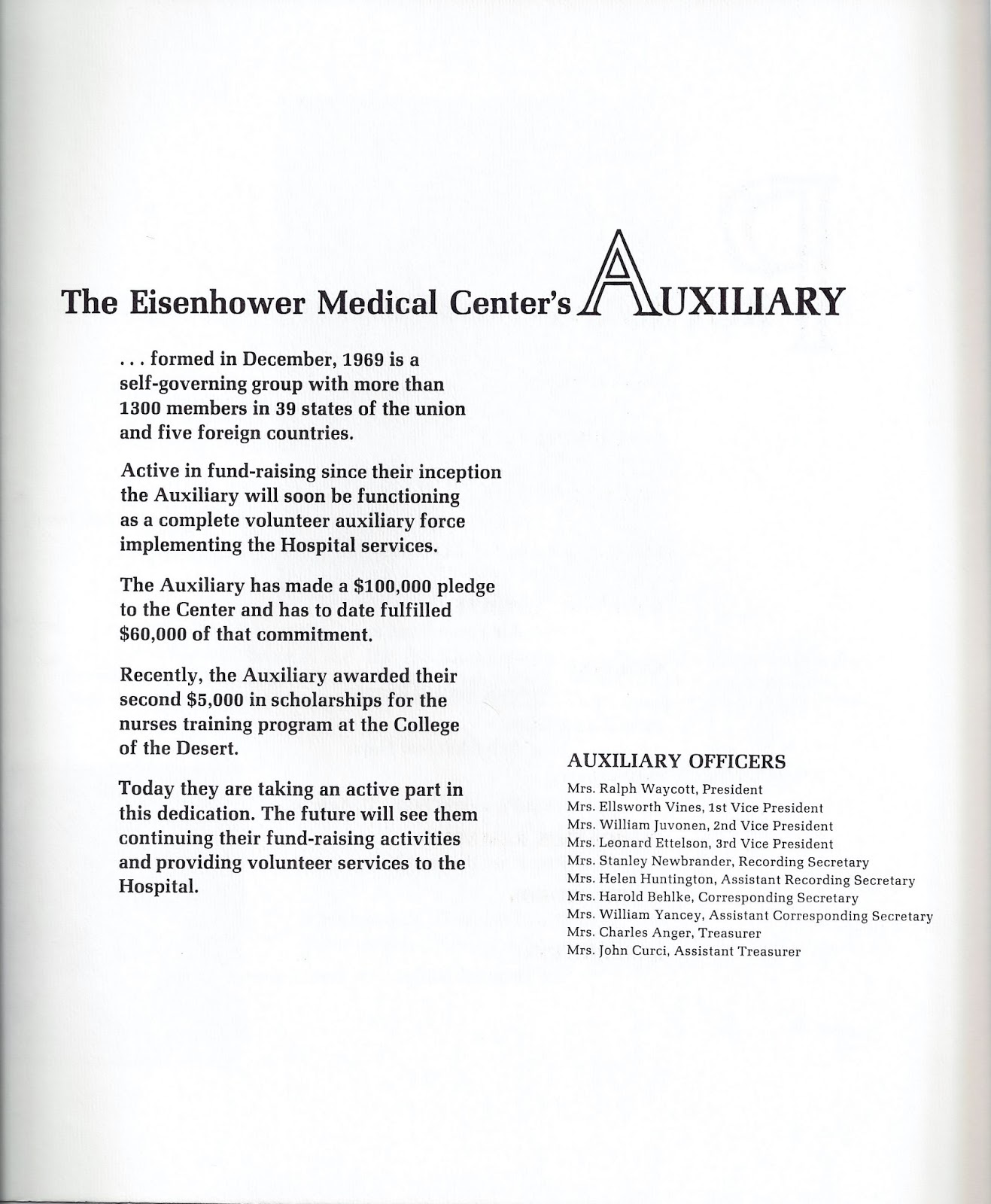
   Program from the Dedication