WHCA Transforms Presidential Communications | |
 | |
Type of Activity | Modernizing Communications |
Location | |
Location | Washington DC and Others |
Date of Activity | 1992 through Present |
Coordinates | 38°53'51.2"N 77°02'20.9"W |


DOD IG Audit of WHCA | |
 | |
Type Of Activity | DOD IG Audit |
Location | |
Location | Washington DC |
Date of Activity | Dec 1995 |
Coordinates | |
Over the decades, WHCA’s mission has grown significantly. What began as a low-profile communications unit now encompasses a wide range of services supporting the president, vice president, National Security Council, First Family, and White House staff. This includes setting up secure communications, videotaping key presidential moments for the National Archives, providing stenographic services for press briefings, and managing logistics for presidential appearances.
By 1978, WHCA had reached a peak staffing level of over 1,000 personnel. Although downsizing efforts reduced the agency to about 850 members, it remains the largest organization under the White House Military Office (WHMO), with a budget exceeding $120 million during the Clinton administration. Despite this, WHCA operated largely under the radar, with minimal oversight from both the Department of Defense (DoD) and White House leadership.
Scandals, Oversight, and “The Coffees”
In the 1990s, WHCA faced increased scrutiny due to its involvement in videotaping Democratic National Committee (DNC) fundraisers and informal White House coffees. This controversy erupted after WHCA, following Senate inquiries into campaign finance practices, delayed the release of video footage, sparking accusations of obstruction. The tapes documented President Bill Clinton’s interactions with major donors, raising questions about WHCA’s role in preserving politically sensitive moments.
Critics argued that WHCA’s presence at these events blurred the line between its communications mission and political activities. Some speculated that WHCA’s expanded duties were a byproduct of bureaucratic mission creep, with the agency taking on additional roles to justify its budget and staffing levels. Others noted that Clinton may have become so accustomed to constant video documentation that he failed to question WHCA’s ubiquitous presence.
Former White House Deputy Chief of Staff Harold Ickes acknowledged the ambiguity surrounding WHCA’s activities, admitting in congressional testimony that White House staff rarely noticed the agency’s video crews. He also described WHCA as part of the White House Military Office, a unit with a long history of classified projects, including the construction of presidential bomb shelters and secret taping systems used by past presidents.
A History of Secret Funds and Loose Oversight
WHCA’s overseer, the White House Military Office, controlled a secret fund during the Eisenhower, Kennedy, Johnson, and Nixon administrations. This fund, purportedly for security-related expenses, was sometimes used for questionable projects, including renovations to presidential properties and the installation of President Lyndon B. Johnson’s and President Richard Nixon’s secret recording system. WHCA personnel were often assigned to these classified tasks, highlighting the agency’s role as a tool for executive discretion.
Following revelations about this secret fund in the 1980 book Breaking Cover by former WHMO Director Bill Gulley, the Reagan administration promised reforms, but questions about WHCA’s management persisted. In the 1990s, congressional inquiries and audits by the DoD’s Inspector General revealed issues such as unaccounted property, excessive equipment leases, and mission overreach.
A History of Secret Funds and Loose Oversight
WHCA’s overseer, the White House Military Office, controlled a secret fund during the Eisenhower, Kennedy, Johnson, and Nixon administrations. This fund, purportedly for security-related expenses, was sometimes used for questionable projects, including renovations to presidential properties and the installation of President Lyndon B. Johnson’s secret recording system. WHCA personnel were often assigned to these classified tasks, highlighting the agency’s role as a tool for executive discretion.
Following revelations about this secret fund in the 1980 book Breaking Cover by former WHMO Director Bill Gulley, the Reagan administration promised reforms, but questions about WHCA’s management persisted. In the 1990s, congressional inquiries and audits by the DoD’s Inspector General revealed issues such as unaccounted property, excessive equipment leases, and mission overreach.
Despite WHCA’s considerable size, WHCA has operated with little attention from either its Defense Department or White House masters. The agency’s basic tasks have been reviewed only three times since its inception, and it escaped formal audit until a DOD IG audit was completed in November 1995.
The initial attempts to conduct oversight of this 900-person, $100 million-a-year White House-directed agency were made by Congress in 1994. Those attempts were met with repeated delays and White House stonewalling. Early 1995, after meetings with the White House Counsel's office, GAO, and the Department of Defense IG's office, Congress finally received the approval to have an IG's investigation done going back 5 years.
WHCA was annually performing $7.8 million worth of tasks beyond the scope of its mission; it was unable to account for more than half a million dollars’ worth of agency property; and it was paying close to $800,000 to lease superfluous equipment.
This report on phase one of the audit cited “no evidence of significant theft or significant waste” in WHCA, but noted several areas in need of “management attention.”
Finally, the DODIG concluded that WHCA is providing the White House with services and equipment which are outside way, outside of the scope of its mission of telecommunications support to the President of the United States.
Congressional Inquiry and the Road Ahead
Despite these findings, WHCA’s operations remain shrouded in secrecy due to their classification as matters of “presidential protection.” Efforts by the Government Accountability Office (GAO) to investigate WHCA were blocked by the White House, which cited national security concerns. Congressional Republicans pushed for further hearings resulting with Congressional hearings conducted on May 16 and June 13, 1996.
While WHCA continues to support the president with essential communications services, its evolving mission, political entanglements, and history of minimal oversight raise ongoing questions about transparency, accountability, and the proper scope of its activities.
The April 1996 phase-two report concluded that WHCA was receiving “little or no oversight of budgeting, acquisition planning, and organizational effectiveness,” and recommended that the DoD’s oversight role be strengthened.
WHCA has been a deep, dark hole over at the White House into which there has been spending nearly $100 million annually without any executive branch oversight. It has also become a pot of money devoted to many things-kind of a miscellaneous pot of money-that have nothing to do with telecommunications or the President.
The White House Communications Agency has had a totally unique mission, and the staff who serves there perform their duties exceptionally well and have done so for more than 50 years and for 11 Presidents, both Democrats and Republicans.
Among these:
The DOD IG’s report concluded that WHCA's budgets have gone largely unreviewed. Its annual performance plan has failed to meet DOD standards. Its acquisition planning has violated DOD regulations and resulted in wasteful purchases.
Finally, the DOD IG concluded that WHCA is providing the White House with services and equipment which are outside way, outside of the scope of its mission of telecommunications support to the President of the United States.
The executive summary is copied below with complete report available at Audit Report on White House Communications Agency. (Report No. 96-033) and Audit Report on White House Communications Agency Phase II. (Report No. 96-100)
Transcript of Congressional hearings conducted on May 16 and June 13, 1996 Oversight of theWhite House Communications Agency
November 29, 1995
MEMORANDUM FOR DIRECTOR, WHITE HOUSE MILITARY OFFICE
UNDER SECRETARY OF DEFENSE (COMPTROLLER)
ASSISTANT SECRETARY OF DEFENSE (COMMAND,CONTROL, COMMUNICATIONS AND INTELLIGENCE)
DIRECTOR, DEFENSE INFORMATION SYSTEMS AGENCY
COMMANDER, WHITE HOUSE COMMUNICATIONS AGENCY
SUBJECT: Audit Report on White House Communications Agency
(Report No. 96-033)
We are providing this report for review and comment. We performed the audit in response to a request from Congress and the Deputy Secretary of Defense. We considered management comments on a draft of this report in preparing the final report.
The recommendations in Findings A and B relate to a reallocation of funding between parts of the DoD budget and the budget for the Executive Office of the President. Finding A questions the appropriateness of DoD, through the White House Communications Agency, funding audiovisual, stenographic and news wire services and photographic equipment for the White House. Finding B covers the provision of .White House Communications Agency support and equipment to the Secret Service. Although the Secret Service is required by law to reimburse an agency providing the support, the Secret Service has not done so. Several DoD appropriations and Secret Service appropriations would be affected by the recommendations. Thus, we suggest early consultation with the Office of Management and Budget and the Under Secretary of Defense (Comptroller) so those changes, if agreed to, could be implemented in the President's FY 1997 budget.
DoD Directive 7650.3 requires that all recommendations be resolved promptly. Management comments were responsive to all recommendations except the recommendation to specify services to be provided by the White House Communications Agency and to transfer funding, managing, contracting, and purchasing of audiovisual, news wire, and stenographic services and camera equipment to the Executive Office of the President. We request that the Assistant Secretary of Defense (Command, Control, Communications and Intelligence) reconsider his position and provide additional comments by January 12, 1996.
We have not completed our audit of all aspects of White House Communications Agency activities. We started work on the final phase of the audit and expect to provide a draft report in early 1996. The issues we plan to review during the final phase include the organization and staffing of the White House Communications Agency, acquisition planning, management of telecommunications equipment and services, and controls over selected financial activities.
Office of the Inspector General, DoD
November 29, 1995
Report No. 96-033
(project No. 5RD-5027)
White House Communications Agency
Executive Summary
Introduction. The Chairman, House Committee on Government Reform and Oversight; the Chairman, House Subcommittee on National Security, International Affairs, and Criminal Justice, Committee on Government Reform and Oversight; and the Deputy Secretary of Defense requested the audit. The Deputy Secretary of Defense emphasized that this review should be as thorough as possible of all White House Communications Agency (WHCA) activities in the last 5 years.
Audit Objectives. The audit objective was to review all activities at the WHCA, the authorities and management controls under which the activities are conducted, and various nonspecific allegations of mismanagement and waste. The adequacy of the management control program will be discussed in a subsequent report.
Audit Results. We found no evidence of theft or significant waste of resources in this phase of the audit. However, the following areas need management attention.
o During FY 1995, WHCA and DoD funded about $7.8 million for services and equipment that are not within the scope of the WHCA telecommunications mission as presently defined and should be funded by the Executive Office of the President (Finding A).
o WHCA was not reimbursed for permanent support to the Secret Service, as required by law, and understated support costs reported to Congress by $3.2 million. The Secret Service did not reimburse about $4.3 million for support and, because DoD absorbed support costs, the. The Secret Service budget was augmented by that amount. WHCA is expected to provide permanent support valued at $7.0 million during FYs 1996 through FY 2001 for which DoD should be reimbursed by the Secret Service (Finding B)..
o WHCA managers did not maintain control over repair parts inventories, and contracting officer's representatives did not document maintenance data. Therefore, WHCA can neither ensure the adequacy or accountability of repair parts inventories nor determine the cost-effectiveness of maintenance contracts (Finding C).
o WHCA lacked accountability for nonexpendable property on hand and had excess expendable supplies valued at about $226,000. Property valued at about $577,000 was not accounted for and is at risk for potential waste or loss. Further, by reducing the requisition objective for expendable items and by eliminating excess expendable items with no demand histories, $226,000 could be put to better use during FY 1996 (Finding D).
o The inventory of base communications equipment and services is neither complete nor accurate. Consequently, the inventory could not be audited, and WHCA could neither review and revalidate communications requirements nor assess the cost effectiveness of configurations for equipment and services. Further, WHCA is at risk of paying for unneeded equipment and services (Finding E).
o WHCA paid for leased, long-haul telecommunications circuits and equipment that were no longer required. If the circuits are terminated, about $759,000 can be put to better use during FYs 1996 through 2001 (Finding F).
o WHCA did not validate bills for long-haul telecommunications equipment and services before verifying that the bills were accurate. As a result, WHCA had no assurance that payments ceased for terminated services or that payments would not be initiated for services ordered but not installed. If effective procedures are implemented, about $294,000 could be put to better use during FYs 1996 through 2001(Finding G).
Summary of Recommendations. We recommend that management take the following corrective actions.
o Specify the services. that WHCA is to provide to the Executive Office of the President. Transfer responsibility for funding, managing, contracting, and purchasing of audiovisual, news wire, and stenographic services and camera equipment to the Executive Office of the President.
o Specify the permanent and temporary support provided to the Secret Service and determine which is reimbursable or non-reimbursable, specify billing procedures, and bill the Secret Service for reimbursable support provided during FY 1995 and continue to bill for all future reimbursable support.
o Fully implement the existing maintenance management system, turn in excess. repair parts, update lists of equipment under maintenance contracts, and use vendor service reports to assess the cost-effectiveness of maintenance contracts.
o Record identified property in the property book, establish the control point for receiving all property, perform monthly reconciliations of the document register, annually review requisition objectives, and turn in excess property.
o Establish a complete and accurate inventory of short-haul equipment and services, and maintain required inventory records.
o Initiate action to terminate unneeded long-haul circuits and equipment, establish the required review and revalidation program for equipment and services and establish a complete inventory of equipment and services.
o Establish procedures to verify the accuracy of Customer Cost and Obligation Reports on a monthly basis.
Management Comments. The Assistant Secretary of Defense (Command, Control, Communications and Intelligence) submitted joint comments for himself; the Director, DISA; and the Commander, WHCA. The Assistant Secretary concurred in all recommendations except for the recommendation to specify the services that WHCA is to provide to the White House and to transfer responsibility for funding, managing, contracting, and purchasing of audiovisual, news wire, and stenographic services and camera equipment to the Executive Office of the President. See Part I for a summary of management comments and Part III for the complete text of management comments.
Audit Response. As a result of information from management, we deleted one recommendation (Finding D) regarding property accountability. The Assistant Secretary's comments are not responsive regarding the recommendation related to specifying WHCA services and transferring these responsibilities. We maintain that WHCA should not fund the costs of audiovisual, news wire, and stenographic services and photographic equipment for the White House absent clearer direction to do so. We do not question the President's need for the services, contracts, or equipment provided by WHCA, and we recognize the legal authority of the President to issue an Executive Order to specify the services WHCA is to provide. However, as a DoD organization, WHCA is governed by DoD Directive 4640.13 in providing telecommunications services and the functions now performed and funded by WHCA go beyond telecommunications services as defined in that Directive. We request that the Assistant Secretary of Defense (Command, Control, Communications and Intelligence) reconsider his position and provide additional comments in response to the final report by January 12, 1996.
| |||
Type Of Activity | Presidential Activities - WHCA A/V Support | ||
Location | |||
Location | Washington DC | ||
Date of Activity | Jan. 1, 1995 and Aug. 23, 1996 | ||
Coordinates | |||

On October 4 1997, Time magazine is credited with breaking this story, deep into the Senate hearings on campaign finance reform, the Clinton administration turned over to investigators “belatedly discovered” videotapes of the infamous White House coffees and contribution's received to stay in the Lincoln Bedroom. Within days, the White House Communications Agency, the unfortunate maker, and keeper of the tapes, just as was the case with the Watergate tapes found itself under siege again from all sides. Why hadn’t the agency responded to previous committee inquiries regarding taped events? Why had WHCA ignored a memo from the White House requesting all videos of coffees and political events?
Attorney General Janet Reno was furious. President Clinton said he was even more furious. And Senate Committee Chairman Fred Thompson and his Republican cohorts were downright apoplectic. Having requested all pertinent information on the events months earlier, GOP lawmakers charged that this delay in producing the tapes was another example of the administration’s obstructionist “foot-dragging.
” Between Jan. 1, 1995 and Aug. 23, 1996, some 1,500 people were invited to the White House for coffee sessions and with the right political contribution and overnight stays in the Lincoln bedroom as guests of President Clinton, First Lady Hillary Rodham Clinton, and Vice President Al Gore. The coffees were a fundraising scheme hatched by Clinton’s longtime political adviser Dick Morris, and may have raised more than $3.5 million for the Democratic National Committee and the Clinton/Gore re-election effort. But now the questions are, who were the donors invited to these gatherings and what promises did they receive from the administration in exchange for their political contributions?
As the news media detailed the furious finger-pointing, what emerged read more like a comedy of errors than a grand conspiracy: The White House had sent a memo to WHCA in April, but part of the memo hadn’t gotten distributed by the White House Military Office, so WHCA officials didn’t know the White House wanted the database searched specifically for coffee footage, and certainly nobody at WHCA had thought to query the database using the keywords “coffee or Lincoln bedroom.”
But an even more basic question is likely to remain unexplored: What were WHCA camera crews doing at those coffees to begin with?
The agency’s stated reason for attending the events sounds benign enough: The duties of the White House Communications Agency include videotaping “key” moments in the presidency for posterity. But while this may be a valid explanation for WHCA crews’ tailing the president to peace conferences and their presence around him during state dinners, it still leaves the question of why they were on hand for DNC fund-raisers and White House love-ins with big-money donors. The agency is, after all, under operational control of the White House, and senior White House aides are, in fact, the folks who arrange for WHCA coverage of an event.
Didn’t the president or someone on his staff ever question the wisdom of having Bill Clinton’s years in office memorialized as a never-ending kiss-up to checkbook-swinging fat cats? Granted, fund-raising is fast becoming the primary activity of America’s elected officials. But to preserve in Technicolor detail the pathetic realities of today’s political money-grub is hardly a shrewd move for a guy supposedly obsessed with his presidential “legacy.”
A handful of explanations for WHCA’s videotaping the coffees comes to mind. One, President Clinton wanted them there. After five years in the Oval Office, Clinton’s judgment may have been so eroded by all of the bowing and scraping that accompany the job, that he came to assume any move he made merited video documentation. (Footage of at least 44 coffees and more than 200 fundraisers were turned over to congressional investigator's.)
A plausible scenario is that Clinton never thought twice about the cameras being there—that he is so accustomed to being shadowed by the video crews that he no longer notices when they’re around. This, at least, was the impression given by former White House Deputy Chief of Staff Harold Ickes in his October testimony before Congress concerning the WHCA incident. When asked about the agency’s function, Ickes responded: “I’m fortunate, I think, that I know little about it. They were around a great deal of time to the extent that those of us traveling with, or with the president in meetings or otherwise, came not to even notice them, quite frankly…. My understanding [is] that they were a unit of the United States military and that their function is to record … certain events and certain statements by the president. I don’t know when they are called. I don’t know what the criteria is for what they film and what they take on audio. All I know is they were there, and they were there quite frequently, but not all the time.” Ickes’ offered similar insight into the workings of WHCA’s operational overseer, the White House Military Office:
One might get the impression from Ickes’ statement that, despite its size, WHCA has never been very important to anyone in the White House. One would be wrong. If anything, the agency’s low profile was once a sign of the exact opposite. As a part of the even lower-profile White House Military Office, WHCA has long been among one of the least understood government agencies.
From the Eisenhower administration up through Reagan, WHCA’s overseer, the White House Military Office, is known to have controlled a multimillion-dollar secret fund (maintained ostensibly for the construction of presidential bomb shelters) into which the president could dip any time and for any purpose he so desired. The various abuses of this fund—including JFK’s upgrading family properties, President Johnson’s spending millions to improve the wiring and plumbing at his Texas ranch, Nixon’s using half a million for a swimming pool at Camp David—are outlined in the 1980 book Breaking Cover, by former WHMO Director Bill Gulley. The White House Military Office simply hid any expenditure the president did not want examined by “classifying” it as a matter of “presidential security,” said Gulley, who noted that WHCA personnel were frequently employed for these “classified” projects. For example, from the time he left office until six months after his death, LBJ had a dozen WHCA staffers down at his ranch, compliments of the WHMO fund.
The book also includes memos documenting WHCAs setting up of LBJ’s secret taping system. Wrote Gulley, “It’s no exaggeration to say [the Military Office is] the President’s Aladdin’s lamp: there’s nothing that can’t be done, and there’s a bottomless pit of money, ingenuity, and resources to do it with.” When Breaking Cover was released in 1980, the Reagan White House admitted to the existence of the secret fund, which had survived undetected throughout the uproar and paranoid aftermath of Watergate, but vowed that the Gipper would never dream of misusing it. WHMO and the White House Counsel’s Office have been unavailable for comment on the current status of the fund.
Today, the administration remains very protective where WHCA and WHMO are concerned. In March of 1994, Congress asked the General Accounting Office to look into the agency’s management and finances. Although the GAO’s preliminary inquiries raised concerns about, among other issues, WHCA’s budgeting policies, investigators were barred from pursuing the matter by the White House. As the GAO’s Assistant Comptroller Henry L. Hinton Jr. later told the House subcommittee on National Security, International Affairs, and Criminal Justice “On three occasions in May, June, and August 1994, DoD representatives advised us that the White House had prohibited DoD contact with GAO or release of DoD data.” The GAO pursued the matter, said Hinton, and “during a January 1995 meeting with DoD and White House staff, White House Counsel staff indicated that we would not be provided the information needed to further pursue these issues.” The White House explained that its denial of the GAO’s request was because WHCA operations involved matters of “presidential protection.”
In February 1995, an agreement was finally reached whereby the Defense Department’s Inspector General would conduct an audit of WHCA. But even then, the White House kept an eye on the proceedings. In the 1996 follow-up hearings, the House Subcommittee on National Security, International Affairs, and Criminal Justice requested testimony from the head of WHMO, presidential appointee Alan Sullivan. The White House Counsel’s office wrote a letter seeking to block Sullivan’s appearance. In Sullivan’s place they sent WHCA Commander Col. Joseph Simmons.
But even Simmons’ testimony proved controversial. Simmons first submitted a prepared statement indicating that “WHMO provides operational direction and control to the WHCA. Simmons then submitted a second statement from which this reference to the White House’s oversight role had been deleted. The change had been made upon recommendation from someone who had reviewed the document, Simmons told the subcommittee, although he could not say precisely whom. Democrats chalked the incident up to a simple editing decision. Republicans saw it as the White House’s attempts to distance itself from the agency.
The administration’s apparent evasions on WHCA, along with the nature and history of the agency, bring up the very real possibility that the White House is not at all ignorant of the agency’s operations.
Congressional Republicans certainly suspect as much, and the recent videotape fiasco has spurred a movement to launch hearings by early spring into the perceived abuses of WHCA. But the public shouldn’t expect too much from a congressional inquiry. WHCA has made a career of operating under the radar, and Congress will be hard-pressed to breach the walls of “presidential security” surrounding the agency. As Congressman Souder admits, right around the time last year that House members were hearing testimony on the appropriateness of WHCA’s oversight and operations, WHCA video crews were—unbeknownst to the subcommittee—busy working the coffee/fund-raiser circuit.
Transcripts of the DOD IG Audit of WHCA (1995) and Congressional Hearings of Oversight of the White House Communications Agency (1996)
The White House’s New Telephone System | |
 | |
Type Of Activity | New Telephone System |
Location | |
Location | Washington DC |
Date of Activity | Jan. 1, 1995 and Aug. 23, 1996 |
Coordinates | |
Additionally, the public comment lines, usually staffed by volunteers, were left unattended due to a lack of coordination during the transition. This left the outdated switchboard overwhelmed, leading to tens of thousands of unanswered calls and the declaration of a "failure" in the telephone system. In Clinton's early weeks the White House switchboard was deluged with about 65,000 calls a day, compared to about 5,500 on a busy day during the Reagan and Bush years. The main number - 202-456-1414 - stayed busy.
At the time, White House officials acknowledged part of the problem was inexperience: new staffers and volunteers manning the phones. But they also complained that the system itself was a technical hodgepodge, a relic of past administrations.
They were astonished to see how relatively primitive the White House communications system was," Vice President Al Gore recalled recently. "President Clinton and I took a tour and found operators actually having to pull cords for each call and plug them into jacks."
In fact, the old Admin phone system was set to handle 100,000 calls an hour but could have handled up to 200,000 calls an hour, according to the congressional report written by Republicans on the House Government Operations Committee who was investigating the cost of the purchase of the new system.
The White House declared that the phone system had "failed," and immediately began its hunt for a new one. In an attempt to rush through the order for the system, the White House claimed there was a dire need for the upgrade. The final straw? According to documents obtained under the FOIA, the phone system "on a single day in February" reached a "saturation point" of 65,000 calls, which jammed the entire telephone network.
"The system problem, which led to thousands of unanswered calls and busy signals was not inadequate equipment, but rather a lack of personnel to properly man the public comment lines and inadequate management procedures," the report said.
In response, the White House Milatary Office expedited the procurement of the new system, citing an urgent need. Under the guise of national security, they sidestepped standard procurement procedures, opting to solicit bids from only two hardware providers.
What really transpired behind the scenes reveals more about chaotic transition and mismanagement than technological failure. Through a thorough examination of procurement documents,
White House memos obtained via Freedom of Information Act (FOIA) requests, and materials from a Congressional investigation which found that the existing system worked just fine and wasn't even being used fully. In addition, the costly new system, selected without competitive bidding, offers only minimal improvements over the old one, the congressional report says.
An investigation by the House Government Operations Committee revealed that the American public may have been shortchanged in the deal. Contracts were awarded in potential violation of federal law, raising questions about the handling of taxpayer funds.
Then, in April, a full two months after the "February Surprise," C&P Telephone sent in a team of engineers and, with $600,000 of its own money, 'voluntarily" upgraded the DMS-100 switch, White House documents show. Previously shielded from any publicity surrounding its dealings with the White House, C&P saw a public relations fiasco in the making and took the initiative to upgrade the switch, a move that should have been made years ago, according to other telephone engineers familiar with the improvements. "Before Clinton began complaining [about the phone system), there was never really any need to put all that money into the switch," quoting a C&P official The upgrade consisted of reconfiguring the call-handling capability of the switch.
Despite these revelations, the contract for the new system was signed, with costs extending beyond the initial $25 million price tag. While touted as a cost-saving measure, the intricacies of the 12,000-page contract reveal additional expenses for wiring, staffing, and structural renovations.
"The administration appears more concerned about getting what it wants when it wants it than in saving the taxpayers money," said Rep. William Clinger of Pennsylvania, the ranking Republican on the House Government Operations Committee.
White House officials defend the new phone system, saying it will save money by centralizing telecommunications management and will include features such as a voice mail system. They say they had to bypass competitive-bidding procedures to protect national security and "urgent telecommunications requirements."
"The new system will be able to provide more in-depth statistical information of calls received and hang-up calls," White House aide Patsy Thomasson told the committee.
The White House Staff didn't know how to make the phone system work. The taxpayers got taken for a ride because the staff didn't know what they were doing," said Monty Tripp, the principal congressional investigator.
"... Only the three vendors allowed to compete for the award could meet the Executive Office of the President's delivery and security requirements," Thomasson wrote.
The congressional report disputes that, saying the White House could have delayed the purchase to allow other vendors to obtain White House security passes.
Thomasson said bids were limited because "it is impossible for President Clinton to carry on truly private telephone conversations since the White House operators have access to all phone lines," the report says. This is also not true, if the President wanted a private line all he had to do is ask for it and it would have been provided within 24 hrs.
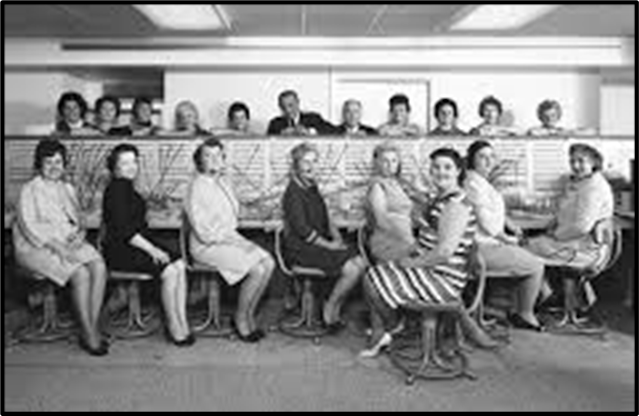 |
| The White House Admin Switchboard |

Richard LePere, I'm not sure if the "Signal Board" still does this or if it had stopped. Back in '84 to '92, during Desert Storm/Shield. Oper18, especially during the holidays, we would randomly pick the worst remote military sites in the Autovon directory. We'd call the site, announce that it was the White House performing a holiday call for person on duty.
I remember one kid, a private, stuck pulling guard duty on Christmas Day in South Korea. I asked him if he would like to speak to someone, anyone in his family. He said he would like to talk to his Mom. So I dialed his mom's telephone number and explained to her the same thing. When I connected the Mom & Son, her son couldn't speak, he so emotional, crying, I had to step into the call, and said, "Son, you can take as long as you want, to talk to your Mom, tonight, this is our present to you both. Merry Christmas."
The private finally stopped crying and said he hadn't spoken to his mom, since the day he left for basic training. His only way to reach her was by writing letters home.
They talked for over an hour. Of all the things I still miss from my time in WHCA, it's placing calls like that to the troops stuck halfway around the world, stuck in a shit hole spot pulling guard duty.
Chris Morgan put through a call like this at Christmas time with an E-3. His call had only been up for a couple of minutes, then terminated. The call was made via the EUCOM drop. The EUCOM operator said there was a Major General who wanted to call his family, and he pulled rank.
I said, "no problem", put the general through. When I got him on the line I asked if the call was for official White House business. He said no and I told him this line was only for official business. He started cussing and asking my rank, etc. I told him he could submit a complaint to the President the next day. He hung up, but was NOT happy.
I called EUCOM back, got the E-3 back on the line and let him complete his call.
The good old days of the Western Electric 608D Cord Swbd, and "Official White House Business" Old Signal Oper 10
| |||
Type of Activity | Visiting the Oval Office | ||
Location | |||
Location | Washington DC | ||
Date of Activity | January 2021 | ||
Coordinates | 38°53'51.2"N 77°02'20.9"W | ||

The telephones on the President’s desk
 |
| Former president Donald Trump in the Oval Office, December 3, 2020. |
Both phones are not the standard commercially available model, however, as they have been modified by a small communications security company called Advanced Programs, Inc. (API). This can be recognized by the dark gray metal box at the back side of the phone's color display and an additional red button on the front panel of the phone:
The purpose of these modifications is to provide on-hook security for the handset and the speakerphone and probably also for TEMPEST protection - to make sure that the phone cannot, either accidentally or deliberately, pick up and transmit audio when the handset is on-hook.


 |
| Close-up of the presidential seal on a Cisco 8851 IP phone |
 | |
President Biden's desk in the Oval Office. One of the Cisco 8851 IP phones
|

 |
| President Joe Biden at his desk in the Oval Office, January 25, 2021 |
"Out of nowhere, he'd suddenly press the button," Sims wrote. "Not sure what to do, guests would look at one another with raised eyebrows" he added. "Moments later, a steward would enter the room carrying a glass filled with Diet Coke on a silver platter, and Trump would burst out laughing."
 |
| Trump's glass of Diet Coke in front of the Cisco 8851 IP phone for secure calls |
|

The button has nothing to do with nuclear command and control, but can be used by the president to summon assistance. According to earlier sources, it was meant to alert the Secret Service, while others say that pushing the button makes an aide come in for whatever the president may need.
WHCA Recruitment Video (1992) | |
 | |
| Type of Activity | |
Location | |
| Location | Washington DC |
| Date of Activity | 1992 |
| Coordinates | 38°53′52″N 77°02′11″W |
The Unit was activated under the Military District of Washington to provide normal and emergency communications requirements in support of the President. Initially named the White House Signal Detachment (WHSD) consisting of 32 people provided mobile radio, teletype, telephone, and cryptographic aids in the White House and at the Presidential Retreat Shangri-La, now known as Camp David.
WHSD wasn’t even a real agency for the first three months of its life. Rather, it was an unofficial collection of the U.S. Army whose low-profile mission was to provide secure lines of communication for the president during World War II. Officially activated in March 1942, WHSD has since undergone two name changes and a couple of shifts in oversight. During the Eisenhower administration WHSD was renamed the White House Army Service Agency (WHASA)
In June of 1962, a review of the organizational arrangements by which the Communications needs ln the White House were being met and the review suggested certain changes involving Department of Defense support. It was believed that these changes would facilitate the White House operations. The White House Communications Agency (WHCA), as it has been known since 1962, is a “joint service agency” staffed by all branches of the armed forces, as well as a handful of civilians. Recruiting qualified personnel was always a huge problem, because of the sensitive nature of the assignment WHCA formed recruiting teams and sent them to many bases in the US and overseas,
I reported into Ft. Monmouth and started training as a Microwave Radio Repairman in April 1965. Several weeks before I completed training, I was interviewed by a recruiting team from the White House Communications Agency (WHCA). Normally these teams were comprised of an Trip Officer and three enlisted members knowledgeable of the MOS’s needed by the Agency. After reviewing hundreds of 201 files, a handful of students were selected to be interviewed. I returned the next day and was told that I had been selected.
Passing a polygraph examination was required and your background needed to be squeaky clean and have ZERO deceptions with your answers, you can't get offended or flinch even when they ask you insane questions about your character or lifestyle. I remember the first time through the test I had no deceptions, and the examiner asked the last question “have you told the truth to all of the previous questions”? Well the machine went wild, so after some consultation with the examiner, I re-took the test and passed.
Then an extensive background investigation was conducted, even for those of us who already had security clearances, my WHCA contact told me that only 1 of 3 make it through the screening.
Reportable items included within the Interview , but are not limited to, were as follows:
-Adverse involvement with law enforcement agencies to include arrests, fines, speeding tickets and parking tickets
-Negative Counseling or Uniform Code of Military Justice (UCMJ) punishment
-Security Incidents/Infractions
-Court Summons
-Credit judgments, bankruptcy filings, repossessions, or late payments
-Association with foreign nationals (not previously reported or a change in contact relationship/frequency)
-Foreign Travel (NLT 30 days prior to travel)
-Change in marital status -Legal name change
The background investigation actually took about six months with Investigators interviewing references and traveling to my hometown talking to my neighbors
I was ultimately selected and was transferred to WHCA in Washington DC. It was November of 1965 when my experiences with WHCA began.
When I reported for duty in 1965 WHCA had a total of 450 people assigned. I quickly found out that it was a very unique organization, no uniforms, civilian status, and an assignment that was unlimited in length.
There was a different set of rules for the old timers who were there . They served the President with excellent service longevity which seemed more valuable then. The term “WHCA Baby” was coined for homesteaders. Many folks arrived from AIT as E-3’s and stayed an entire career. Only a few were promoted to E-9, many hit ceiling at E-8 and had choice to return to Army and attend SGM Academy, but many deserving troops just retired and moved on to great second careers . I ended up serving nine years at four duty stations, but I know serval people who served twenty years in WHCA.
Civilian status is a very interesting situation when you are told to “blend in” and you are assigned to a military installation. It was my honor to serve in WHCA for over nine years, and although I worked on a Naval Support Facility, Coast Guard Station, Marine Corp Air Station, and Air Force Base, I was never required to wear a uniform.
Today uniform policy differs from section to section as members are required to wear uniforms while they are at their duty station. However, when traveling on a support trip, civilian attire is worn.
WHCAs mission has constantly grown over the years by adding new responsibilities such as the Photo Lab, the Audio/Video Section, the Carpenter Shop (building all Presidential podiums), AG, Financial, Transporters, Logisticians, Sheet Metal workers, Multimedia Specialists, and Intelligence, Finance, Logistics, and Military Intelligence fields, as well all other activities as directed by the White House Military Aides Office (WHMO). By 1990 the Agency had grown to over 1000 service members and civilians.
WHCA would constantly send out four men recruiting teams to various military installations worldwide looking for potential personal with needed MOS’s. Military training schools were prime targets for finding qualified targets. Recruiting qualified individuals had become so difficult that recruitment became a priority. WHCA produced video’s like this one, Ready To Receive, as an attempt to stimulate interest in active units within all branches of the military and Reserve units. Soliciting applications became the preferred way of recruitment in WHCA.
 |
WHCA Headquarters Building (Front Entrance) |
A typical Army Application package would contain:
- Application (SSQ)
- Last three NCOERs or Counseling Statements
- Last three APFT (with body fat worksheet if applicable)
- Current SRB
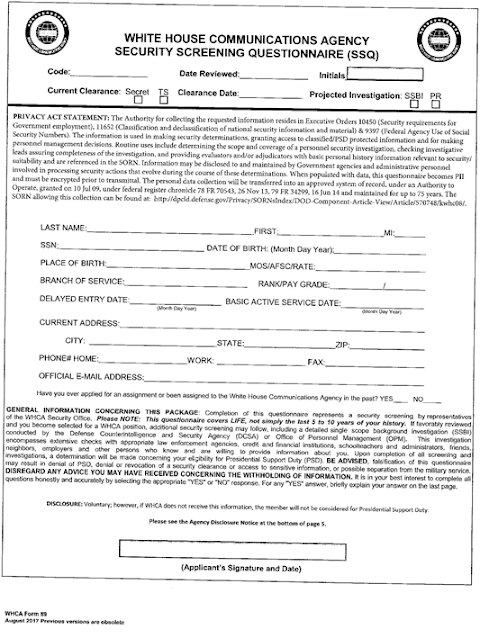


Everyone selected to work at WHCA receives special duty assignment pay and a civilian clothing allowance. They serve a minimum of three years in a presidential support duty and are eligible to earn the Presidential Service Badge. WHCA trains and works with cutting-edge communications and media technology.
DOD IG Audit of WHCA | |
 | |
Type Of Activity | DOD IG Audit |
Location | |
Location | Washington DC |
Date of Activity | Dec 1995 |
Coordinates | |
Over the decades, WHCA’s mission has grown significantly. What began as a low-profile communications unit now encompasses a wide range of services supporting the president, vice president, National Security Council, First Family, and White House staff. This includes setting up secure communications, videotaping key presidential moments for the National Archives, providing stenographic services for press briefings, and managing logistics for presidential appearances.
By 1978, WHCA had reached a peak staffing level of over 1,000 personnel. Although downsizing efforts reduced the agency to about 850 members, it remains the largest organization under the White House Military Office (WHMO), with a budget exceeding $120 million during the Clinton administration. Despite this, WHCA operated largely under the radar, with minimal oversight from both the Department of Defense (DoD) and White House leadership.
Scandals, Oversight, and “The Coffees”
In the 1990s, WHCA faced increased scrutiny due to its involvement in videotaping Democratic National Committee (DNC) fundraisers and informal White House coffees. This controversy erupted after WHCA, following Senate inquiries into campaign finance practices, delayed the release of video footage, sparking accusations of obstruction. The tapes documented President Bill Clinton’s interactions with major donors, raising questions about WHCA’s role in preserving politically sensitive moments.
Critics argued that WHCA’s presence at these events blurred the line between its communications mission and political activities. Some speculated that WHCA’s expanded duties were a byproduct of bureaucratic mission creep, with the agency taking on additional roles to justify its budget and staffing levels. Others noted that Clinton may have become so accustomed to constant video documentation that he failed to question WHCA’s ubiquitous presence.
Former White House Deputy Chief of Staff Harold Ickes acknowledged the ambiguity surrounding WHCA’s activities, admitting in congressional testimony that White House staff rarely noticed the agency’s video crews. He also described WHCA as part of the White House Military Office, a unit with a long history of classified projects, including the construction of presidential bomb shelters and secret taping systems used by past presidents.
A History of Secret Funds and Loose Oversight
WHCA’s overseer, the White House Military Office, controlled a secret fund during the Eisenhower, Kennedy, Johnson, and Nixon administrations. This fund, purportedly for security-related expenses, was sometimes used for questionable projects, including renovations to presidential properties and the installation of President Lyndon B. Johnson’s and President Richard Nixon’s secret recording system. WHCA personnel were often assigned to these classified tasks, highlighting the agency’s role as a tool for executive discretion.
Following revelations about this secret fund in the 1980 book Breaking Cover by former WHMO Director Bill Gulley, the Reagan administration promised reforms, but questions about WHCA’s management persisted. In the 1990s, congressional inquiries and audits by the DoD’s Inspector General revealed issues such as unaccounted property, excessive equipment leases, and mission overreach.
A History of Secret Funds and Loose Oversight
WHCA’s overseer, the White House Military Office, controlled a secret fund during the Eisenhower, Kennedy, Johnson, and Nixon administrations. This fund, purportedly for security-related expenses, was sometimes used for questionable projects, including renovations to presidential properties and the installation of President Lyndon B. Johnson’s secret recording system. WHCA personnel were often assigned to these classified tasks, highlighting the agency’s role as a tool for executive discretion.
Following revelations about this secret fund in the 1980 book Breaking Cover by former WHMO Director Bill Gulley, the Reagan administration promised reforms, but questions about WHCA’s management persisted. In the 1990s, congressional inquiries and audits by the DoD’s Inspector General revealed issues such as unaccounted property, excessive equipment leases, and mission overreach.
Despite WHCA’s considerable size, WHCA has operated with little attention from either its Defense Department or White House masters. The agency’s basic tasks have been reviewed only three times since its inception, and it escaped formal audit until a DOD IG audit was completed in November 1995.
The initial attempts to conduct oversight of this 900-person, $100 million-a-year White House-directed agency were made by Congress in 1994. Those attempts were met with repeated delays and White House stonewalling. Early 1995, after meetings with the White House Counsel's office, GAO, and the Department of Defense IG's office, Congress finally received the approval to have an IG's investigation done going back 5 years.
WHCA was annually performing $7.8 million worth of tasks beyond the scope of its mission; it was unable to account for more than half a million dollars’ worth of agency property; and it was paying close to $800,000 to lease superfluous equipment.
This report on phase one of the audit cited “no evidence of significant theft or significant waste” in WHCA, but noted several areas in need of “management attention.”
Finally, the DODIG concluded that WHCA is providing the White House with services and equipment which are outside way, outside of the scope of its mission of telecommunications support to the President of the United States.
Congressional Inquiry and the Road Ahead
Despite these findings, WHCA’s operations remain shrouded in secrecy due to their classification as matters of “presidential protection.” Efforts by the Government Accountability Office (GAO) to investigate WHCA were blocked by the White House, which cited national security concerns. Congressional Republicans pushed for further hearings resulting with Congressional hearings conducted on May 16 and June 13, 1996.
While WHCA continues to support the president with essential communications services, its evolving mission, political entanglements, and history of minimal oversight raise ongoing questions about transparency, accountability, and the proper scope of its activities.
The April 1996 phase-two report concluded that WHCA was receiving “little or no oversight of budgeting, acquisition planning, and organizational effectiveness,” and recommended that the DoD’s oversight role be strengthened.
WHCA has been a deep, dark hole over at the White House into which there has been spending nearly $100 million annually without any executive branch oversight. It has also become a pot of money devoted to many things-kind of a miscellaneous pot of money-that have nothing to do with telecommunications or the President.
The White House Communications Agency has had a totally unique mission, and the staff who serves there perform their duties exceptionally well and have done so for more than 50 years and for 11 Presidents, both Democrats and Republicans.
Among these:
The DOD IG’s report concluded that WHCA's budgets have gone largely unreviewed. Its annual performance plan has failed to meet DOD standards. Its acquisition planning has violated DOD regulations and resulted in wasteful purchases.
Finally, the DOD IG concluded that WHCA is providing the White House with services and equipment which are outside way, outside of the scope of its mission of telecommunications support to the President of the United States.
The executive summary is copied below with complete report available at Audit Report on White House Communications Agency. (Report No. 96-033) and Audit Report on White House Communications Agency Phase II. (Report No. 96-100)
Transcript of Congressional hearings conducted on May 16 and June 13, 1996 Oversight of theWhite House Communications Agency
November 29, 1995
MEMORANDUM FOR DIRECTOR, WHITE HOUSE MILITARY OFFICE
UNDER SECRETARY OF DEFENSE (COMPTROLLER)
ASSISTANT SECRETARY OF DEFENSE (COMMAND,CONTROL, COMMUNICATIONS AND INTELLIGENCE)
DIRECTOR, DEFENSE INFORMATION SYSTEMS AGENCY
COMMANDER, WHITE HOUSE COMMUNICATIONS AGENCY
SUBJECT: Audit Report on White House Communications Agency
(Report No. 96-033)
We are providing this report for review and comment. We performed the audit in response to a request from Congress and the Deputy Secretary of Defense. We considered management comments on a draft of this report in preparing the final report.
The recommendations in Findings A and B relate to a reallocation of funding between parts of the DoD budget and the budget for the Executive Office of the President. Finding A questions the appropriateness of DoD, through the White House Communications Agency, funding audiovisual, stenographic and news wire services and photographic equipment for the White House. Finding B covers the provision of .White House Communications Agency support and equipment to the Secret Service. Although the Secret Service is required by law to reimburse an agency providing the support, the Secret Service has not done so. Several DoD appropriations and Secret Service appropriations would be affected by the recommendations. Thus, we suggest early consultation with the Office of Management and Budget and the Under Secretary of Defense (Comptroller) so those changes, if agreed to, could be implemented in the President's FY 1997 budget.
DoD Directive 7650.3 requires that all recommendations be resolved promptly. Management comments were responsive to all recommendations except the recommendation to specify services to be provided by the White House Communications Agency and to transfer funding, managing, contracting, and purchasing of audiovisual, news wire, and stenographic services and camera equipment to the Executive Office of the President. We request that the Assistant Secretary of Defense (Command, Control, Communications and Intelligence) reconsider his position and provide additional comments by January 12, 1996.
We have not completed our audit of all aspects of White House Communications Agency activities. We started work on the final phase of the audit and expect to provide a draft report in early 1996. The issues we plan to review during the final phase include the organization and staffing of the White House Communications Agency, acquisition planning, management of telecommunications equipment and services, and controls over selected financial activities.
Office of the Inspector General, DoD
November 29, 1995
Report No. 96-033
(project No. 5RD-5027)
White House Communications Agency
Executive Summary
Introduction. The Chairman, House Committee on Government Reform and Oversight; the Chairman, House Subcommittee on National Security, International Affairs, and Criminal Justice, Committee on Government Reform and Oversight; and the Deputy Secretary of Defense requested the audit. The Deputy Secretary of Defense emphasized that this review should be as thorough as possible of all White House Communications Agency (WHCA) activities in the last 5 years.
Audit Objectives. The audit objective was to review all activities at the WHCA, the authorities and management controls under which the activities are conducted, and various nonspecific allegations of mismanagement and waste. The adequacy of the management control program will be discussed in a subsequent report.
Audit Results. We found no evidence of theft or significant waste of resources in this phase of the audit. However, the following areas need management attention.
o During FY 1995, WHCA and DoD funded about $7.8 million for services and equipment that are not within the scope of the WHCA telecommunications mission as presently defined and should be funded by the Executive Office of the President (Finding A).
o WHCA was not reimbursed for permanent support to the Secret Service, as required by law, and understated support costs reported to Congress by $3.2 million. The Secret Service did not reimburse about $4.3 million for support and, because DoD absorbed support costs, the. The Secret Service budget was augmented by that amount. WHCA is expected to provide permanent support valued at $7.0 million during FYs 1996 through FY 2001 for which DoD should be reimbursed by the Secret Service (Finding B)..
o WHCA managers did not maintain control over repair parts inventories, and contracting officer's representatives did not document maintenance data. Therefore, WHCA can neither ensure the adequacy or accountability of repair parts inventories nor determine the cost-effectiveness of maintenance contracts (Finding C).
o WHCA lacked accountability for nonexpendable property on hand and had excess expendable supplies valued at about $226,000. Property valued at about $577,000 was not accounted for and is at risk for potential waste or loss. Further, by reducing the requisition objective for expendable items and by eliminating excess expendable items with no demand histories, $226,000 could be put to better use during FY 1996 (Finding D).
o The inventory of base communications equipment and services is neither complete nor accurate. Consequently, the inventory could not be audited, and WHCA could neither review and revalidate communications requirements nor assess the cost effectiveness of configurations for equipment and services. Further, WHCA is at risk of paying for unneeded equipment and services (Finding E).
o WHCA paid for leased, long-haul telecommunications circuits and equipment that were no longer required. If the circuits are terminated, about $759,000 can be put to better use during FYs 1996 through 2001 (Finding F).
o WHCA did not validate bills for long-haul telecommunications equipment and services before verifying that the bills were accurate. As a result, WHCA had no assurance that payments ceased for terminated services or that payments would not be initiated for services ordered but not installed. If effective procedures are implemented, about $294,000 could be put to better use during FYs 1996 through 2001(Finding G).
Summary of Recommendations. We recommend that management take the following corrective actions.
o Specify the services. that WHCA is to provide to the Executive Office of the President. Transfer responsibility for funding, managing, contracting, and purchasing of audiovisual, news wire, and stenographic services and camera equipment to the Executive Office of the President.
o Specify the permanent and temporary support provided to the Secret Service and determine which is reimbursable or non-reimbursable, specify billing procedures, and bill the Secret Service for reimbursable support provided during FY 1995 and continue to bill for all future reimbursable support.
o Fully implement the existing maintenance management system, turn in excess. repair parts, update lists of equipment under maintenance contracts, and use vendor service reports to assess the cost-effectiveness of maintenance contracts.
o Record identified property in the property book, establish the control point for receiving all property, perform monthly reconciliations of the document register, annually review requisition objectives, and turn in excess property.
o Establish a complete and accurate inventory of short-haul equipment and services, and maintain required inventory records.
o Initiate action to terminate unneeded long-haul circuits and equipment, establish the required review and revalidation program for equipment and services and establish a complete inventory of equipment and services.
o Establish procedures to verify the accuracy of Customer Cost and Obligation Reports on a monthly basis.
Management Comments. The Assistant Secretary of Defense (Command, Control, Communications and Intelligence) submitted joint comments for himself; the Director, DISA; and the Commander, WHCA. The Assistant Secretary concurred in all recommendations except for the recommendation to specify the services that WHCA is to provide to the White House and to transfer responsibility for funding, managing, contracting, and purchasing of audiovisual, news wire, and stenographic services and camera equipment to the Executive Office of the President. See Part I for a summary of management comments and Part III for the complete text of management comments.
Audit Response. As a result of information from management, we deleted one recommendation (Finding D) regarding property accountability. The Assistant Secretary's comments are not responsive regarding the recommendation related to specifying WHCA services and transferring these responsibilities. We maintain that WHCA should not fund the costs of audiovisual, news wire, and stenographic services and photographic equipment for the White House absent clearer direction to do so. We do not question the President's need for the services, contracts, or equipment provided by WHCA, and we recognize the legal authority of the President to issue an Executive Order to specify the services WHCA is to provide. However, as a DoD organization, WHCA is governed by DoD Directive 4640.13 in providing telecommunications services and the functions now performed and funded by WHCA go beyond telecommunications services as defined in that Directive. We request that the Assistant Secretary of Defense (Command, Control, Communications and Intelligence) reconsider his position and provide additional comments in response to the final report by January 12, 1996.
Oversight of the White House Communications Agency | |
 | |
Type of Activity | IG audit of Communications Support |
Location | |
Location | Washington DC |
Date of Activity | May 16, 1996, June 13 1996 |
Coordinates | 38°53'51.2"N 77°02'20.9"W |

- $577,000 worth of missing equipment will remain unaccounted for.
- $300,000 software packages will be purchased yet sit unopened.
- $294,000 will be paid for services never provided.
- $784,000 in illegal contracts will continue to be let.
- $4.9 million unusable communications trailers will continue to be purchased.
- $2.1 million maintenance contracts will continue to be sole sourced to WHCA friends in total violation of Federal contracting law.
- services quoted at $35,000 will be billed at $91,000, and those bills will be paid.
- $14.5 million in outstanding obligations will remain unvalidated.
DETAILS OF THE DOD IG AUDIT REPORTS
Second Report: Report No. 96-100, April 29, 1996:
OVERALL ASSESSMENT
CONCLUSION
The Reagan Presidential Library | |||
| |||
Type Of Activity | Visiting the Reagan Presidential Library | ||
Location | |||
Location | Simi Valley CA | ||
Date of Activity | May 6 2012 | ||
Coordinates | |||

The Ronald Reagan Presidential Library and Museum, is a prominent and well-regarded institution dedicated to the life and legacy of the 40th President of the United States. The Reagan Presidential Library is a must-visit for anyone interested in American politics and history. It offers a comprehensive look at Ronald Reagan's life, presidency, and the significant events that occurred during his time in office.
THE REAGAN PRESIDENTIAL LIBRARY AND MUSEUM
 |
| Main Entrance |
 |
| Entering the Library with the statue of President Reagan at the entrance |
 |
| Views of the surrounding area from the Reagan Library |

Teleprompter, Camp David & Rancho del Cielo Exhibits
 |
| I had to try using the Teleprompter |

 |
| My home for five years |
 |
The Camp David Exhibit |
I was assigned to WHCA at Camp David for five years as a microwave radio technician installing and maintaining the M/W, FM radio and telephone systems necessary for daily operations at the facility, as well as supporting the President and USSS when visiting the site.
The Oval Office
The Reagan Library offers a full-scale replica of the Oval Office during the Reagan presidency. Featuring Ronald Reagan's Oval Office desk, this exhibit allowed us to step into the Oval Office and get a sense of what it was like for the President during the time he occupied the office.
 |
| Ronald Reagan's Oval Office desk |
 |
Replica of Ronald Reagans Oval Office |
One of the most popular exhibits at the Reagan Library is the Air Force One Pavilion. Opening in 2005, the Air Force One Pavilion features multiple historic Presidential transportation exhibits and the Annenberg Discovery Learning Center, and it is the highlight of the Library. The Air Force One Pavilion at the Reagan Library is one of Southern California’s “must-see” destinations!
The upper floor of this three-floor exhibit starts with the Mezzanine Gallery. The Museum highlights President Reagan’s face-to-face diplomacy with world leaders on economic relations, strategic relations, and arms control as he travels on Air Force One. The Secret Service and their role in protecting the President while he travels displays on a gallery wall on this level.
 |
| Air Force One Pavilion SAM (Special Air Mission) 27000, better known as Air Force One, flew 444 missions and carried seven presidents from 1972 to 2001. President Richard Nixon first used the plane in 1972, and famously traveled to his San Clemente, California home following his resignation in 1974. President Ronald Reagan sent predecessor President Jimmy Carter to West Germany to greet the 52 American hostages freed from Iran in 1981. Reagan used Air Force One more than any other president, registering over 660,000 miles aboard the plane. President George H.W. Bush was the last to use the SAM 27000 model as a primary means of transportation, and President George W. Bush was the last to use it as Air Force one when he and First Lady Laura Bush flew to TSTC Waco Airport in 2001. SAM 27000 was retired to the Ronald Reagan Presidential Library and Museum in 2001. See it through the years in today’s gallery. |
 |
| Telephone Access Panel in the Nose of AF1 |
The second floor of the Pavilion focuses on the history of Air Force One, Explore a 120’ mural which represents all 22 aircraft that has ever flown a U.S. president. It also showcases the Stan Stokes’ mural, History of the Flying White House, featuring aircraft from FDR’s Dixie Clipper to the current Boeing 747.
 |
| Air Force One Pavilion |
 |
We are about to start our tour of AF-1 |
The Air Force One Pavilion, allowed us to step aboard the actual Air Force One aircraft a Boeing 707 that was used by President Reagan during his time in office.
 |
| AF-1’s Cockpit |
 |
| 27000’s (Angel) Radio Room |
The tour gave me a chance to see the Radio Room again, where I had spent so many hours on the ground communicating with 26000 and 27000 from various trip sites around the world, while I was with WHCA It's a unique and immersive experience that gives you a sense of what it was like to travel as the President of the United States and see the many places where he spent time working, meeting with advisors, and relaxing with his family.
 |
The President’s office aboard Air Force One |
This Flying White House, tail number 27000, served seven U.S Presidents from 1973 to 2001, including Presidents Nixon, Carter, Ford, Reagan, George H.W. Bush, Clinton, and George W. Bush. For Ronald Reagan, this was the plane in which he hand-wrote many of his speeches, signed important legislation and even officially started the Daytona Beach, Florida NASCAR race via phone.
But the Air Force One Pavilion is about more than just his plane. The lower floor of the Pavilion also has the Marine One Gallery, which showcases President Lyndon Johnson’s Marine One helicopter. |
The Cockpit of Marine One |
 |
The interior of Marine One |
We were able to tour the actual Marine One helicopter that flew President Johnson.
 |
| Marine One |
 |
| I am standing near the phone jack on Marine One |
On the Lower Floor It has a presidential motorcade featuring President Reagan’s 1984 parade limousine, and a secret service suburban as part of an exhibit on presidential motorcades, which rounds out the Presidential transportation exhibits. The presidential limousine is always preceded by the lead car, LAPD used a normal police vehicle, a standard equipped 1982 Chevrolet Impala converted for this purpose. LAPD has also been using two lead Kawasaki motorcycles to provide additional protection for presidential motorcades since 1976.
 |
| LAPD lead car and lead motorcycles |
 |
| The USSS’s follow-up Vehicle |
The Secret Service motorcade follow-up vehicle, also known as the "Halfback", is a specially outfitted Chevrolet Suburban that follows the President's limousine in the motorcade. It is staffed by Secret Service agents who are responsible for providing additional security to the President and their family.
President Reagan’s parade limousine also known as Stagecoach, was a modified 1984 Cadillac Brougham d'Elegance that is heavily armored, and has a 76 millimeter higher roof, a telephone system, rear bumper platforms and grab bars for security agents as well two special headlights, which were only intended to illuminate the flags waving on the front fender standard holders.
 |
| President Reagan’s parade limousine |

We were able to walk around the Limo and could see the vehicle up close, but not close enough to see if the FM radios were installed. The USSS used these radios for the security measures in place for the President's transportation. The limousine did have the phones installed in the rear seat.
 |
President Reagan’s personalized license plate |
The Ronald Reagan Ballyporeen, Irish Pub
The Ronald Reagan Pub is located at the Ronald Reagan Presidential Library and Museum in Simi Valley, California. It is a popular spot for visitors to the library, and is known for its casual atmosphere and pub fare. Experience the actual Irish pub from Ballyporeen, Ireland when he visited on a diplomatic trip in 1984 which now sits within the Pavilion and serves as the Library’s snack shop. The entire interior was dismantled (bar and all!) and shipped to California to become the Ronald Reagan Pub which sits under the wings of Reagan's retired Air Force One.
Visitors can also enjoy refreshments in the “Ronald Reagan Pub” - an actual Irish pub which was donated to the Library from Reagan’s ancestral Irish village of Ballyporeen, Ireland.
 |
Entrance to the Ronald Reagan Irish Pub |

The Ronald Reagan Pub is a great place to relax and have a drink or a meal after visiting the library. The food is good, the drinks are cold, and the service is friendly.
 |
| Taking a break at the Ronald Reagan Irish Pub |
 |
Time to rest and enjoy a brew |
BERLIN WALL
This exhibit showcases a section of the Berlin Wall, a powerful symbol of the Cold War era. Visitors can learn about Reagan's role in bringing about the end of the Cold War and the fall of the Berlin Wall.
 |
| A section of the Berlin Wall |

The Iron Curtain took shape following World War II as a fortified border between the nations of Eastern and Western Europe. But as an idea, the Iron Curtain stood for the profound division between communism and democracy, oppression, and freedom. The Soviet Union dominated life on the eastern side of the border and enforced its brand of communism in its satellite states. Ronald Reagan took on the enormous challenge of bringing down the Iron Curtain.
Since receiving the Wall, President Reagan’s wish has come true many have visited the Wall at the Reagan Library and learned its lesson of freedom and democracy for all.
Reagan's Memorial:
 |
| The Ronald Reagan Memorial at the Reagan Library |
Ronald Wilson Reagan passed away on June 5, 2004, at the age of 93. His death induced an outpouring of respect, grief, and honor. Mourners around the world left flowers and trinkets at makeshift memorial sites. The former President laid in repose here at his Presidential Library on June 7-8, 2004. His casket then laid in state in the U.S. Capitol from June 9-11, 2004. Over 200,000 mourners made the journey to say their final goodbye to the former president. Dignitaries from 165 nations attended the public funeral held at the Washington National Cathedral. President Reagan was laid to rest during a private funeral service at sunset on June 11, 2004, at the Ronald Reagan Presidential Library and Museum.

 |
| Remembering President Ronald Reagan and the First Lady Nancy Reagan |
Overall, the Reagan Presidential Library and Museum is a must-see for anyone interested in American history and politics. The museum's exhibits are informative, engaging, and well-presented. Visitors of all ages can learn something new about Reagan and his time in office.
Ronald Reagan's trip to ancestral home in Ballyporeen, Ireland in 1984
by Marty Williams
Ballyporeen 12
This didn’t happen on St Paddy’s Day, but it is my favorite Irish memory of my favorite Irish President. At the Economic Summit, in London, in June of 84, I was working the switchboard the morning after President Reagan arrived from Ireland. At just the time that the Trip Officer (TO) was bringing the White House Communications Agency (WHCA) Commander (CDR) through the Switchboard area, the Boss’s line rang in to my console. (For non-operators, when the Boss’s line went off you heard a loud, annoying, stress inducing, modulating tone), the pencil comes up and you start taking notes. With the Reagans two things could happen. One, Mrs. Reagan, could be calling. if she was, the conversation was going to be short, the information would be given quickly, and there would be no opportunity to have it repeated. The call might go something like this: “Crestview 5-4724” (click) and we’re done. You had better have gotten it all. (yes, that’s how folks did phone numbers in the old days).
Now if it were the Boss, it would most likely be a long conversation that could take a meandering route to what he wanted. Anything said along the way could be the call information and would need to be written on the Presidential Call Log for the archives. Obviously, I had the full attention of the CDR and T.O. The call went something like this: “Hello, Signal (the designator for the WHCA Switchboard). I have an unusual request for you, I probably shouldn’t bother you with it, I mean I asked my staff to take care of it yesterday, but I guess it didn’t happen. Well anyway, yesterday, when I was in Ballyporeen, Ireland, I was there because my grandfather came from there, so it was a kind of homecoming, well, there was this young woman I met there, she was a nurse who took care of war wounded in Baghdad. She was there for a homecoming too. I told my staff I wanted to talk some more to her, but I guess they didn’t come through. Her last name was (ok, here comes some help) Clancy.(some help) that would make her name (ok, here we go) Nurse Clancy. (Ahh) I shouldn’t bother you with this, its just too hard.” “Not a problem sir” “Well ok, give it a try”
So i went into action. The CDR and TO were giving me “the look”. I figured I needed information in another country. So I got on to the international operator. They got me to an Ireland information operator. And she got me to the Ballyporeen Switchboard operator. Yes, I said switchboard. The town still had an operator. I asked how many Clancy’s there were in town. She had about 30 listings for Clancy. But the most popular one was the Clancy Pub. I figured if anyone might know, a small-town pub might be a good place to start.
 |
| President Reagan enjoys a Brew at the Pub |
I had her put me through. In a full brogue the proprietor answered. I explained that it was the White House calling and that President Reagan had met a Nurse Clancy the day before and wanted to talk to her again. I asked if he might know a Clancy who was a Nurse for war wounded in Baghdad who was home for a visit. “Sure and I do! It’s my daughter Margaret. MARGARET! Get your arse down here, the President of the United States wants to speak to you!” Margaret got on the phone, and I gave her a quick briefing. Then I called the president back. “Hello” “Mr. President, about your call to Nurse Clancy” “Oh, I know, that was too hard. Don’t worry about it. Thanks for trying” “Mr. President, do you still want to talk to her?” “Well yes” “Well sir, her name is Margaret and she’s on the line. Go ahead please”. Total time request to connect, less than six minutes. As he chatted with her, I realized I didn’t have a number for the log. So I retraced the call and got the Ballyporeen operator again. She gave me the number. Ballyporeen 12. The TO and CDR were duly impressed. A few minutes later the call came down and the boss called in again. “That was amazing, how did you do that?” “Magic Sir”. And though it may not qualify as “saving the day” it was an Oh Yeah! moment… Was privileged to have many of those over the years, but this is one of my favorites.
The Nixon Library and Birthplace | |
 | |
Type Of Activity | Nixon Presidential Library |
Location | |
Location | Yorba Linda CA |
Date of Activity | Est, 1990 |
Coordinates | |
The museum is housed in a 52,000-square-foot building in the suburbs of Yorba Linda. Opening its doors in 1990, this complex was established to celebrate former President Nixon's accomplishments as a peacemaker and an international statesman. From the humble farmhouse built by his father in 1912, to priceless gifts from heads of state, to the peaceful memorials of the President and Mrs. Nixon, the museum and its beautifully landscaped grounds and gardens trace the long road from Richard Nixon's past.

The entire facility underwent a $15 million renovation in 2016, and reopened on October 14 2016. The Library now features updated, multimedia museum exhibits; aimed at bringing the country’s 37th president closer to younger generations less familiar with his groundbreaking trip to China or the Watergate scandal. the complex is jointly operated by NARA and the Richard Nixon Foundation.
 |
| Wall mural of former President Richard Nixon in the lobby area of the Richard Nixon Presidential Library and Museum |
President Nixon's Oval Office
In the Nixon Library is a replica of the Oval Office in the White House, where President Nixon made many of his most crucial decisions.
 |
| President Nixon’s Oval Office |

The Space Race gallery connects Nixon to NASA's missions. There's an Apollo 16 space suit reproduction, dehydrated pork and scallops astronaut food, and gift lunar landing cufflinks.
 |
| Apollo 11 display at the Nixon Library and Museum |
 |
| The Moon Walk 1969 |
When Apollo 11 landed on the moon I was in New Delhi India preparing for President Nixon’s arrival on his first world tour since taking office in 1969. Since the Janpath Hotel in New Delhi did not have a radio or TV I had to read about its success in the Newspaper the next day.
A phone used by Nixon to call the Apollo 11 astronauts after they landed on the Moon may be on display (it occasionally goes on tour), along with a contingency speech drafted by speechwriter William Safire in case of a disastrous ending of the mission.
 |
| The phone used by Present Nixon to call the Apollo 11 astronauts |
The President arrived on Guam and spent the night at the residents of Rear Adm. Pugh Residence, Commander of the U.S. Naval Forces, Mariana Islands. While the President was on the mainland we were held in reserve for any Personnel sickness or equipment malfunction, The team spent two weeks there without incident before we returned to San Clemente.
 |
| President Nixon’s arrival in China |
 |
| President Nixon is greeted By Chinese Premier Zhou Enlai |

 |
| Stagecoach the President's Limousine |
Army One

Richard Nixon's Birthplace
Behind the museum is the birthplace, which was constructed by Nixon’s father using a home-building kit and restored to appear as it was in 1910.
President Richard Nixon’s Birthplace

President Nixon’s Birthplace is located in a slightly secluded setting east of the main building, in a grove of trees. It is a 1+1⁄2 story Craftsman-style bungalow, with a gabled roof and clapboarded exterior. The house was built in 1910 on family ranchland; President Nixon was born there the following year. He and his family stayed there until 1922, when they moved to Whittier, California
The front entrance
The Rear on the Birthplace
The piano on which Richard Nixon learned to play.
In the Kitchen as it was in 1910 The Presidents Bedroom


The Nixon Memorial Garden.
The original farmhouse where President Nixon was born is just a few steps away from his final resting place in the Nixon Memorial Garden.
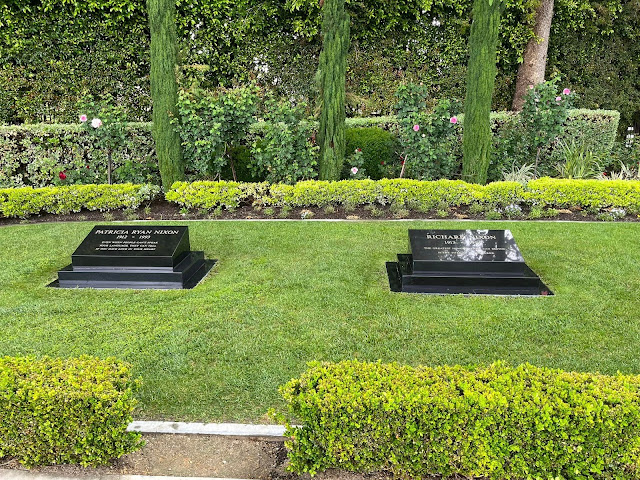
President and Mrs. Nixon are buried on the grounds, just a few feet from his birthplace
 |
| President Richard Nikon’s headstone |
 |
| First Lady Patricia Nixon’s headstone |
In 2023 there was a reunion of past and present members of the White House Communications Agency at the Nixon Presidential Library and Birthplace and these photographs were taken by Marty Williams during a tour.
Trump Presidential Library | |||
| |||
| Type of Activity | Planning of Presidential Library | ||
| Location | |||
| Location | Miami FL | ||
| Date of Activity | 30 Mar 2026 | ||
| Coordinates | |||

Trump Presidential Library Foundation announces new design
Eric Trump, a trustee of the Donald J., said he worked for six months with his team to create a lasting tribute to his father’s legacy as a transformative leader, successful developer, and champion of American greatness.
"The Donald J. Trump Presidential Library is officially here."
"Over the past six months, We have poured our hearts and souls into this project with my incredible team at Trump"
 |
| Renderings of Trump Presidential Library |
 |
| Renderings of Trump Presidential Library |
"This landmark on the water in Miami, Florida will stand as a lasting testament to an amazing man, an amazing developer, and the greatest President our Nation has ever known.  "
"
"These images have never been seen by the public — until today. Enjoy!"
Eric described it as one of the most "beautiful buildings ever built,” an “icon on the Miami skyline,” and visible for miles into the Atlantic.
 |
| Renderings of Trump Presidential Library |
 |
| The Main Entrance to the Trump Presidential Library |
The site sits on the water in Miami, Florida, next to the historic Freedom Tower on Biscayne Boulevard.
The Freedom Tower once served as a federal processing center for Cuban refugees escaping communism, lining up with Trump’s strong stance against socialism and his support for freedom-loving immigrants who embrace American values.
 |
| Library Lobby complete with AF-1 (SAM 28000) and a gold escalator |
The deed requires construction of a presidential library, museum, and/or center to start within five years.
The Eisenhower Farm | ||||
| ||||
Type of Activity | Communications Support | |||
Location | ||||
Location | Gettysburg PA | |||
Date of Activity | 1955 to 1979 | |||
Coordinates | 39°47'28.83"N/ 77°15'51.18"W | |||

The Eisenhower Farm, located in Gettysburg, Pennsylvania, was the weekend retreat and home of President Dwight D. Eisenhower and his wife, Mamie. e farm was equipped with a helicopter landing pad the president often used when traveling back and forth between the White House, Gettysburg and Camp David. Eisenhower was the first president to use the helicopter as a means of transportation.
The original farmhouse was in disrepair when purchased; and extensive renovations were completed by 1955.
 |
| Eisenhower Farm Main Residence |
 |
| The Eisenhower's Bedroom |
Originally the barn’s milkhouse was established as an office and USSS Command Post (CP) for President Eisenhower’s protective detail.
 |
| The USSS CP at the Eisenhower farm in Gettysburg PA |
 |
| The USSS CP at the Eisenhower farm in Gettysburg PA |
 |
Secret Service guard hut at the main entrance The agents left the farm at the end of Eisenhower’s presidency, but returned in 1965 after Kennedy’s assassination prompted legislation providing protection to former presidents and First Ladies. Once again the agents utilized the old milk house as an office. When I arrived at Camp David in 1965, Det. 3 (Cadre/Creed) was maintaining the radio equipment on the Eisenhower Farm. There was a remote radio console (MIKE) for the secret service CP that terminated in the switchboard room at Camp David. I tested the remote keying circuit on several occasions over the years but was never at the farm. President Eisenhower passed away in 1969 and although scaled back the USSS provided continuing protection for Maime Eisenhower at the Gettysburg farm.  Dedication of the Eisenhower Medical Center In 1972 I did have the pleasure of meeting Mamie Eisenhower while I was covering an event at the dedication of the Eisenhower Medical Center in Palm Springs CA. Also attending the dedication was President Nixon, Vice President Agnew, Ronald Reagan the Governor of California at the time, along with celebrities Bob Hope, Frank Sinatra, and John Wayne. The San Clemente CCT provided all the temporary communications required to support three different protective details that were present at the dedication.  |
The Secret Service manned the Gettysburg farm until Mamie passed away in 1979. The National Park Service preserves the farm of General and 34th President Dwight D. Eisenhower.
Camp David and Presidential Residences | |
 Camp David logo | |
Elevation | 1,900 ft. (579.1 m) |
Location | |
Location | |
Coordinates | +39.648333N -77.466667 W |
The Naval Support Facility in Thurmont, Maryland—better known as Camp David—no longer appears to receive the level of presidential use it once did. This historic, secluded, and highly secure retreat, located just 65 miles from Washington, D.C., has seen only limited presidential visitation in recent years.
 |
| Entrance to retreat |
Modern Camp David bears little resemblance to the modest facility Roosevelt occupied during World War II. He originally authorized no more than $10,000 to make the camp suitable for presidential use, though costs ultimately reached $18,000.
 |
| Aspen Lodge (2025) |
Most modern presidents have maintained private residences and divided their time between those locations and Camp David, often favoring their personal retreats.
Presidential Use of the Presidential Retreat by Era
Harry Truman (1945–1953) President Truman used the retreat least among postwar presidents, visiting only 10 times for 35 days. At one point, he considered closing Shangri-La due to operating costs. Truman preferred Key West, Florida, visiting the Little White House there 11 times for 175 days. When President Trueman left office, he returned to his private residence in Independence Mo.
 |
| President Truman’s residence in Independence MO |
He hosted Soviet Premier Nikita Khrushchev there in 1959, producing the famous “Spirit of Camp David.”
Eisenhower also purchased a Gettysburg farm (Scorecard), visiting both retreats a combined 45 times for 517 days.
 |
| David Eisenhower at the entrance |
 |
| The Gettysburg Farm |
 |
| The Kennedy Compound In Hyannis Port President Lyndon Johnson 1963-1969 took office after President Kennedy was assassinated in Dallas in 1963. LBJ visited Camp David approx. 30 times during his five years in office and spent 45 days at the retreat. With advisors in this setting LBJ hosted both Australian prime minister Harold Holt and Canadian prime minister Lester B. Pearson there. |
President Johnson spent much more time relaxing at the LBJ ranch near Stonewall Texas codename (Volcano), he visited the ranch 96 times for almost 400 days or one quarter of his Presidency. The White House Communications Agency (WHCA) had a detachment of permanent personnel to provide and maintain all the communications required at the LBJ Ranch.
 |
| The LBJ Ranch in Stonewall TX |
President Richard Nixon 1969-1973 was a frequent visitor to Camp David approx. 170 times. Before his Watergate days, Nixon used Camp David to draft many of his important speeches. In his first term alone, Nixon made nearly 120 trips to the camp, refurbished Aspen into a posh home, converted the cluster of other cabins into a mini-White House., and he personally directed the construction of a new swimming pool. Nixon also added new cabins to the grounds, one of which was used by Daughter Tricia and Edward Cox on their honeymoon. Tricia aptly called it a “resort hotel where you are the only guests.” Nixon sometimes offered the retreat to others like Henry Kissinger to ponder the state of the world and to John Dean to whitewash the state of the coverup. Dean, like his boss, found Camp David conducive to “hard reflective work. It’s as close to being away and still being plugged in as anything the Government has.”
President Nixon had two private residences La Casa Pacifica in San Clemente CA codename (Storm King ) where he would visit anywhere from one week to one month each time he visited his Western White House he also hosted Japanese Prime Minister Sato and Soviet leader Leonid Brezhnev in 1973.
 |
| The Western White House in San Clemente CA |
Nixon also had a retreat on the island of Key Biscayne FL codename (Swordfish) where he visited at least 50 times spending 700 days. These were mostly weekend visits with frequent weekend side trips to Grand Cay island in the Bahamas.
WHCA also had a detachment of permanent personnel to provide and maintained all permanently installed communications equipment in both San Clemente CA, and Key Biscayne FL. WHCA positioned Communications Contingency Teams (CCT) in El Toro MCAS and Homestead AFB to cover any side trips that the President might take while visiting.
 |
| The Presidential Compound in Key Biscayne FL |
Gerald Ford (1973–1977) Ford visited Camp David 29 times for 170 days and hosted Indonesian President Suharto during his term in office. He had no permanent second home but vacationed widely as he spent 189 days in various places such as Palm Springs CA,, Vail CO and occasionally Mackinac Island.
President Jimmy Carter 1977-1981 initially favored closing Camp David to save money, but once he visited the retreat, and after he was given a tour of the complete facility including the permanent communications and he reviewed the facilities COG mission, he decided to keep the retreat operational. Jimmy Carter was a private person, and about once a month he found that Camp David perfectly suits his need to get away from the Capital.
In 1978, after 14 days of intense negotiations, President Jimmy Carter brought together Egypt’s Anwar Sadat and Israel’s Menachem Begin, producing the historic Camp David Accords. President Carter visited Camp David 99 times spending 189 days at the retreat.
 |
| President Carters Residence in Plains GA |
President Carter’s Residence is in Plains Ga codename (Driftwood) where he visited around 200 days many these visits were working vacations during his Presidency. WHCA provided the same level of support that was required for every Presidential residence without providing permanent personnel.
President Ronald Reagan 1981-1989 visited the retreat more than any other president 189 times 575 days over his eight years in office. President Reagan restored the nature trails that President Nixon paved over, so he could horseback ride with the first lady.
President Reagan didn’t host many foreign visitors at Camp David, but he did welcome British Prime Minister Margaret Thatcher in 1984. In a private meeting with Reagan, Thatcher recounted the recent visit of up-and-coming Soviet leader Mikhail Gorbachev to London. Her observations would prove quite prescient; she called Gorbachev an “unusual Russian.”
 |
| Rancho Del Cielo Santa Barbara Ca |
President Reagans favorite Retreat was his ranch Rancho del Cielo near Santa Barbra CA, codename (Ridgeline) the President visited there 33 times and 349 days. Each time the President visited WHCA provided the manpower to man 24 hr. coverage of the Switchboard, Comm Center, FM Radio, and voice circuits back to Washington throughout the entire trip. President Reagan hosted Soviet leader Mikhail Gorbachev in 1992 after they had both left office. During Gorbachev’ visit he was offered accommodations in the ranch’s guest house, Once he saw it Mr. Gorbachev declined the offer stating it was too austere and he would seek other accommodations in Santa Barbra.
President George HW Bush 1989-1993 visited Camp David a total of 149 times for 487 days. In 1989 President Bush and Australian Prime Minister Bob Hawke relaxed by pitching horseshoes at Camp David during his visit. The Washington/Camp David Summit occurred June 2, 1990 Russian Premier Mikhail Gorbachev had never been to Camp David, the American president's official retreat, so Bush made а point of moving the summit there via helicopter and then scrambling through the woods with interpreter Pavlichenko, Gorbachev and а contingent of security agents,. Also the President hosted Prime Ministers Margaret Thatcher(1989) and John Major(1990&1992) of Great Britain
Ronald Reagan drew up plans for a non-denominational chapel, which was opened during George H.W. Bush’s tenure and named Evergreen. The only wedding to take place at Camp David occurred on June 27, 1992 when President Bush’s daughter, Doro, married Bobby Koch in the Evergreen Chapel. The reception was held on the lawn of Aspen.
President Bush spent every Summer at his residence on Walkers Point codename( ) in Kennebunkport ME. During his term in office he visited 21 times for a total of 150 days during his four years in office.
 |
| Walkers Point Kennebunkport ME |
President, Bill Clinton 1993-2001 During his tenure President Clinton spent every Thanksgiving at Camp David with his family. In July 2000, he hosted the summit negotiations between Israeli prime minister Ehud Barak and Palestinian Authority chairman Yasser Arafat there resulting in the Camp David Accords. President Clinton visited Camp David 60 times for a total of 173 days.
During his two terms President Clinton spent 174 days on vacation at such places as Martha’s vineyard 100 days, and Jackson Hole WY. The Clintons did not have a permanent residence until they left office and bought their house in Chappaqua NY.
President George W. Bush 2001-2009 In February 2001, President Bush held his first meeting with a European leader, British prime minister Tony Blair, at Camp David, to discuss missile defense, Iraq, and NATO. After the September 11 attacks, Bush held a Cabinet meeting at Camp David to prepare the United States invasion of Afghanistan. During his two terms in office, Bush visited Camp David 149 times, for a total of 487 days, for hosting foreign visitors as well as a personal retreat. He met Blair there four times. Among the numerous other foreign leaders he welcomed at Camp David were Russian president Vladimir Putin , and President Musharraf of Pakistan in 2003, Danish prime minister Anders Fogh Rasmussen in June 2006, and British prime minister Gordon Brown in 2007.
While President Bush’s Prairie Chapel Ranch codename (Base) in Crawford Texas was is primarily a private retreat, it has also played a significant role in American politics. The ranch hosted several significant meetings, including a notable visit from Vladimir Putin on November 16, 2001, where discussions focused on U.S.-Russian relations and arms control, and British Prime Minister Tony Blair. These meetings, often held in the informal setting of the ranch, allowed for candid discussions and strengthened diplomatic ties. On May 10, 2008, the ranch played host to the wedding of Jenna Bush to Henry Hager. The first family made frequent visits to the Bush Western White House on 77 trips, spending 490 days on vacation in Crawford TX.
 |
| President Bush’s Prairie Chapel Ranch Crawford TX |
President Barack Obama 2009-2017 hosted the largest foreign contingent in American history at Camp David when he welcomed the G-8 Summit to the site in 2012. President Obama also hosted Russian prime minister Dmitry Medvedev at Camp David, as well as the Gulf Cooperation Council (GCC) Summit there in 2015. President Obama visited Camp David 39 times and a total of 96 days during his eight years in office.
Even though President Obama had a private residence in Chicago , he visited only a few times for only maybe 20 days and never longer than two or three nights on a visit. The Obamas preferred locations like Hawaii, Martha's Vineyard, and a few visits to Florida, for 28 visits and 220 days.
President Donald Trump 2017-2021 made 15 visits for a total of 34 days during his first term. President Trump hosted Senate majority leader Mitch McConnell and Speaker of the House Paul Ryan at Camp David while the Republican Party prepared to defend both houses of Congress in the 2018 midterm elections. Trump also planned to meet with the Taliban at Camp David to negotiate a peace agreement in 2019, but refrained after a suicide bombing in Kabul killed US troops. The 46th G7 summit was to be held at Camp David on June 10–12, 2020, but was cancelled due to health concerns during what was at the time considered the height of the COVID-19 pandemic.
By comparison, for his part, he has favored Mar-a-Lago codename ( )since acquiring access to the Palm Beach estate in the mid-1980s. The restored 1924 mansion of heiress Marjorie Merriweather Post, where the President visited 45 times spending 442 days at the lavish estate.
 |
| President Trumps estate Mar-a-Lago in Palm Beach FL |
President Joe Biden 2021-2025 hosted the U.S.–Japan–Korea Summit with Japanese prime minister Fumio Kishida and South Korean president Yoon Suk Yeol at Camp David in August 2023, resulting in the declaration of the Camp David Principles on trilateral relations between the U.S., Japan, and South Korea.
President Biden spent a significant amount of time as his home in Wilmington DE codename ( ) where he spent 532 days or about 40%of his time in office, including many weekends at his home in Rehoboth Beach DE. Other vacations to the Virgin Islands, Ynes Valley California added an additional 118 days.
 |
| President Biden’s residence in Wilmington DE |
President Donald Trump 2025-2029 During the first year of his second term, President Trump visited Camp David only once for two days, while making 33 trips to Mar-a Lago spending more than 130 days working and relaxing.
The Question of Camp David’s Future
Presidents such as Eisenhower, Nixon, Carter, Reagan, and the Bushes embraced Camp David as a working retreat, while Truman, Kennedy, Ford, Clinton, Obama, Biden, and Trump favored their private residences.
There would be considerable—and justified—pushback against any proposal to sell this historic property. The annual cost of maintaining Camp David and its personnel runs into the tens of millions of dollars. With its privacy, accessibility, and unmatched security, the facility could easily serve as an expanded government retreat. But that is not the central question.
The real issue is how to persuade future presidents to rediscover Camp David’s value—not merely as a getaway, but as a uniquely American setting for diplomacy, reflection, and leadership.
Presidential Emergency Operations Center Renovation of the East Wing | |
 | |
Type Of Activity | Renovation |
Location | |
Location | The White House, Washington DC |
Date of Activity | 2025 |
Coordinates | |
White House Renovation Includes Major Security Upgrades Beneath the East Wing
President Donald Trump’s sweeping renovation of the White House — a project that has drawn both fascination and fierce criticism — includes one of the most secure and secretive facilities in the U.S. government.
As part of the overhaul, Trump has ordered the temporary demolition of the East Wing, which will be rebuilt and modernized to house the new White House State Ballroom. The East Wing, originally expanded during World War II, conceals the Presidential Emergency Operations Center (PEOC) — the underground bunker designed to protect the president and senior staff during national emergencies.

A White House official told the Daily Caller News Foundation that the modernization effort encompasses the entire East Wing to support Trump’s new ballroom — along with the enhanced security features. Trump himself has said that the U.S. military is “deeply involved” in the work, though the White House has not clarified the specific role of defense personnel.
According to a 2020 Military Times report, the PEOC was originally built as a Cold War–era facility capable of withstanding a direct nuclear strike. Access is granted only via a heavily secured elevator behind multiple vault doors equipped with biometric controls. The precise specifications of the facility remain classified.
Recently, the Treasury Department warned employees not to take or share photos of the East Wing demolition, citing concerns over “sensitive items, including security features or confidential structural details,” according to the Wall Street Journal. The directive followed viral social media posts showing heavy machinery tearing into the historic structure.
The Underground White House: A History of Hidden Construction
The White House’s underground complex has evolved quietly over decades of reconstruction.
The East Wing was first constructed in 1902 under President Theodore Roosevelt and rebuilt in 1942 under President Franklin D. Roosevelt, primarily to conceal the newly built underground command center.
The White House tunnel network began during the Truman administration in the early 1950s, when the aging mansion was gutted and rebuilt with steel and concrete. During that reconstruction, a tunnel was installed linking the West Wing and East Wing, allowing access to the PEOC and other shelters.
The East Wing was first constructed in 1902 under President Theodore Roosevelt and rebuilt in 1942 under President Franklin D. Roosevelt, primarily to conceal the newly built underground command center.
 |
| East Wing Tunnel System 1950 |
 |
| Present day tunnel |
On September 11, 2001, President George W. Bush’s National Security Council met in the PEOC as the terrorist attacks unfolded on the Twin Towers. First Lady Laura Bush, in her memoir, described descending through “big steel doors” and “unfinished subterranean hallways” to reach the secure conference room adjacent to the PEOC command center.
 |
| VP Cheney on a conference call in the PEOC’s conference room |
 |
| Before and after the West Wing upgrade |
A former WHCA member who worked in the PEOC during the Carter administration said the underground facility had long needed modernization.
“When he worked in the PEOC almost 50 years ago, it was full of rats, roaches, and asbestos dust,” the former member said. “If the East Wing had to come down to rebuild the PEOC, it was probably overdue. The ballroom might be optional, but the PEOC is essential for continuity of government.”
 |
| Demolition starts of the East Wing |
 |
| East Wing totally demolished |
Marine One Receives Granite Helipad | |
| |
Type Of Activity | New Helipad |
Location | |
Location | White House South Lawn |
Date of Activity | July 1, 2026 |
Coordinates | 33°40′34″N 117°43′52″W |

Construction is underway on a permanent granite helipad on the South Lawn of the White House, marking one of the most significant changes to the presidential grounds in decades. President Donald Trump confirmed the project on Monday, saying the new landing pad is being built specifically to accommodate the Marine Corps’ new VH-92A Patriot presidential helicopters, whose powerful engines and downward-directed exhaust have repeatedly damaged the White House lawn.
Photos taken on July 1, 2026, show crews working around the clock on the circular landing area, replacing a section of lawn that recently served as the site of a temporary UFC arena. Once completed, the granite helipad will provide a permanent landing surface for Marine One while preserving the surrounding landscape from the intense heat generated by the new aircraft.
 |
Construction of the new helipad on the south lawn of the White House |
The Marine Corps completed delivery of 23 next-generation Sikorsky VH-92A Patriot helicopters in August 2024 to replace the aging presidential helicopter fleet. Although the aircraft offer significant improvements in performance, reliability, and maintenance costs, they introduced an unexpected problem at the White House.
Unlike the older VH-3D Sea King and VH-60N White Hawk helicopters, the VH-92A directs much of its engine exhaust downward near the rear of the aircraft. Each landing scorched and tore up portions of the South Lawn, making routine operations increasingly difficult.
“It isn’t that the grass gets discolored,” President Trump explained. “It gets ripped out.”
For several years, Marines attempted to minimize the damage by placing metal landing mats on the lawn. Even then, the aircraft’s exhaust often extended beyond the mat, leaving the surrounding grass badly damaged after each landing. As a result, the new helicopters saw only limited use at the White House while the older aircraft remained in regular service.
A Permanent Solution
Rather than continue repairing the lawn after every landing, the administration approved construction of a permanent granite helipad.
“It’s got the seal of the White House on it in carved granite,” Trump said. “It’s really a beautiful thing.”
According to the President, Sikorsky Aircraft, a subsidiary of Lockheed Martin, agreed to pay the entire cost of the project because the company recognized the operational challenges created by the new helicopters.
“Sikorsky is paying for it,” Trump told reporters. “They didn’t tell us how powerful these helicopters were, and they felt a little bit guilty.”
Trump estimated the project would cost between $5 million and $6 million. However, construction documents reviewed by The Washington Post indicate the total cost, including related improvements to the South Portico and surrounding driveway, could approach $13 million, with an additional $875,000 approved to accelerate construction.
Clark Construction, the same firm building the new White House ballroom, is overseeing the project. Work began on June 29 and continues 24 hours a day, seven days a week, with completion scheduled for September 17, ahead of the planned September 24 state visit by Chinese President Xi Jinping.
Lockheed Martin stated that its contribution was made in full compliance with all applicable laws and regulations through the appropriate federal channels.
Granite is one of the strongest and most durable natural building materials available, making it an ideal surface for helicopter operations.
Unlike grass or gravel, a granite landing pad provides a perfectly level, stable, dust-free surface capable of supporting heavy aircraft without erosion or debris being blown into the rotor system. The smooth surface also distributes landing loads evenly through the helicopter’s landing gear, improving safety during touchdown.
A former Marine One pilot noted that a level landing surface allows equal compression of the landing struts, reducing stress on the aircraft and providing a safer landing environment.
The completed helipad will also feature the official White House seal carved directly into the granite and may occasionally serve as a platform for outdoor press conferences and ceremonial events.
Many White House observers have long questioned why the Executive Mansion never had a permanent presidential helipad. For decades, Presidents and First Ladies have walked across the often wet South Lawn in dress shoes and heels before boarding Marine One.
The White House lawn itself also slopes gently away from the South Portico, making helicopter landings more challenging than on a purpose-built landing surface.
Interestingly, President Richard Nixon’s Florida compound at Key Biscayne featured a dedicated helicopter landing pad constructed adjacent to Biscayne Bay, providing a level and permanent landing area during his frequent visits.
The new White House helipad follows that same principle by creating a safer and more efficient operating environment for presidential helicopter operations
The End of an Era
The Marine One mission has relied primarily on Sikorsky VH-3D Sea King helicopters since 1978, with VH-60N White Hawks joining the fleet in the late 1980s. Multiple efforts to replace the aging helicopters began during the George W. Bush administration but were canceled because of rising costs. The modernization effort resumed under President Barack Obama, ultimately leading to the 2014 contract awarded to Sikorsky for development of the VH-92A Patriot.
 |
Today’s Marine One a Sikorsky VH-3D Sea King |
The new granite helipad finally removes that obstacle, allowing the Marine Corps to transition fully to the VH-92A fleet while retiring helicopters that, in some cases, have served Presidents for nearly half a century.
The Engineering Behind the VH-92A
The VH-92A Patriot represents the most technologically advanced presidential helicopter ever built. Developed by Sikorsky, a Lockheed Martin company, it is based on the proven civilian S-92 medium-lift helicopter but extensively modified for the unique demands of presidential transport.
In addition to a hardened communications suite, defensive countermeasures, electromagnetic shielding, executive interior, and enhanced navigation systems, the aircraft is designed to serve as an airborne command post capable of supporting the President during national emergencies. Powered by two General Electric CT7-8A6 turboshaft engines, the VH-92A has a maximum gross weight of approximately 27,700 pounds and can carry a crew of four along with up to 14 passengers.
 |
Sikorsky VH-92A Patriot |
Every helicopter remains airborne by forcing a large column of air downward. This moving column of air, known as rotor downwash, creates the lift needed to support the aircraft’s weight.
The heavier the helicopter and the more power applied by its engines, the greater the volume and velocity of this downwash. During landing, especially in confined areas such as the White House South Lawn, the rotor system creates a concentrated stream of high-energy air that strikes the ground before spreading rapidly in all directions.
This airflow is strong enough to lift loose debris, move gravel, scatter landscaping materials, and flatten vegetation. On grass surfaces, the combination of aerodynamic force and engine heat can remove moisture from the soil, damage root systems, and literally tear the turf from the ground. The effect is even more pronounced when a helicopter hovers for several seconds before touchdown or after liftoff.
Why the VH-92A Damages the White House Lawn
The principal issue is not simply rotor downwash, but the interaction between the rotor wash and the helicopter’s exhaust system.
The older VH-3D Sea King, which entered presidential service in the 1970s, routes much of its engine exhaust outward and away from the ground. While the aircraft still generates substantial downwash, relatively little extremely hot exhaust is driven directly into the landing surface.
The VH-92A, however, is derived from the commercial S-92, whose engine installation places the exhaust outlets farther aft and closer to the rotor system. During hover, the main rotor forces the hot exhaust plume downward where it mixes with the rotor downwash before striking the ground. The result is a concentrated blast of high-temperature air capable of scorching grass almost immediately under certain wind and atmospheric conditions. This issue became significant enough that landing-zone suitability for grass surfaces was identified as one of the program’s remaining technical challenges, prompting engineering modifications to the rotor system intended to reduce heat damage while the rotors are turning.
Landing Loads and Why a Level Surface Matters
Another advantage of a permanent helipad is structural rather than aerodynamic.
When a helicopter touches down, its landing gear and shock struts are designed to absorb the aircraft’s weight evenly. If the landing surface is uneven or sloped, one landing gear may compress before the others, increasing structural loads on the airframe and rotor mast.
The White House South Lawn has a noticeable slope away from the South Portico. While experienced Marine One pilots have operated safely there for decades, a perfectly level granite landing surface distributes landing loads more uniformly through all three landing gear, reduces side loading on the struts, and minimizes stress on the aircraft during repeated operations.
A former Marine One pilot has noted that equal compression of the landing gear improves stability during touchdown and provides the safest possible landing environment for both crew and passengers.
Granite offers several operational advantages over grass. It provides a rigid, level surface that will not rut, settle, or erode under repeated helicopter operations. Unlike gravel or asphalt, properly finished granite produces virtually no loose debris that could become dangerous foreign object damage (FOD) when caught in rotor wash. The stone also tolerates repeated exposure to hot exhaust without deterioration and requires far less maintenance than constantly repairing sections of damaged turf. Because the landing area remains dimensionally stable over time, pilots also benefit from a consistent visual reference during every approach.
For these reasons, permanent helicopter landing facilities at military installations, hospitals, offshore platforms, and executive transport facilities are almost always constructed from reinforced concrete or stone rather than maintained turf.

In many respects, the White House granite helipad brings presidential helicopter operations in Washington into line with long-established aviation engineering practices. Rather than serving as a cosmetic improvement, it addresses aerodynamic, structural, and operational issues that have become increasingly apparent with the introduction of the more capable VH-92A Patriot.
The president was
apparently displeased with the appearance of the massive
granite helipad that would serve as a landing site for Marine One, sources told
the Washington Post.
He reportedly raised concerns that
the slant of the White House's South Lawn would prevent the helipad from
being level with the horizon, prompting contractors to pull the project apart
and consider whether they needed to alter the lawn itself.

Thankyou for such an informative article. I'm an Amateur radio operator and started listening to Federal Gvt comms at 14yrs old in 1970. My favorite stations to listen to were when I saw in the news paper that the President was going on a trip. I had a Radio Shack DX-160 shortwave radio at the time and was able to find most of the "FOX #'s" freqs that the WHCA operated on SW. I heard many communications from AF1/2 on shortwave, also called HF. Even though the Fox #'s were changed, it wouldn't take long to figure out the new ones by using radio propagation relating to the time of day to know what freqs were probably in use. I purchased a Yaesu FRG-7 in 1976, so I could keep the DX-160 on one freq; and search for the back-up freq, or search for the new freq that they switched to. I spent many hours, especially when the President went on overseas trips, by the radios following the plane on the military freqs and Oceanic freqs. THANKYOU for your service!
ReplyDelete