Search This Blog

Tuesday, May 21, 2024

WHCA Recruiting Video (1992) Ready to Receive


WHCA Recruitement Video (1992)


Type of Activity
WHCA Recruiting video 
Location
LocationWashington DC
Date of Activity1992
Coordinates38°53′52″N 77°02′11″W
 
Ever since its inception, and officially formed by the War Department on 25 March 1942 during the Roosevelt Administration, the mission of WHCA was to provide primer communications for the President of the United States,

The Unit was activated under the Military District of Washington to provide normal and emergency communications requirements in support of the President. Initially named the White House Signal Detachment (WHSD) consisting of 32 people provided mobile radio, teletype, telephone, and cryptographic aids in the White House and at the Presidential Retreat Shangri-La, now known as Camp David.

WHSD wasn’t even a real agency for the first three months of its life. Rather, it was an unofficial collection of the U.S. Army whose low-profile mission was to provide secure lines of communication for the president during World War II. Officially activated in March 1942, WHSD has since undergone two name changes and a couple of shifts in oversight. During the Eisenhower administration WHSD was renamed the White House Army Service Agency (WHASA)

In June of 1962, a review of the organizational arrangements by which the Communications needs ln the White House were being met and the review suggested certain changes involving Department of Defense support. It was believed that these changes would facilitate the White House operations. The White House Communications Agency (WHCA), as it has been known since 1962, is a “joint service agency” staffed by all branches of the armed forces, as well as a handful of civilians. Recruiting qualified personnel was always a huge problem, because of the sensitive nature of the assignment WHCA formed recruiting teams and sent them to many bases in the US and overseas,

I reported into Ft. Monmouth and started training as a Microwave Radio Repairman in April 1965. Several weeks before I completed training, I was interviewed by a recruiting team from the White House Communications Agency (WHCA). Normally these teams were comprised of an Trip Officer and three enlisted members knowledgeable of the MOS’s needed by the Agency. After reviewing hundreds of 201 files, a handful of students were selected to be interviewed. I returned the next day and was told that I had been selected.

 Passing a polygraph examination was required and your background needed to be squeaky clean and have ZERO deceptions with your answers, you can't get offended or flinch even when they ask you insane questions about your character or lifestyle. I remember the first time through the test I had no deceptions, and the examiner asked the last question “have you told the truth to all of the previous questions”? Well the machine went wild, so after some consultation with the examiner, I re-took the test and passed.

Then an extensive background investigation was conducted, even for those of us who already had security clearances, my WHCA contact told me that only 1 of 3 make it through the screening.

Reportable items included within the Interview , but are not limited to, were as follows: 

-Adverse involvement with law enforcement agencies to include arrests, fines, speeding tickets and parking tickets

-Negative Counseling or Uniform Code of Military Justice (UCMJ) punishment

-Security Incidents/Infractions

-Court Summons

-Credit judgments, bankruptcy filings, repossessions, or late payments

-Association with foreign nationals (not previously reported or a change in contact relationship/frequency)

-Foreign Travel (NLT 30 days prior to travel)

-Change in marital status -Legal name change

The background investigation actually took about six months with Investigators interviewing references and traveling to my hometown talking to my neighbors

I was ultimately selected and was transferred to WHCA in Washington DC. It was November of 1965 when my experiences with WHCA began. 

When I reported for duty in 1965 WHCA had a total of 450 people assigned. I quickly found out that it was a very unique organization, no uniforms, civilian status, and an assignment that was unlimited in length. 

There was a different set of rules for the old timers who were there . They served the President with excellent service longevity which seemed more valuable then. The term “WHCA Baby” was coined for homesteaders. Many folks arrived from AIT as E-3’s and stayed an entire career. Only a few were promoted to E-9, many hit ceiling at E-8 and had choice to return to Army and attend SGM Academy, but many deserving troops just retired and moved on to great second careers . I ended up serving nine years at four duty stations, but I know serval people who served twenty years in WHCA. 

Civilian status is a very interesting situation when you are told to “blend in” and you are  assigned to a military installation. It was my honor to serve in WHCA for over nine years, and although I worked on a Naval Support Facility, Coast Guard Station, Marine Corp Air Station, and Air Force Base, I was never required to wear a uniform. 

Today uniform policy differs from section to section as members are required to wear uniforms while they are at their duty station. However, when traveling on a support trip, civilian attire is worn. 

WHCAs mission has constantly grown over the years by adding new responsibilities such as the Photo Lab, the Audio/Video Section, the Carpenter Shop (building all Presidential podiums),  AG, Financial, Transporters, Logisticians, Sheet Metal workers, Multimedia Specialists, and Intelligence, Finance, Logistics, and Military Intelligence fields, as well all other activities as directed by the White House Military Aides Office (WHMO). By 1990 the Agency had grown to over 1000 service members and civilians.

WHCA would constantly send out four men recruiting teams to various military installations worldwide looking for potential personal with needed MOS’s. Military training schools were prime targets for finding qualified targets. Recruiting qualified individuals had become so difficult that recruitment became a priority. WHCA produced video’s like this one, Ready To Receive, as an attempt to stimulate interest in active units within all branches of the military and Reserve units. Soliciting applications became the preferred way of recruitment in WHCA.

WHCA Headquarters Building (Front Entrance)

WHCA Headquarters Building (Rear Entrance) 
WHCA is currently accepting applications from personnel on active duty in the grades of E4 with less than eight years in service (on a case-by-case basis) and grades of E5 to E6 with less than 15 years in service. for a 5 year tour. But people would leave early do to dropping packets for varies things. Now it's policy to stay at WHCA for a minimum of 3 years, for all branches. Currently there is a recruiter assigned to each branch of the service with a defined application process for each branch.

A typical Army Application package would contain:

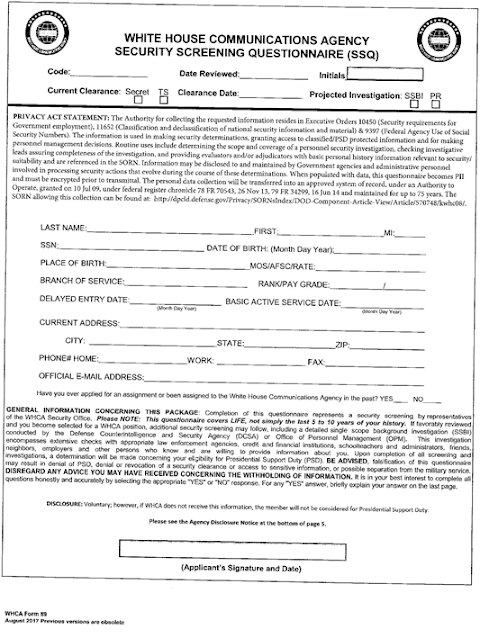
  • Application (SSQ)
  • Last three NCOERs or Counseling Statements
  • Last three APFT (with body fat worksheet if applicable)
  • Current SRB


Everyone selected to work at WHCA receives special duty assignment pay and a civilian clothing allowance. They serve a minimum of three years in a presidential support duty and are eligible to earn the Presidential Service Badge. WHCA trains and works with cutting-edge communications and media technology.


Thursday, April 4, 2024

Detachment 3 “Cadre/Creed”by Don Cammel


Detachment 3 “Cadre/Creed” 

    Main entrance to Site R and access road to Creed Tower

Elevation
 1,516 feet (462.08m)
Location
Location
 Adams County, Pa
Established
 1962
Coordinates


Site 6-Detachment 3 “Cadre/Creed”

By Don Cammel

DCSU one of the three operating elements of the White House Communications Agency was headquartered at nearby Camp David, and had 4 detachments, one at Camp David (Cactus), one at FEMA Special Facility near Berryville, VA (Crystal), one located at the Reno Reservoir (Cartwheel) just off Wisconsin Ave, in the DC area, and Site R (Raven Rock) (Cadre).

All of these locations were manned 24/7 from the late 1950’s to serve as Emergency relocation sites for the President and White House Staff. They remained operational until about April 1970, and then were reduced to “mothball” status over the next several decades.

Don Cammel was assigned to Detachment 3, DCSU located within Site R and the remote microwave silo at nearby Creed Tower. The total Detachment was about 20 people, and from its inception until closing, the total number of people assigned to this unit was probably less than 40 people. It was often a boring assignment, but living in the small rural community near Blue Ridge Summit and Gettysburg had a lot of benefits.

WHCA personnel from Detachment 3 also maintained the communications installed at the Eisenhower farm in Gettysburg Pa. All of Detachment 3 also participated in worldwide travel in support of all WHCA deployments for the President and others as directed.

The USSS CP at the Eisenhower farm in Gettysburg PA


CREED Tower was a part of the WHCA hardened microwave network locations providing connectivity for the President to Camp David, Corkscrew, Cannonball, Cowpuncher, and Crystal East/West towers in the event of a national emergency

Construction of Creed tower and the C adre facility within Site R  was completed during the mid-50 and early 60’s.  Creed tower had eight floors plus two levels of Plexiglas which covered the microwave dishes and other antennas. 

Cross Section view of Creed Tower


Site of Creed Tower near the main entrance to Site R

The tower only had the two top levels above ground. Creed Tower was a separate facility near Site R which housed all of the WHCA microwave equipment as well as the HF and FM radio equipment, and had a separate entrance into the tower through its own blast door and tunnel at the base of the tower.

Site 6 Cadre (Site R, Blue Ridge Summit, PA.)

The site that was codenamed Cadre was built as part of the Site R underground complex.  The Cadre facility consisted of the WHCA switchboard and the communications center. 

The West Portal A and B entrances to Site R

 Site R was the designated relocation site for the Pentagon, and was under the control of 7th Signal Command, located at Fort Ritchie, MD. The WHCA DCSU Det 3, was a tenant activity located inside the Operations area of Site R.

Inside Site R, WHCA maintained the Presidential Office Suite and Quarters for relocation of the President.  WHCA also had an admin area for use as the detachments office, a switchboard room, Commcenter and Crypto area, plus a small dining room with private cooking facilities for the White House Mess to cook meals for the relocated Presidential party.  This area was a very sterile looking underground office environment, black asbestos tile floors, dropped faded white ceiling tiles, and often very noticeable air handlers moving fresh air about the facility.      

The makeup of the detachment consisted of about 3 or 4 switchboard operators, 3 TTY Commcenter operators, 2 COMSEC repairmen, and our OIC, an Army CWO and NCOIC for inside Site R.   We had a supply person, and about 10 people at CREED with various radio skills in both FM base stations, HF radio, and microwave.

The switchboard at Site R was one of the very first ESS Digital switchboards, and the most obvious distinction was very noticeable immediately….NO CORDS!   The Operator would see an LED read out of the party calling, answer the call, and then push an extension button or trunk line and make the connection.  Once the call was connected, the operator was now completely OUT of the call.  The users could “flash” back to operator, but in order to reconnect to someone different, it was often easier to hang up and restart a new call.   Since this switchboard was going to be used for the President in time of crisis, and only a few people trained, the section was often not able to travel because of manpower requirements to always keep two trained people off travel status. CWO Frank Sisco, started an aggressive cross-training program, and all the Commcenter, COMSEC, and people working inside the complex became very efficient at operating this system.   We had Position 17 and 18 of the ANMCC Fort Ritchie switchboard, and our positions were remoted to our own facility, we never interfaced with the other 16 positions.   There were so many “gee-whiz features” we discovered new applications every day.  You could place a call, receive a busy signal, and initiate a “Camp On Busy” feature where both parties would be connected when the call was finished.  This always added confusion, and early versions of Call Forwarding, and very robust in creating group conference calls, but difficult to release individuals from such conferences.   We had to put in a retro-system to transfer all the ESS 4W circuits with relays, to traditional 2W circuits and have a 19in rack of relays that would allow an umbilical cable to be connected to the WHCA analog mini-board. This was a Giant step backward, but the Stromberg-Carlson system would take 10-15 minutes to reboot during scheduled and unscheduled outages. In my opinion, this was one of the most challenging systems ever used by WHCA and only a few of us were ever involved.

Cadre and and Creed locations at Site R

 Presidential Office Suite and Quarters

WHCA’s designated Office space was located in Bldg. C, and the Presidential Offices and Quarters just down the hallway in Bldg. D.  There were 5 buildings designated from A-E which coincided with the 5 rings of the Pentagon.  Each of the building was 3 stories tall and there was a freight elevator near the cafeteria, and a small private controlled elevator for the Presidential Suite. 

The President’s office had a balcony, overlooking the ANMCC War Room, which was located down the hall in the 'D' corridor. The living quarters were across the hallway from the office space. Every Friday, we had a cleaning schedule to vacuum and dust the POTUS Suite and Office. I remember there being one of the first King Size beds I had ever seen.

The original furniture was chosen based on Jackie Kennedy's preferences. One piece that stood out was a wicker rocking chair, which seemed somewhat out of place amidst the otherwise bland surroundings. (It was one of those standard LBJ high-back chairs with the Presidential Emblem in the working area.)"

One afternoon, we were informed of an upcoming dignitary tour and instructed to remove the rocking chair from the suite. We managed to stash it in a mop closet, and the following week our CO at the time sought guidance on what to do with it

The order was to 'get rid of it.' The challenge lay in removing 'property' from Site R, considering we had to pass through a double blast door or our special vehicle access point. We cleverly packaged the chair in brown paper, labeled it as a package for 'Armed Forces Courier' service, and used our 'Courier Card' to successfully transport it out of the facility.

I'm certain that someone enjoyed the chair for years afterward, and no questions were ever asked. We encountered a similar situation when we needed to transport two cases of LBJ wine urgently to Camp David. It became something of a game to figure out how to circum-navigate the Military Police enforcing the rules." 

It is rumored that the Presidential quarters was nicknamed the 'Lucy and Desi' suite, their television series was actually better decorated than the bare walls of the quarters. However, after the events of 9/11, WHCA underwent significant upgrades in communications, including substantial changes in internet usage. This might explain why that particular nickname could have been fitting for someone in 2000. It's possible that modernization efforts extended to the POTUS quarters as well.

In all of these shelters, the office supplies seemed to be stuck in the late 1950s and early 1960s. Carbon manifold sets, rock-hard bottles of White Out, new Remington 550 manual typewriters, and plenty of steno pads were abundant. Typewriter ribbons were in ample supply, though well past their expiration date by 1970. We had many 2 ½ lead pencils with hardened erasers, rusted paperclips in the box, and serious doubts about how stenographers and secretaries could function properly.

The most modern equipment during that time was the introduction of the IBM Selectric typewriter, of which we had two. They utilized a special 'type ball' for all-capital lettering, possibly for use in a teleprompter. Dignitaries assigned to deploy to Site R often came for orientation tours, primarily from the USSS, WH Staff, and Military Aides.

DSCU Detachment 3 personnel were all Active Duty Military, but never wore uniforms.  There were up to 2500-3000 people at times working inside Site R, and most were Active Duty sent on a rotating basis from the Pentagon for 14 days at a time. 

Access to the Presidential Suite was VERY controlled and only WHCA personnel, visiting USSS, and occasional WH Staff on orientation would occasionally gain access for a tour or briefing inside the suite.

We manned our office space 24/7 like “Firemen in the Firehouse”. Once the day crew departed around 4:30 pm, you would basically clean up the dining room (Pinochle Game Daily), and then we would use the kitchen to cook whatever food we brought for our 24 hour shift.   On duty personnel were allowed to sleep at night once the check list had been completed. Television with local DC and Baltimore. stations was available, and there was a hide-a-bed that we were allowed to use.

One night Don was all comfortable in the scratchy US Army issue wool blanket about 1:30am, and our doorbell rings. “I put on my pants and shirt, combed my hair without a mirror, and go look outside through the peep hole. All I can see is the chest of a USAF uniform and a guy pacing back and forth with a couple of strap hangers. 

I opened the door, and while doing so, a USAF BG attempted to push the door open as I pulled it shut behind me.   I asked him if I could help him, and he announced, “I am here for my tour of the Presidential Suite”.   

At this point he had no clue that I was a US Army Active Duty SSG (E-6), and I told him, I didn’t get word on your visit, the area is controlled by the White House Military Office, you can “Dial “O” on the phone here by the door and reach the Camp David  Operator that can connect you to the WHMO stand-by Officer. 

He then started out…..this is “B.S”, I am a ONE STAR GENERAL, and the ranking person inside Site R for this week.   You will regret not granting me access, this is wasting my time.  Sorry, General, but I have my rules.  Who is your boss?   Chief Warrant Officer Frank Sisco….was my reply.   And what is your title?   I told him I was an Army SSG.  He then went wild and told me that I would regret not allowing him access.   He made the call to the Camp David Operator who connected him first to the WHCA Duty Officer, and then the Situation Room, and was told to call back during core hours the next day!   He was totally steamed when he departed.

The next day, I received a call at home from Frank Sisco and he was laughing about the events of my shift.  He had been on multiple calls from WHMO and DCSU Headquarters during the day, and they were proud of my actions and laughing about it. 

This guy never did get his tour and after his rotation back to the Pentagon, they arranged for a tour of the next person on the roster and made sure he told the other General we honored the request.   I am sure he was steamed again! Just another day inside the mountain. “

It's worth noting that there were no windows due to being 768 feet underground, and the same black asbestos tile floor was present, which we stripped and buffed on a monthly basis. Upon entering, the lack of occupancy and poor air circulation always seemed to produce a musty odor. Other operational areas weren't as bad, but the humidity remained quite high, resulting in oxidation on door hinges and 19" equipment racks.

In 1970 the WHCA microwave network and the PEF locations were deemed obsolete and WHCA’s presence was no longer needed. Detachment 3 personnel were re-assigned to form the new CCT’s at Fort Ritchie, Camp David, San Clemente, and Key Biscayne and to other WHCA units. “During the early 1970s to the mid-1980s, Fort Ritchie Detachment/CCT had Site R responsibilities. The CCT frequently conducted short-notice deployments into the Site, periodically checking RF and phones. There was not anything remarkable about the quarters or decorating colors. The surroundings were quite drab, but things may have changed after the CCT closed Fort Ritchie and relocated to Luke AFB, AZ. 

Travel and Trip support

Det #3’s personnel were also required to support Presidential travel worldwide.

"Acoustical Couplers”-Don Cammel

My first overseas Presidential Trip was with LBJ to El Salvador in Central America in 1968. We actually tested three systems using the GE Acoustical Coupler, the DEX-1, and the XEROX version of the DEX-1 our team  set up the Comm. Center in the new U.S. Embassy. Dan Schottlekotte was the 13A technician and he worked on a completely isolated system in his hotel room when we had lots of failures. It was then discovered that the built-in cradle to accept the handpiece was often different than the traditional WECO 500 set. This allowed for ambient noise from air-handlers, even conversation and sometimes "feedback" to interfere with the connection.

The Commcenter was set up in a storage room that had a couple of large power transformer/rectifiers which gave off a very loud annoying background loud hum. We had a difficult time getting a standard TTY line working, so we attempted a test of the GE Acoustical Coupler. We would get a few lines of good copy and then it would drop out. Dan S, in his quiet thinking process, determined that the physical seal of the handset in the coupler base was not keeping out the ambient noise of the electrical rectifiers and interfering with our connection. Out came a roll of Gaffers Tape, in an attempt to seal the space around the handset. You had to tape it fast, or you would lose the connection and have to start over. This effort continued for several hours during the pre-visit. We tried covering the coupler with a pillow without success. The next attempt was to wrap a washcloth around the handpiece with some improvement, but we need a thinner fabric to create a seal.   We then tried very thin black socks and wrapped them around the handset before placing it in the coupler and then closed the cover. This solved the problem, and we were able to make everything work. We never did get the dedicated TTY line working. 

We then bypassed the acoustic receiver on the GE unit, and we had a hard wire DC Voltage signal direct from the KW-7's with a fabricated harness so we used the GE Acoustical Coupler for the entire visit, including the transmission of the morning PDB, which needed about 3 transmissions to fill in the occasional errors and splice the TTY tape to make a final good copy. I still can hear the hum from that rectifier that bothered us for the entire week.

Graphic Sciences would never allow us to do the same thing with the DEX series machines. That is my recollection from a non-techie, who always got in trouble with the Maintenance guys and reminded I was an "Operator"!

I was the junior person in the Commcenter on the El Salvador trip and working the midnight shift. One night around 2am, we had a TOP SECRET message on the TTY arrive with IMMEDIATE precedence and one of the addressees was Walt Rostow, the National Security Advisor to LBJ. The same role was made famous by Dr. Kissinger with Nixon and other administrations. Mr. Rostow had elected not to stay in the same Staff Hotel, and the State Department rented a mountain chalet overlooking the ocean for him, which was about 30 miles away, but a minimum of a two hour ride.

I was dispatched to deliver this message, and the Supervisor mandated that since it was TOP SECRET, I should carry the standard issue Commcenter pistol, a Colt Detective Special with a 2" barrel and 5 rounds. After a scary ride through crowded streets and narrow mountain roads, I finally arrived at Mr. Rostow's temporary quarters for the visit. It was now approaching 4am.

The State Department and USSS guards pointed me to the bedroom, and I walked in and knock on the door, only to find him slumped over his desk in in pajamas. He of course was startled, but I delivered the message, and announced that I would be waiting in the foyer in the event he wanted to dispatch a reply, to please let me know so I could return to the Embassy.

I couldn't help but notice, he was using an old fashion fountain pen, and it was in his PJ pocket, and he had a big circle of "black" ink about 5" in diameter on around his pocket. After a few minutes he comes out, has the message and instructs me, please bring this back at 7am. Quickly, I advised him, I will just stay here in the foyer until 7am, because it is a 4 hour round trip to and from the Embassy. He thought for a second, and I got my first lesson on downgrading. He placed the yellow TTY copy on the table, took his ruler and held it in place and tore off the top and bottom headers of the message which contained the RED letter with the classification markings. He then folded up the text portion and placed it in his pajama pocket, reached for his Presidential Zippo lighter, took the two strips with the classification, and lit them on first and dropped them into the large ash tray. He then told me to have a safe trip back to the Embassy.

I got back to the Embassy, and explained the situation, and the Trip Officer and others really struggled with how to record what had actually happened to the message for the logging purposes. I was an E-5 at the time, and I wasn't going to challenge the National Security Advisor on how to handle a message in the middle of the night! That was actually the first TS message that I ever touched, and have to say, I still remember it well. · 


Sunday, March 3, 2024

Early Presidential Emergency Facilities-Revised


Presidential Emergency Facility Sites
Cannonball Tower on Cross Mountain Pa.(note the tower on the summit)

Site Code Name
Other Name
Location
Cactus
Camp David
Thurmont, Maryland
Cannonball
Cross Mountain
Mercersburg, Pennsylvania
Cowpuncher
Martinsburg
Roundtop Summit, WV
Cartwheel
Fort Reno
Washington, D.C.
Crystal
Mt. Weather
Berryville, Virginia
Creed
Site R (Raven Rock)
Waynesboro, Pennsylvania
Corkscrew
Lamb’s Knoll
Frederick County, Maryland
Crown
The White House
Washington, D.C.


Continuity of Government (The Undisclosed Location Disclosed)


When terrorists struck the morning of September 11, 2001, Vice President Richard Cheney was whisked from his Washington office to a secure “undisclosed location.” Cheney’s undisclosed location is rumored to have been a Cold War era facility buried deep beneath Raven Rock Mountain near the Pennsylvania-Maryland border. Located east of Waynesboro, Pennsylvania, the Raven Rock Military Complex is also known as Site R and it was designed as the Alternate Joint Communications Center (AJCC) where senior military officials were to be taken in the event of a nuclear attack. Site R was among the first relocation facilities built in the 1950s and early 1960s as federal planners conceived of and realized a Federal Relocation Arc extending outwards from Washington where key documents and people could be sheltered during and after a nuclear exchange.

The Text Content of an article in The Hagerstown Morning Herald, July 25, 1977 is:

That silo isn’t for cattle

To the casual observer driving down Maryland Route 67 southwest of Boonsboro, the distant object on lop of South Mountain looks like a farmer’s silo.

Closer inspection would reveal that it is indeed a silo, but not the kind used to store cattle feed. This particular silo belongs to the US Navy and is one of at least three similar Top Secret Navy facilities in the Tri-State area. Two other silos are located atop mountain ridges in Pennsylvania and in West Virginia. Just what goes on inside the silos the Navy isn’t saying?

After repeated requests to the Navy for information on silos spokesman Ron Black gave this reply, “No information can be released its classified”.

According to residents of the area the Boonsboro silo was built sometime during the late 1960s. Like the others it is served by a narrow but a small road complete with guard rails. Although the Boonsboro silo is still in daily use the one located on Cross Mountain just inside the Pennsylvania state line north of Mercersburg was open earlier this year. The high chain link fence surrounding it has been ripped down and a heavy steel blast door leading into the silo was ajar recently. The silo is equipped with an elevator to each of its eight floors. Although much of the equipment inside has obviously been removed, much remains... Heavy air conditioning equipment, air filters and electrical panels are still in place. In an apparent effort to blast proof the equipment the panels arc mounted on heavy springs with coiled wire lo take up movement. The silo apparently housed offices. On the ceilings are fluorescent lamps. The floors are tiled.

Whatever goes on inside the silos it is not related to the Alternate National Military Command Center near Blue Summit Pa.? Sources at the Pentagon responsible for The Rock say they do not know anything about the Navy silos.

And until the Navy decides to talk its mysterious silos will remain one of the government secrets in the area.

The White House Communications Agency (WHCA) would play a key role in the implementation of Continuity of Government (COG) plan. The Continuity of Government is the principle of establishing defined procedures that allow a government to continue its essential operations in case of nuclear war or other catastrophic events. In 1954 a plan to implement emergency communications was developed and presented to the Secretary of Defense. A major element of this plan was an emergency relocation strategy which provided for the dispersal of essential elements of the Federal Government. This plan also addressed the necessary communications need by the President, and other Governmental agencies. Because little or no reliable communications were available in the emergency relocation areas, the Army Signal Corps was tasked with the planning, designing, engineering, installing and maintaining the communications support of this program.

These sites were constructed very quietly and actually hidden from the Public but in reality were in plain sight and visible from miles around, several of these Continuity of Government sites were built in Maryland, Pennsylvania, Virginia, West Virginia, and Washington, D.C., these sites were designed to house large numbers of federal officials in underground bunkers while the exposed concrete towers that housed sophisticated radio equipment kept communications open among the survivors, the military, and civilian populations. These were among the first relocation facilities built in the 1950s and early 1960s as federal planners conceived of and realized a Federal Relocation Arc extending outwards from Washington were key documents and people could be sheltered during and after a nuclear exchange.

The Federal Relocation Arc included above- and below-ground sites located within a 300-mile radius of the nation’s capital. These sites were administered through the Executive branch’s White House Military Office (WHMO), while the communications personnel were attached to the White House Communications Agency (WHCA). The Early Presidential Emergency Facilities (PEF) were literally holes in the ground, deep enough to withstand a nuclear blast and outfitted with elaborate communications equipment, funds to support the sites wound their way through a circuitous route in the Defense Department. All oversight for these facilities originated in the White House Military Office.

These sites in the Arc were the key to ensuring open lines of communications were built in a network that relied upon line-of-sight microwave technology, i.e., each transmitter and receiver had to have an unobstructed line-of-sight between its nearest neighbors for the network to be viable. These microwave hops were usually no more than fifty miles apart. I’m assuming that when they did their studies they knew specifically where the main terminals were going to be and they looked for locations that they had line of sight.

The microwave system connected the primary relocation facilities and key to this new communications network plan were:

  1. The White House and Camp David near Thurmont Md.
  1. The hardened Alternate Joint Communications Center (AJCC) at Ravens Rock, near Blue Ridge Summit, Pa. and Ft Ritchie, Md.
  1. The hardened Emergency Command Post and Relocation site for the Executive Branch of the Government at Mount Weather, near Winchester Va.
The microwave network would provide non-secure voice circuits terminating on manual switchboards, to be located at each of the primary relocation sites. The network would also provide secure teletype including the famous Moscow to Washington Hotline, and the Red Phone voice circuits between the President and the heads of all sensitive agencies. Finally the network would be capable of carrying broadcast video interfacing with the Emergency Broadcast System.

Cannonball Tower atop Cross Mt. near Mercersburg PA

Access rd. to Cannonball Tower (2010)

The concrete microwave towers would become known as the Presidential Emergency Facilities (PEF) and was built during the late 50’s early 60’s. Construction included the cylindrical tower and in some cases underground bunkers used to relocate the President, Vice President, Secret Service, and key members of the White House Staff. These facilities were all capable of withstanding a nuclear attack. The towers housed all of the communication equipment necessary to provide the emergency voice, radio and teletype communications required to continue inter-departmental communications.

Each of the sites included a 100-foot cylindrical tower, two-thirds of which was solidly built to house transmitters and receivers, supply rooms, and quarters for the skeleton staff which oversaw the facilities around the clock. The upper portions of the towers held parabolic antennas aimed towards the next facility in the network. These antennas were shielded by radio frequency-transparent Plexiglas that protected the antennas from the elements and concealed them from view while enabling radio waves to pass through. Some of these towers were connected to elaborate underground bunker complexes and entry to all of the facilities was through massive blast doors.

The microwave network which would connect Mount Weather with Camp David and Site R would be operated and maintained by the White House Army Signal Agency (WHASA). WHASA already had personnel in place at these principle relocation facilities and in 1962 would become the White House Communications Agency (WHCA). The communication network was developed, installed and maintained by WHCA, and all of the towers in this network were staffed by WHCA personnel on a continuous basis.

Locator Map

Location of the Presidential Emergency Facilities.
Because the towers were highly visible yet top secret, no official explanation of their functions were ever released. Locals near the Cannonball Tower and Camp David’s Cactus site were believed to be water tanks. People around Mercersburg thought it was a water tower. We used to buy water from the City of Mercersburg and we had a water tanker that we’d haul water back up to the mountaintop so they saw that and they saw the water tanker and they just figured that they were getting better water pressure that way.

According to Cold War communications enthusiasts, the concrete towers were designed to deflect the force of a nuclear blast, all of the towers were constructed of solid reinforced concrete and the air system was filtered so that if anything did happen all the he air intakes would be shut down and you had a filtration system. Everything was engineered with the concrete structure able to withstand a nuclear attack. All of the towers were located in remote areas so the effects of a nuclear blast would be minimal. Now there was always a possibility of problems with the antenna decks but we had spare microwave dishes that could be put in temporarily if a blast was close enough to tear off some of the dishes. We had spare dishes that we could replace any damage in a fairly short period of time.

Sites like Cactus, Crystal, Creed, Cartwheel, Corkscrew, Cowpuncher, and Cannonball were critical Continuity of Government sites during the Cold War. Their highly visible towers became part of an industrial landscape defined by telecommunications infrastructure essential to the information-based third industrial revolution. Beyond their highly function roles in the ubiquitous military industrial complex, they also were places where people worked and lived daily.  I had a lot of fun even though it was a job, I just had had a lot of fun working there. You know, the funny thing about it, I worked with people that were at Crystal, and Cadre for years after we closed down those sites. But we never discussed what went on at those locations.
.
The microwave systems were the major reason for the construction of the towers; however each tower was equipped with other radio systems. There were VHF FM base stations installed for the use by the Presidential motorcade. The Secret Service and the White House Stall also used these 2 way FM handheld mobile units. There was also an HF single sideband (SSB) radio system installed in every location capable of interfacing with the Air Force One, and other airborne commutations centers like Silver Dollar worldwide. The SSB radios could transmit voice on the upper sideband and TTY on the lower sideband. Finally UHF radios to communicate with Marine One.

We closed down Cannonball in 1970 shortly after significant upgrades were installed. Changes in communications technology and Continuity of Government plans obviated the 1950s facilities. Most of us were transferred to other WHCA facilities. 

Mt. Weather remains a top secret facility and Cannonball was abandoned with its tower exposed to the elements and vandals. The tower at Cactus (Camp David), and Cowpuncher Tower were demolished and Creed Tower and both Crystal Towers have been abandoned in place at Site R and Mt. Weather respectively.

The communications equipment at Cannonball, Cowpuncher and Crystal facilities was removed in the mid 1970’s, Cadre/Creed was deactivated and all of the PEF tower facilities were officially closed on or about 1990.

The emergency Continuation of Government plan was approved in 1954 and evolved into the seven locations that that would become the core Presidential Emergency Facilities (PEF) they were all cylindrical towers. The primary source of voice communications was the use of microwave radio systems interconnecting these seven locations. The microwave routes were installed to connect relocation sites at Mt. Weather, Camp David and the Pentagon (Site R) directly to the President wherever he might be at the time of the emergency.

WHCA Communications Facilities

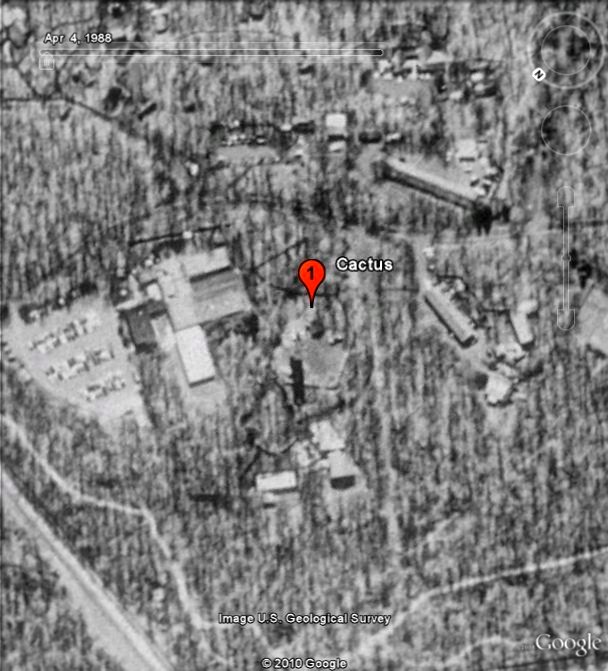
Site 1 Cactus (Camp David, Thurmont, MD.), the tower had eight floors plus two levels of Plexiglas to cover microwave dishes and other antennas. The Tower was above ground level. 

Barracks, Mess Hall, and Cactus Tower (1988)

Site 2 Cannonball (Mercersburg, PA.), the tower had eight floors plus two levels of Plexiglas to cover microwave dishes and other antennas. The Tower was above ground level.

Cannonball Tower in Mercersburg PA

Site 3 Cowpuncher (Martinsburg, WV.), the tower had eight floors plus two levels of Plexiglas to cover microwave dishes and other antennas. The Tower was above ground level.

Cowpuncher Tower in Martinsburg WV

Site 4 Cartwheel (Ft Reno Park, Washington DC.), the tower had eight floors plus two levels of Plexiglas to cover microwave dishes and other antennas. The Tower was above ground level.

Cartwheel Washington DC


Site 5 Crystal, East and West Towers (Mt Weather, Winchester, VA.), both towers had eight floors plus two levels of Plexiglas to cover microwave dishes and other antennas. Both of the towers only had the two top levels above ground and were accessed through Mt. Weather.

Crystal West Tower (2015)

Crystal East Tower (2015)

Site 6 Creed Tower (Site R, Blue Ridge Summit, PA.), Creed tower had eight floors plus two levels of Plexiglas covered microwave dishes and other antennas. The tower only had the two top levels above ground. Creed Tower was a separate facility near Site R which housed all of the microwave equipment as well as the HF and FM radio equipment and had a separate entrance into the tower through its own blast door and tunnel at the base of the tower.

Entrance to Creed Tower near Blue Ridge Summit PA


Site 7 Corkscrew (Boonsboro, MD.), the tower had eight floors plus two levels of Plexiglas to cover microwave dishes and other antennas. The Tower was above ground level.
Corkscrew near Boonsboro MD

Government Relocation Facilities

Relocation support functions in the event of a nuclear attack, was to be provided to key members of the Government. In terms of accommodations for potential presidential habitation, primary locations such as Mt. Weather (codenamed Crystal), Greenbrier (codename Casper), Camp David (codenamed Cactus), and Site R (codenamed Cadre) were initially decorated in the 1960s with fairly basic colors, lacking any exciting elements. These areas remained untouched for many years, well into the Reagan administration, resulting in everything being essentially brand new.

Secondary locations with furnished quarters included Boonesboro, MD (codenamed Corkscrew), and Tinley Park (codenamed Cartwheel).

Cactus (Camp David Thurmont Md.), Cactus had a two-level bunker that was adjacent to the microwave tower. The WHCA switch board and communications center was located within the bunker as well as sleeping quarters, water, food, and necessary supplies needed for survival. This facility was capable of accommodating around one hundred individuals,  

 Aspen Lodge with Cactus Tower

In 1959, President Eisenhower commissioned the construction of a secret bomb shelter at Camp David, designed as a Presidential Command Center in the event of nuclear war. Concealed beneath seemingly innocent guest cabins and carved out of rock, this underground facility cost 10 million dollars at the time. This bunker was built near Aspen Lodge specifically for the President and First Family.

Personally, I can provide some insight into the POTUS apartment in the bunker at Camp David, which featured neutral-colored paint, tile, and carpet. Considering the involvement of the Navy, it is reasonable to assume that the décor in their facilities would have seen more updates compared to other sites.

Near the old Hagerstown Drive-in Theater, there used to be an upscale furniture store that had a longstanding association with Camp David. During each change of administration, a lady would be escorted into the "key cabins" to make alterations. Since this fell under the purview of the Naval Support Unit, it wasn't particularly visible. However, I often wondered if this "consultant" ever consulted the new occupants about their preferences or presented pictures to the WHMO or other staff members. Unfortunately, that store closed down approximately five years ago. Locals in the area were aware that the store supplied Camp David, and while items were purchased, when replacements were made, the old furniture, which had seen minimal use, was recovered, and removed. These pieces would then appear in the store's consignment area, without any signs indicating their origin. However, if you asked, they would gladly inform you of their source.

Layout of Aspen Lodge

There was a Command Center strategically located underneath Aspen Lodge. Accessible via elevators from various points, including the President's bedroom, it would serve as a hub for crucial decision-making during times of crisis.

Equipped with advanced communication technology, the Command Center allowed the President to be broadcast globally from Mt Weather  and connected directly into the Emergency Broadcast System (EBS).Also the WHCA microwave network provided voice and secure TTY with the Pentagons War Room at Site R for military communication in the event of war. To maintain its secrecy, extensive efforts were made to conceal the facility before a visit from Soviet Leader Nikita Khrushchev in September 1959.

In preparation for Khrushchev's visit, laborers worked tirelessly to cover the underground Command Center, constructing a large deck to hide the cavernous hole. Unbeknownst to Khrushchev, he stood atop a presidential relocation site as he posed for photographers on the deck.

During Khrushchev's visit, the existence of the communications tower, codenamed Cactus, was disguised as an ordinary water tower using Water Works signs. The communications tower, equipped with Microwave antennas, transmitters, and receivers, housed a detachment of the White House Communications Agency (WHCA), and had multiple floors and an underground section capable of accommodating up to 150 support staff. Though the tower (Cactus) has been demolished, the underground command center at Camp David remains intact.

This underground facility was part of a larger microwave network connecting various underground locations to Camp David. Other sites in this network included Crown (The White House Situation Room), Crystal (Mt. Weather) providing audio and video to the Emergency Broadcast System (EBS), and Creed/Cadre (Raven Rock Mountain Complex) connecting the War Room of the Pentagon.

Aspen Lodge swimming pool

When President Nixon decided to add a swimming pool outside the Aspen Lodge, the location he selected was directly over the bomb shelter. "Orange One", as it was called, had to be reinforced for a cost of $261,000.the money for this came from secret military funds.  The interior of the underground shelter was also redone with new beds, bedspreads, pictures, paint, and office furnishings.

When President Carter expressed concerns to Bill Gulley from the White House Milatary Aides Office (WHMO) about the cost of Camp David and considered shutting it down,  Gulley asked the President if he knew what was there.  President Carter replied "cabins".  Then Gulley "explained to him about the bomb shelter, the emergency communications center, and other facilities."

Cadre (Site R, Blue Ridge Summit Pa.), Cadre was a part of the underground facility at Site R. and was located on the 2nd floor of building C. This area housed the WHCA switchboard and communications center plus the Presidential Quarters and Office if needed due to any emergency relocation.

The WHCA space at Site R. was designated 3C58, and the POTUS office with a balcony, overlooking the ANMCC War Room, was located down the hall in the 'D' corridor. The living quarters were across the hallway from the office space. 

Layout of site R


The WHCA mission at site R was discontinued in early 1970. The Detachment was moved to Ft Ritchie. “During the early 1970s to the mid-1980s the Fort Ritchie Det/CCT had Site R responsibilities. The CCT frequently conducted short-notice deployments into the Site, periodically checking RF and phones. There was not anything remarkable about the quarters or decorating colors. The surroundings were quite drab, but things may have changed after the CCT closed Fort Ritchie and relocated to Luke AFB, AZ. 

Entrance to Site R (Cadre)

Cadre had no windows due to being 768 feet underground, and the same black asbestos tile floor was present, which we stripped and buffed on a monthly basis. Upon entering, the lack of occupancy and poor air circulation always seemed to produce a musty odor. Other operational areas weren't as bad, but the humidity remained quite high, resulting in oxidation on door hinges and 19" equipment racks
Corkscrew (Boonsboro Md.), Corkscrew had a two level bunker that circled the towers base. The WHCA communications center was located within the bunker.

Corkscrew (Boonsboro Md.)

The President’s Office and Living Quarters were located in pie shaped rooms on the lower level of the underground facilities. This site was also furnished in the 1960’s and remained untouched for many years.

Crystal (Mt Weather, Va.), Crystal was part of the Mt. Weather underground facility. The east and west towers were accessed by inter connecting tunnels. The WHCA switch board and communications center was part of the underground facility and located in Building 13. This Facility also interfaced directly with the Civil Defense Emergency Broadcast System (EBS) located at Mt Weather allowing video interface with the WHCA microwave network.

Mt. Weather retained some serious 1960s-style furnishings that still appeared brand new in the 1980s.,


Mt Weather (Crystal West and East Towers)

Cartwheel (Washington DC), Cartwheel had a two level bunker that circled the Towers base. The WHCA secure switchboard and communications center was located within the bunker.

Cartwheel (Fort Reno, Washington DC) 

The President’s Office and Living Quarters were located in pie shaped rooms on the lower level of the underground facilities. This site was also furnished in the 1960’s and remained untouched for many years.

Crown (Washington DC). The White House

The White House (Crown)

The communications equipment at Cadre, Cannonball, Cowpuncher, and Crystal facilities was removed in the mid 1970’s. Primarily because of advancements in communications technology, these fixed locations became obsolete and were replaced in 1970 by strategically placed Communications Contingency Teams (CCT) at San Clemente CA, Key Biscayne FL, Ft Ritchie MD. and Andrews AFB MD; they were very mobile and could be deployed at a moment’s notice.

The microwave systems between Cactus, Cartwheel and Corkscrew were left in service at least through 1986, but they were only used as backup for the landlines to the White House. At least one system of the Raytheon KTR-1000 in each route was upgraded to a newer version that was partially transistorized but the rest of the systems remained all electron tubes.

During the Reagan Administration a new UHF system (AN/GRC-103 UHF FM radio with TD-660 Multiplexer 24 voice channels) was installed between Cartwheel, Corkscrew, and Cactus, but the microwave still remained operational. Cadre/Creed, although inactive all of the equipment in the tower was still operational and fully maintained.

All of the microwave routes were phased out in the early 1990's I can only assume that the FAA took over Cartwheel and Corkscrew at this time and when the tower at Cactus was demolished this brought to an end the communications network that started in 1954 and played such a major role in the Cold War.