Search This Blog

Wednesday, November 15, 2023

The Reagan Presidential Library visit (2012)-Revised


The Reagan Presidential Library
Main Entrance to the Reagan Library
Type Of Activity
Visiting the Reagan Presidential Library
Location
Location
Simi Valley CA
Date of Activity
May 6 2012
Coordinates


 In May of 2023 my son (Robert) and I flew to Los Angeles to tour the Reagan Presidential Library in Simi Valley, even though I was no longer a member of WHCA, much of the communications used in 1980 had not changed since I left the Agency in 1973. There was a working teleprompter that I checked out, a Camp David exhibit, and Reagan Ranch (Rancho del Cielo) exhibit. It was a real pleasure to tour the museum and the Air Force 1 Pavilion, Where I could once again, see the oval Office, Air Force One (27000), Marine One, and the Presidential Limo.

The Ronald Reagan Presidential Library and Museum, is a prominent and well-regarded institution dedicated to the life and legacy of the 40th President of the United States. The Reagan Presidential Library is a must-visit for anyone interested in American politics and history. It offers a comprehensive look at Ronald Reagan's life, presidency, and the significant events that occurred during his time in office.

THE REAGAN PRESIDENTIAL LIBRARY AND MUSEUM

Main Entrance

Entering the Library with the statue of President Reagan at the entrance

The Ronald Reagan Museum houses a vast collection of artifacts, documents, and interactive exhibits that provide insights into Ronald Reagan's personal and political life. from his early years to his Hollywood career, his time as Governor of California, and his two terms as President We were able to explore various aspects of his presidency, from his economic policies to his stance on foreign affairs. There are 18 galleries that pay tribute to America’s 40th president and his accomplishments by capturing his patriotic spirit, his respect for individual liberty, his belief in global democracy and his support of economic opportunity.

Views of the surrounding area from the Reagan Library


The Museum is situated on a stunning hilltop location with picturesque
views of the surrounding area. The setting alone is worth the visit, as it provides a serene and peaceful atmosphere. The Reagan Library rests on a majestic hill overlooking the breath-taking topography of Southern California.  The 100-acre campus, with picturesque views reaching out to the Pacific Ocean, lush gardens, and a serene setting, pays tribute to one of the nation’s most liked leaders.

Teleprompter, Camp David & Rancho del Cielo Exhibits

I had to try using the Teleprompter 


Bob chose to take a horse ride at Rancho del Cielo

Ronald Reagan always loved the outdoors and made sure to make time for nature during his presidency. Camp David and Rancho del Cielo, his two retreats while in office, allowed for the president to relax and ride his beloved horses. Rancho del Cielo, also known as the Western White House, was the private residence of President and Mrs. Reagan located in the Santa Ynez Mountains of California.

My home for five years

The Camp David Exhibit

Camp David is a presidential retreat, its facilities maintained today by the US Navy Seabee’s. Camp David was built during the Roosevelt administration and allowed for seclusion while still having quick access to the White House in Washington. The President could also host heads of state and other guests in a secluded and peaceful environment.

I was assigned to WHCA at Camp David for five years as a microwave radio technician installing and maintaining the M/W, FM radio and telephone systems necessary for daily operations at the facility, as well as supporting the President and USSS when visiting the site.

The Oval Office

The Reagan Library offers a full-scale replica of the Oval Office during the Reagan presidency. Featuring Ronald Reagan's Oval Office desk, this exhibit allowed us to step into the Oval Office and get a sense of what it was like for the President during the time he occupied the office. 

Ronald Reagan's Oval Office desk

Replica of Ronald Reagans Oval Office

Air Force One Pavilion:  

One of the most popular exhibits at the Reagan Library is the Air Force One Pavilion. Opening in 2005, the Air Force One Pavilion features multiple historic Presidential transportation exhibits and the Annenberg Discovery Learning Center, and it is the highlight of the Library. The Air Force One Pavilion at the Reagan Library is one of Southern California’s “must-see” destinations!

The upper floor of this three-floor exhibit starts with the Mezzanine Gallery. The Museum highlights President Reagan’s face-to-face diplomacy with world leaders on economic relations, strategic relations, and arms control as he travels on Air Force One. The Secret Service and their role in protecting the President while he travels displays on a gallery wall on this level.

Air Force One Pavilion
SAM (Special Air Mission) 27000, better known as Air Force One, flew 444 missions and carried seven presidents from 1972 to 2001.

President Richard Nixon first used the plane in 1972, and famously traveled to his San Clemente, California home following his resignation in 1974. 

President Ronald Reagan sent predecessor President Jimmy Carter to West Germany to greet the 52 American hostages freed from Iran in 1981. 

Reagan used Air Force One more than any other president, registering over 660,000 miles aboard the plane. President George H.W. Bush was the last to use the SAM 27000 model as a primary means of transportation, and President George W. Bush was the last to use it as Air Force one when he and First 

Lady Laura Bush flew to TSTC Waco Airport in 2001.

SAM 27000 was retired to the Ronald Reagan Presidential Library and Museum in 2001. See it through the years in today’s gallery.
Telephone Access Panel in the Nose of AF1
There is a small access door in the nose of 27000 where we would plug in the two telephone lines for the aircraft and the ramp phone, a four prong plug, upon all arrivals and unplug at departures.

The second floor of the Pavilion focuses on the history of Air Force One, Explore a 120’ mural which represents all 22 aircraft that has ever flown a U.S. president.  It also showcases the Stan Stokes’ mural, History of the Flying White House, featuring aircraft from FDR’s Dixie Clipper to the current Boeing 747.  

Air Force One Pavilion

We are about to start our tour of AF-1

The Air Force One Pavilion, allowed us to step aboard the actual Air Force One aircraft a Boeing 707 that was used by President Reagan during his time in office. 


 AF-1’s Cockpit
 27000’s (Angel) Radio Room

    The tour gave me a chance to see the Radio Room again, where I had spent so many hours on the ground communicating with 26000 and 27000 from various trip sites around the world, while I was with WHCA It's a unique and immersive experience that gives you a sense of what it was like to travel as the President of the United States and see the many places where he spent time working, meeting with advisors, and relaxing with his family.


The President’s office aboard Air Force One

This Flying White House, tail number 27000, served seven U.S Presidents from 1973 to 2001, including Presidents Nixon, Carter, Ford, Reagan, George H.W. Bush, Clinton, and George W. Bush. For Ronald Reagan, this was the plane in which he hand-wrote many of his speeches, signed important legislation and even officially started the Daytona Beach, Florida NASCAR race via phone.

But the Air Force One Pavilion is about more than just his plane. The lower floor of the Pavilion also has the Marine One Gallery, which showcases President Lyndon Johnson’s Marine One helicopter.

The Cockpit  of Marine One


The interior of Marine One

We were  able to tour the actual Marine One helicopter that flew President Johnson.

Marine One

I am standing near the phone jack on Marine One

 I have a lot of history with this chopper. When I was with WHCA during LBJ’s and Richard Nixon’s presidency, I would plug in the telephone lines at many arrivals and departures including President Nixon’s at the Western White House in San Clemente.

On the Lower Floor It has a presidential motorcade featuring President Reagan’s 1984 parade limousine, and a secret service suburban as part of an exhibit on presidential motorcades, which rounds out the Presidential transportation exhibits. The presidential limousine is always preceded by the lead car, LAPD used a normal police vehicle,  a standard equipped 1982 Chevrolet Impala converted for this purpose. LAPD has also been using two lead Kawasaki  motorcycles to provide additional protection for presidential motorcades since 1976. 

LAPD lead car and lead motorcycles

The USSS’s follow-up Vehicle

The Secret Service motorcade follow-up vehicle, also known as the "Halfback", is a specially outfitted Chevrolet Suburban that follows the President's limousine in the motorcade. It is staffed by Secret Service agents who are responsible for providing additional security to the President and their family.

President Reagan’s parade limousine also known as Stagecoach, was a modified 1984 Cadillac Brougham d'Elegance that is heavily armored, and has a 76 millimeter higher roof, a telephone system, rear bumper platforms and grab bars for security agents as well two special headlights, which were only intended to illuminate the flags waving on the front fender standard holders.

President Reagan’s  parade limousine

We were able to walk around the Limo and could see the vehicle up close, but not close enough to see if the FM radios were installed. The USSS used these radios for the security measures in place for the President's transportation. The limousine did have the phones installed in the rear seat.

President Reagan’s personalized license plate

The Ronald Reagan  Ballyporeen, Irish Pub

The Ronald Reagan Pub is located at the Ronald Reagan Presidential Library and Museum in Simi Valley, California. It is a popular spot for visitors to the library, and is known for its casual atmosphere and pub fare. Experience the actual Irish pub from Ballyporeen, Ireland when he visited on a diplomatic trip in 1984 which now sits within the Pavilion and serves as the Library’s snack shop. The entire interior was dismantled (bar and all!) and shipped to California to become the Ronald Reagan Pub which sits under the wings of Reagan's retired Air Force One.

Visitors can also enjoy refreshments in the “Ronald Reagan Pub” - an actual Irish pub which was donated to the Library from Reagan’s ancestral Irish village of Ballyporeen, Ireland.

Entrance to the Ronald Reagan Irish Pub


The Ronald Reagan Pub is a great place to relax and have a drink or a meal after visiting the library. The food is good, the drinks are cold, and the service is friendly.

Taking a break at the Ronald Reagan Irish Pub

Time to rest and enjoy a brew

BERLIN WALL

This exhibit showcases a section of the Berlin Wall, a powerful symbol of the Cold War era. Visitors can learn about Reagan's role in bringing about the end of the Cold War and the fall of the Berlin Wall.

A section of the Berlin Wall 

The Iron Curtain took shape following World War II as a fortified border between the nations of Eastern and Western Europe. But as an idea, the Iron Curtain stood for the profound division between communism and democracy, oppression, and freedom. The Soviet Union dominated life on the eastern side of the border and enforced its brand of communism in its satellite states. Ronald Reagan took on the enormous challenge of bringing down the Iron Curtain.

Since receiving the Wall, President Reagan’s wish has come true many have visited the Wall at the Reagan Library and learned its lesson of freedom and democracy for all.

Reagan's Memorial:

Located on the library's grounds, the memorial site is the final resting place of President Reagan and First Lady Nancy Reagan. It offers a peaceful and reflective space for visitors to pay their respects.

The Ronald Reagan Memorial at the Reagan Library

Ronald Wilson Reagan passed away on June 5, 2004, at the age of 93. His death induced an outpouring of respect, grief, and honor. Mourners around the world left flowers and trinkets at makeshift memorial sites. The former President laid in repose here at his Presidential Library on June 7-8, 2004. His casket then laid in state in the U.S. Capitol from June 9-11, 2004. Over 200,000 mourners made the journey to say their final goodbye to the former president. Dignitaries from 165 nations attended the public funeral held at the Washington National Cathedral. President Reagan was laid to rest during a private funeral service at sunset on June 11, 2004, at the Ronald Reagan Presidential Library and Museum.


 The Memorial Site is on the western portion of the Library Campus and is adjacent to the Library’s piece of the Berlin Wall and the replica of the White House South Lawn.  The Memorial Site looks out toward the Pacific Ocean. Since I visited the grave site in 2012, Nancy Reagan was laid to rest beside President Reagan.

Remembering President Ronald  Reagan and the First Lady Nancy Reagan

Overall, the Reagan Presidential Library and Museum is a must-see for anyone interested in American history and politics. The museum's exhibits are informative, engaging, and well-presented. Visitors of all ages can learn something new about Reagan and his time in office.

Ronald Reagan's trip to ancestral home in Ballyporeen, Ireland in 1984

by Marty Williams

Ballyporeen 12

This didn’t happen on St Paddy’s Day, but it is my favorite Irish memory of my favorite Irish President. At the Economic Summit, in London, in June of 84, I was working the switchboard the morning after President Reagan arrived from Ireland. At just the time that the Trip Officer (TO) was bringing the White House Communications Agency (WHCA) Commander (CDR) through the Switchboard area, the Boss’s line rang in to my console. (For non-operators, when the Boss’s line went off you heard a loud, annoying, stress inducing, modulating tone), the pencil comes up and you start taking notes. With the Reagans two things could happen. One, Mrs. Reagan, could be calling. if she was, the conversation was going to be short, the information would be given quickly, and there would be no opportunity to have it repeated. The call might go something like this: “Crestview 5-4724” (click) and we’re done. You had better have gotten it all. (yes, that’s how folks did phone numbers in the old days).

Now if it were the Boss, it would most likely be a long conversation that could take a meandering route to what he wanted. Anything said along the way could be the call information and would need to be written on the Presidential Call Log for the archives. Obviously, I had the full attention of the CDR and T.O. The call went something like this: “Hello, Signal (the designator for the WHCA Switchboard). I have an unusual request for you, I probably shouldn’t bother you with it, I mean I asked my staff to take care of it yesterday, but I guess it didn’t happen. Well anyway, yesterday, when I was in Ballyporeen, Ireland, I was there because my grandfather came from there, so it was a kind of homecoming, well, there was this young woman I met there, she was a nurse who took care of war wounded in Baghdad. She was there for a homecoming too. I told my staff I wanted to talk some more to her, but I guess they didn’t come through. Her last name was (ok, here comes some help) Clancy.(some help) that would make her name (ok, here we go) Nurse Clancy. (Ahh) I shouldn’t bother you with this, its just too hard.” “Not a problem sir” “Well ok, give it a try”

So i went into action. The CDR and TO were giving me “the look”. I figured I needed information in another country. So I got on to the international operator. They got me to an Ireland information operator. And she got me to the Ballyporeen Switchboard operator. Yes, I said switchboard. The town still had an operator. I asked how many Clancy’s there were in town. She had about 30 listings for Clancy. But the most popular one was the Clancy Pub. I figured if anyone might know, a small-town pub might be a good place to start.

President Reagan enjoys a Brew at the Pub

I had her put me through. In a full brogue the proprietor answered. I explained that it was the White House calling and that President Reagan had met a Nurse Clancy the day before and wanted to talk to her again. I asked if he might know a Clancy who was a Nurse for war wounded in Baghdad who was home for a visit. “Sure and I do! It’s my daughter Margaret. MARGARET! Get your arse down here, the President of the United States wants to speak to you!” Margaret got on the phone, and I gave her a quick briefing. Then I called the president back. “Hello” “Mr. President, about your call to Nurse Clancy” “Oh, I know, that was too hard. Don’t worry about it. Thanks for trying” “Mr. President, do you still want to talk to her?” “Well yes” “Well sir, her name is Margaret and she’s on the line. Go ahead please”. Total time request to connect, less than six minutes. As he chatted with her, I realized I didn’t have a number for the log. So I retraced the call and got the Ballyporeen operator again. She gave me the number. Ballyporeen 12. The TO and CDR were duly impressed. A few minutes later the call came down and the boss called in again. “That was amazing, how did you do that?” “Magic Sir”. And though it may not qualify as “saving the day” it was an Oh Yeah! moment… Was privileged to have many of those over the years, but this is one of my favorites.


Friday, October 20, 2023

The Richard Nixon Presidential Library and Birthplace (est.1990)-Revised


The Nixon Library and Birthplace
Type Of Activity
Nixon Presidential Library
Location
Location
Yorba Linda CA
Date of Activity
Est, 1990
Coordinates

In 2023, past and present members of the White House Communications Agency held a reunion at the Nixon Presidential Library and Birthplace. Unfortunately, I could not attend, but I would like to thank everyone for their comments , and to Marty Williams who took the majority of these photographs during a tour of the Library and birthplace.

The Richard Nixon Presidential Library and Museum is located in Yorba Linda, California and is a historic site dedicated to the life and presidency of Richard Nixon, the 37th President of the United States. The Library houses the Nixon Presidential Materials (textual, photographs, sound, and moving images), Nixon White House Tapes, Nixon pre- and post-Presidential Materials, as well as the Museum, Birthplace, and the restored Army One Helicopter.

The museum is housed in a 52,000-square-foot building in the suburbs of Yorba Linda. Opening its doors in 1990, this complex was established to celebrate former President Nixon's accomplishments as a peacemaker and an international statesman. From the humble farmhouse built by his father in 1912, to priceless gifts from heads of state, to the peaceful memorials of the President and Mrs. Nixon, the museum and its beautifully landscaped grounds and gardens trace the long road from Richard Nixon's past. 

According to the Nixon Library, “The Nixon presidential materials collection contains approximately 4,000 separate recordings of broadcast video, nearly 4,500 audio recordings, 30,000 gifts from foreign heads of states, American citizens, and others, 300,000 still photographs, 2 million feet of film, 46 million pages of documents, and 3,700 hours of recorded presidential conversations.”

The U-shaped museum has a reflecting pool in the middle.
The entire facility underwent a $15 million renovation in 2016, and reopened on October 14 2016. The Library now features updated, multimedia museum exhibits; aimed at bringing the country’s 37th president closer to younger generations less familiar with his groundbreaking trip to China or the Watergate scandal. the complex is jointly operated by NARA and the Richard Nixon Foundation.

Wall mural of former President Richard Nixon in the lobby area of the Richard Nixon Presidential Library and Museum

Richard Nixon’s Birthplace

 The library begins with a tour of Richard Nixon's childhood home. This small, white-frame house has been preserved and restored to its original state, allowing visitors to step back in time and see where Nixon was born and spent his early years. Nixon’s birthplace, which was constructed by his father using a home-building kit and restored to appear as it was in 1910 offers a glimpse into the modest beginnings of a man who would become president.

The front entrance to President Richard Nixon’s Birthplace

President Nixon’s Birthplace is located in a slightly secluded setting east of the main building, in a grove of trees. It is a 1+1⁄2 story Craftsman-style bungalow, with a gabled roof and clapboarded exterior. The house was built in 1910 on family ranchland; President Nixon was born there the following year. He and his family stayed there until 1922, when they moved to Whittier, California

  The Rear on the Birthplace

  The piano on which Richard Nixon learned to play.

The Nixon's Living Room 
  In the Kitchen as it was in 1910

The Presidents Bedroom
The 1968 Election

The library provides a comprehensive timeline of Nixon's life and political career. It outlines his rise through the ranks of politics, from his early days in Congress to his time as Vice President under Dwight D. Eisenhower and eventually his presidency.

 Exhibit displays the events leading to the 1968 presidential election
The Kennedy assignation in 1963 
LBJ and the Vietnam War

After Robert Kennedy was assassinated in 1968 the USSS assigned protective details to party nominated or independent candidates and for the first time WHCA supported the USSS at every Presidential and Vice Presidential candidates rallies.

After several months of moving from city to city in this role, I found myself in California on election night. On that momentous occasion, I had the privilege of attending the election victory party for the nominee, Richard Nixon, held at the Century Plaza Hotel. The following morning, the nation awoke to the news that Richard Nixon had been declared the President-elect of the United States

President Nixon's Oval Office

In the Nixon Library is a replica of the Oval Office in the White House, where President Nixon made many of his most crucial decisions.

  President Nixon’s Oval Office

Replica of the Table behind the Presidents desk

Replica Exit to the West Colonnade and Rose Garden

The Apollo Exhibit

The Space Race gallery connects Nixon to NASA's missions. There's an Apollo 16 space suit reproduction, dehydrated pork and scallops astronaut food, and gift lunar landing cufflinks. 

  Apollo 11 display at the Nixon Library and Museum

 The Moon Walk 1969  

When Apollo 11 landed on the moon I was in New Delhi India preparing for President Nixon’s arrival on his first world tour since taking office in 1969. Since the Janpath Hotel in New Delhi did not have a radio or TV I had to read about its success in the Newspaper the next day.

A phone used by Nixon to call the Apollo 11 astronauts after they landed on the Moon may be on display (it occasionally goes on tour), along with a contingency speech drafted by speechwriter William Safire in case of a disastrous ending of the mission.

  The phone used by Present Nixon to call the Apollo 11 astronauts

The Western White House

A re-creation of President Nixon’s study at La Casa Pacifica immerses guests in the life of the working Western White House in San Clemente. In 1972 I was assigned to the Western White House.

 Re-creation of the  Presidents study at his home at San Clemente
From 1970 to early 1972 I was part of the WHCA Communications Detachment at the Western White House in San Clemente. The Detachment initially installed temporary service and then permanently provided communications for the President, First Family, and the White House Staff whenever they visited San Clemente. The Detachment also provided communications on many side trips in southern and northern CA.

The San Clemente Compound
Domestic and Foreign Policy

The library also highlights Nixon's domestic and foreign policy achievements. It explores his efforts to establish relations with China, and his role in ending the Vietnam War, his domestic policy initiatives, such as the creation of the Environmental Protection Agency (EPA) and the implementation of wage and price controls.

The China Exhibit

The Library has extensive presentation on Nixon’s historic trip to China. The San Clemente CCT was sent to Guam where the President an staff spent overnight relaxing prior to the flight to mainland China. My team made up the core manpower to support the visit and provided all of the equipment . We set up the switchboard and Comm. Center in the Hotel that we were staying, the B/C/S FM base stations and  URT-28 HF Radio Equipment was temporarily installed at Anderson Air Force Base, Agana Guam.

President Nixon’s arrival in China

The President arrived on Guam and spent the night at the residents of Rear Adm. Pugh Residence, Commander of the U.S. Naval Forces, Mariana Islands. While the President was on the mainland we were held in reserve for any Personnel sickness or equipment malfunction, The team spent two weeks there without incident before we returned to San Clemente.

President Nixon is greeted By Chinese Premier Zhou Enlai 
WHCA ran daily communications tests every hour while the President was in China. These tests had predetermined times and HF frequencies, we tested both TTY and voice circuits back to the White House Signal switchboard.

The China exhibit exit (visiting the Great Wall)

Overall the trip went very well without any serious problems. The Opening of China would become one of President Nixon’s major accomplishments. WHCA would be awarded the Meritorious Unit Commendation award for its performance for this trip.

Vietnam Exhibit Captured: Shot Down In Vietnam opened at the Nixon Library on May 24, 2023

During the Vietnam War, hundreds of American aviators were shot down, imprisoned, tortured, and beaten in North Vietnam. They experienced the harshest conditions imaginable as Prisoners of War.

Nixon Library’s Viet Nam Exhibit

Many US ground troops were also captured and imprisoned

For as many as eight long years, the Vietnam POWs stayed true to their mission and survived behind bars. They communicated through codes and raps on prison walls. They were unbelievably brave and resisted enemy tortures. Their families knew little of their fate. The peace agreement was formally signed on January 27, 1973.

                                   With the Paris Peace Accords, 591 U.S. prisoners of war came home                                                 to their families when the war ended in 1973.
From February 12 to April 4, 1973, there were 54 C-141 missions flying out of Hanoi, bringing the former POWs home. Each plane brought back 40 POWs. During the early part of Operation Homecoming, groups of POWs released were selected on the basis of the longest length of time in prison. The first group had spent 6-8 years as prisoners of war

Operation Homecoming

The Celebration of a joyful homecoming was held in a circus tent! On May 24, 1973 President and Mrs. Nixon hosted the largest dinner in White House history in honor of the Vietnam POWs. For the occasion, a colorful tent borrowed from a circus and larger than the White House itself was built on the South Lawn and the entertainment included some of the biggest Hollywood stars of the day including Sammy Davis, Jr., Bob Hope and John Wayne.                                                                                                            

1972 Campaign & Victory


Nixon’s landslide victory in the 1972 campaign provides a portal into the next gallery. A captured moment in time, scenic balloons hang frozen mid-fall above the path, and directly ahead guests hear words from Nixon’s second inaugural address,


Exhibit of 1972 Nixon/McGovern Election
In 1972 I was newly assigned to the Key Biscayne Communications Detachment just in time for the Republican Convention which was held in Miami at the Convention Center. WHCA already had a Radio network, Switchboard, and Comm Center in place because the Nixon’s already had a residence in Key Biscayne. The Detachment handled all secure traffic and voice communications throughout the entire Republican Convention including the White House staff. FM Radio communications, also provided the USSS protection details while supporting all presidential motorcades and other staff movements.

Map of Electoral College in the landslide 1972 election
On November 7, 1972, the Nixon/Agnew ticket was reelected in one of the largest landslides in American political history, taking more than 60 percent of the vote and won the Electoral College of every state but one crushing the Democratic nominee, Sen. George McGovern of South Dakota.

The President and his family visited Key Biscayne the day after the election to relax and celebrate the overwhelming victory! The Family along with Mr.’s Rebozo and Abplanalp spent the weekend aboard the Coco Lobo III and visiting the Ocean Reef Club at Key Largo FL. The President then returned to Washington to start his second term.


Watergate 


The Watergate scandal is a central focus of the library's exhibits. It provides a detailed look at the events surrounding the break-in at the Democratic National Committee headquarters and the subsequent cover-up that led to Nixon's resignation. This section includes audio recordings, documents, and news footage that shed light on this dark chapter in American history.


The exhibit explores the personalities, actions, and intentions at the heart of the Watergate scandal, chronicles the events beginning in June 1971, with the leak of the Pentagon Papers and ending with President Nixon’s public explanations of Watergate after he left office. The content of the Watergate exhibit that opened at the Nixon Library in 2011 remains.


The Watergate Exhibit

It was shortly after the 1972 Presidential Election that things started to unravel for the Nixon White House.

The Watergate break-in was the beginning of the end of the Nixon Presidency and over the next two years the country listened to the relentless pursuit of proving the guilt that the White House was involved with a cover-up of this, and other illegal activities known as Watergate.

Early in the morning of June 17, 1972, several burglars were arrested inside the office of the Democratic National Committee (DNC), located in the Watergate building in Washington, D.C.

The Watergate break-in occurred a month prior to the Republican Convention: Miami Beach, FL August 21 to 23, 1972 and I never paid much attention to the incident because the Key Biscayne Detachment was concentrating on setting up communications required for the 1972 Republican Convention.

In February of 1973 the Senate voted (77-0) to create the Select Committee on Presidential Campaign Activities. The Committee is chaired by Senator Sam Ervin (Democrat, North Carolina). His deputy is Senator Howard Baker (Republican, Tennessee) and Fred Thompson (Republican, Alabama).

The Senate Watergate Committee began public hearings on May 17, 1973, and began its nationally televised coverage the next day. Our lives began to change as we watched the daily broadcasts.

Exhibit of the locations where microphones were placed to record conversations
in the Oval Office, Camp David, and other locations
The most damaging testimony however: came from a most unsuspected source and would expose WHCA to very close scrutiny! On July 16, 1973, the nation was stunned to learn that President Richard Nixon had been recording his conversations in The White House. Alexander P. Butterfield, a former presidential appointments secretary, informed the Senate Committee of the White House taping system. He said that since 1971 President Nixon had recorded all conversations and telephone calls in his office and other locations where these recording systems were presumably set up by the White House Communications Agency and serviced by the Secret Service. Butterfield also revealed that President Nixon was recording all conversations in the oval office with his staff and others. The recordings were secret and very few people knew about them.

The Watergate scandal would ultimately be President Richard Nixon’s undoing, leading to his resignation in 1974

President Nixon's Presidential Limo

The U.S. governments limousine on display was used by President Nixon throughout his presidency, a customized 1965 Lincoln Continental. This Lincoln Continental limousine was used by Presidents Johnson, Nixon, Ford, and Carter.

After the assassination of President Kennedy, additional armor and a fixed hard roof was added to the car, and it was used by Lyndon Johnson until it was replaced by two 1965 Lincoln Continental Executive limousines.

  Stagecoach  the President's Limousine

In 1969, President Richard Nixon received a new Lincoln Continental, with its hard top fitted with a sunroof, through which Nixon could wave to people during motorcades. The President could stand through the sunroof that was cut into the roof of the Presidential limousine. Should the President wish to become more visible he could push a button and raise the rear seat by more than 10 inches and if he wanted to stand and wave, he could hold onto a chrome bar. This sunroof was one of several modifications made after the car's rebuild in the wake of President John F. Kennedy's assassination.

The rear of the vehicle with retractable platforms and hand holds

Other modifications were Armor plating built into the walls, floor, and roof, All of the windows were made of bullet proof glass, that was eight panes thick, making it capable of stopping a machine gun attack. Even the tires made of aluminum metal coated with rubber. Protection came in the form of retractable platforms and hand holds for a full crew of Secret Service agents, so that the car could get out of trouble fast as it had Ford’s most powerful 430 in. V8. WHCA also equipped the limo with twin, two way radio telephones. The President could use these to call anywhere in the world. When all modifications were complete the car weighed in incredible 5 tons

President Nixon’s “Sea King” helicopter

One of the museum’s highlights is President Nixon’s “Sea King” helicopter. The helicopter was in the presidential fleet from 1961 to 1976, transporting Presidents Kennedy, Johnson, Nixon, Ford, and many foreign heads of state and government. The Sea King was operated and maintained by the Army and when the President was on board it was “Army One. Perhaps his most famous use of the helicopter was his last, on August 9, 1974. On that day, President Nixon resigned and flew in the helicopter from the South Lawn of the White House to Andrews Air Force Base, where he boarded Air Force One for a flight to his private residence in San Clemente, California.

 Army One 

In 1976 President Jimmy Carter, as a cost cutting move, disbanded the Army’s Executive Flight Detachment and Army One was retired. Former White House helicopter pilot LTC Gene Boyer found where Army One was mothballed and led a team of volunteers that restored the helicopter for the Nixon Presidential Library.

The Nixon Memorial Garden.

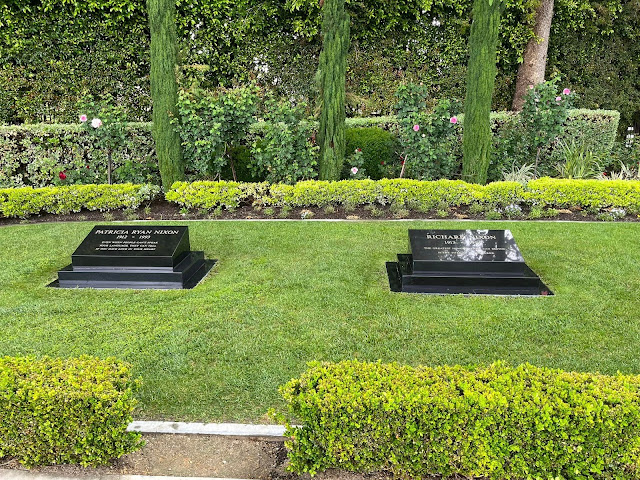
Beyond the exhibits, the library boasts lovely grounds that include beautiful gardens, a reflection pool, and a memorial site where Richard and Pat Nixon are buried.

When Richard Nixon died on April 22, 1994, he became the first U.S. president to have resigned from office, yet he received full state funeral honors. Although his resignation complicated tradition, President Bill Clinton approved the honors in recognition of Nixon’s later role as an elder statesman.

Nixon had planned many details of his funeral in advance, including the Scripture readings and music. One notable choice was “Battle Hymn of the Republic,” requested despite his Quaker background. More than 50,000 mourners viewed his body in the Capitol Rotunda. His mahogany casket, lined with white silk, reportedly contained a handwritten note from his daughter Julie that read, “You are the light of my life.” The military honor guard included members of all five service branches, a rare joint tribute. Gerald Ford, Nixon’s successor and the president who pardoned him, delivered an emotional eulogy. The ceremony reflected the nation’s complicated willingness to honor a deeply controversial figure.

Nixon died four days after suffering a stroke. In a 1978 speech at Oxford University, he acknowledged his flaws but predicted that history would judge his accomplishments kindlier. In many ways, that proved true.

Although Watergate severely damaged public trust in government, some parts of Nixon’s record have gained greater appreciation over time. His foreign policy achievements included opening relations with China and reshaping diplomacy with the Soviet Union. Domestically, he signed major legislation such as the National Environmental Policy Act, the Clean Water Act, and the Endangered Species Act. His administration also created the Environmental Protection Agency, established Amtrak, and authorized the Occupational Safety and Health Administration.

At the same time, Watergate left a lasting stain on his legacy. The cover-up, more than the break-in itself, deeply eroded Americans’ trust in government, and its effects are still felt today.

Even so, Nixon’s overall legacy is often seen as more complex than a single scandal. Like most presidencies, it is best understood as a mix of failures, achievements, and long-term consequences. In retirement, several later presidents sought his advice on foreign affairs.

Nixon and his wife, Pat, are buried at his birthplace in Yorba Linda, California, which is also home to the Richard Nixon Presidential Library and Museum.

The original farmhouse where President Nixon was born is just a few steps away from his final resting place in the Nixon Memorial Garden.

President and Mrs. Nixon are buried on the grounds, just a few feet from his birthplace

Their final resting place in the Nixon Memorial Garden.

President Richard Nikon’s headstone   

 First Lady Patricia Nixon’s headstone 

In conclusion, the Nixon Presidential Library and Birthplace offers a comprehensive and informative experience for visitors interested in the life and presidency of Richard Nixon. It provides a balanced portrayal of his achievements and challenges, and the exhibits are well-curated to offer historical context and perspective. Whether you are a history enthusiast or simply curious about this period in American politics, the library is worth a visit for its educational value and the opportunity to explore the legacy of one of the nation's most complex presidents.

Even though I have never toured the Nixon Presidential Library and Birthplace, I have personal experiences participating in many actives that occurred while I supported President Nixon during my time served with the White House Communications Agency.