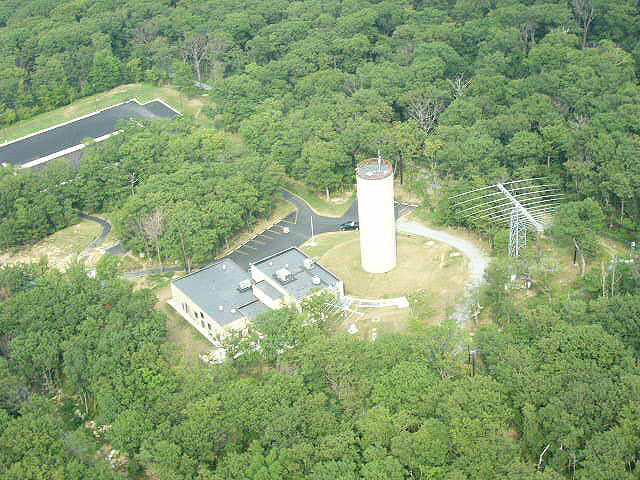
Communication Units at Camp David |
 | | WHCA Camp David Insignia |
|
| |
Location |
| Frederick County, Maryland, USA |
| |
| |
The White House Communications Agency
(WHCA) was originally known as the White House Signal Detachment (WHSD) and
officially formed by the United States Department of War on 25 March 1942 under
President Franklin D. Roosevelt. The WHSD was initially created to provide
normal and emergency communications requirements in support of the President as
well as mobile radio, teletype, telephone and cryptographic aides in the White
House and at Camp David (originally known as Shangri-La).
In April 1942 President Roosevelt visited
Camp David and chose it as the Presidential retreat. On July 5th, 1942 the
President inspected the finished retreat and this began the lineage of the
present day Special Missions Command. In
the early years, members from the White House Signal Detachment would travel in
advance of the President to Camp David and support all communication
requirements. During President Roosevelt's presidency he visited Camp David a
total of 22 times.
As the new Camp increased in usage between
1942 and 1951, the Agency decided to permanently assigned personnel to Camp
David. In 1951 the first member was assigned to Camp and over the subsequent
months the detachment would be filled with new members. As the detachment
started to take shape one of its first missions would be assigned. Late in 1942
right after the WHSD was formed President Roosevelt was presented a newly
rebuilt Ferdinand Magellan train car. During the history of the Presidential
Rail Car, it was the responsibility of the White House Signal Detachment to
support with all communications. After the forming of the Field Branch Division
at Camp David around 1953 it was decided that due to the proximity of the
storage depot in Harrisburg, PA and the need for a specialized group of members
to operate, the FBD would be the permanent
caretakers. The FBD would ensure the communication car would be ready for the
President at a moment’s notice. During the history of the Communications Car,
it would travel a estimated 250,000 miles in support of seven President’s. The
train’s last official trip was in 1954, but remained a WHSD responsibility well
into the 1970’s.
In 1954 the White House Signal Detachment
was reorganized and renamed the White House Army Signal Agency (WHASA).
As the reorganization took shape, the
Field Branch Division was given more responsibility under the new WHASA. In
early 1955 it was decided that any enduring requirements outside of Washington,
DC would be the responsibility of the FBD headquartered at Camp David. During
the early years of the Command the requirement to provide communications at the
sitting President’s private residence was established and fell under the FBD at
Camp David. During President Eisenhower’s administration this requirement
officially began and members from Camp David would support the Eisenhower Farm
in Gettysburg with Radio, Microwave and switchboard communications when the
President would travel home. The mission of supporting the President’s private
residence has evolved from the President Eisenhower’s private farm in
Gettysburg, PA, to President Johnson's Ranch in Johnson City, TX and remains a
core responsibility today at President Obama's home located in Chicago, IL.
Other locations that the Detachment managed over time were President Kennedy's home
in Hyannis Port, MA, President Nixon's home in San Clemente, CA and Key
Biscayne, FL, President Carters home in Plains, GA, President Reagan's Ranch
outside of Santa Barbara, CA, President George H.W. Bush's home in Walker's
Point, ME and President George W. Bush's home in Crawford, TX.
Around 1995 the practice of providing a
similar capability for the Vice President was implemented and continues to this
day with Vice President residence.
Late in 1954 a plan to implement emergency
communications was developed and presented to the Secretary of Defense. The
plan was approved and construction began on a series of emergency facilities
around the United States. The construction took from 1955 to the early 1960’s
to complete, the construction included a series of Presidential Emergency
Communications facilities around the Washington, DC area. These facilities
became a key part of the Camp David Detachment's history and would take the
Detachment into one of its most historic missions. During the height of the
Cold War the Camp David Detachment would provide 24/7 support for seven newly
established microwave relay towers scattered across the mountains of the
Virginia, West Virginia, Maryland and Pennsylvania. As this mission took shape members
of the Detachment would deploys for weeks at a time to these remote towers to
operate and maintain the emergency communications requirements. This mission
remained a core responsibility of the Detachment until the towers were deemed
no longer needed due to satellite communications and all towers were officially
closed or transferred to other Agency’s between 1970 and 1985. It is this piece
of the detachments history where the popular call-sign CACTUS was created and
is still used today. This call-sign dates back to the late 1950’s after the
Tower system was commissioned and remained the name of a tower until it was
demolished.
As the Field Branch Division continued to
operate as a separate command under the WHASA it was decided that small
detachments were needed. These detachments would be responsible for
geographically separated mission requirements and would operate under the
supervisor of an Army Warrant Officer. These detachments were Detachment 1
responsible for the Cactus and Cannonball Towers, Detachment 2 responsible for
the Crystal and Cowpuncher Towers, Detachment 3 responsibility for the
Creed/Cadre Tower complex and the Eisenhower Farm and Detachment 4
responsibility for Cartwheel, Corkscrew and Canteen Towers.
In 1962 the WHASA was discontinued, and
its duties were transferred to the auspices of the Defense Communications
Agency under the operational control of the White House Military Office (WHMO),
and reestablished as the White House Communications Agency (WHCA). At that
point WHCA was divided into three units: The Defense Communications Operations
Unit (DCOU) and Defense Communications Administrative Unit (DCAU) both located
in Washington, DC and The Defense Communication Support Unit (DCSU)
headquartered at Camp David and maintaining responsibility for the operation of
seven Presidential Emergency Facility (PEF) locations and the communications
equipment on the Presidential Train “CRATE” in Harrisburg, Pa, as well as the
Camp David complex.
During the decommissioning of the first
microwave towers in 1969, members assigned to these Detachments would be
repurposed and relocated across the United States. This new mission would again
require a small group of specialized members who could master the requirements
and training needed to operate geographically separated from the WHCA
headquarters. The formation of the Communications Contingency Teams was the
Agency’s answer to this new need. These teams were strategically placed to
support the President and played an important role in the Emergency and
Contingency communications support established during the height of the Cold
War. These teams started in Ft. Richie, MD, Key Biscayne, FL and San Clemente,
CA but over time moved to El Toro, AZ, Andrews AFB, MD and Berryville, VA
By 1983 all CCT teams renamed from
Contingency Team to Support Team and made a strategic move to Carswell, AFB,
TX, Luke AFB, AZ, and the team at Andrews AFB was renamed and support stayed
the same. The CCT’s and CST’s were highly mobile groups that could be deployed
at a moment’s notice. One of the original CCT/CST’s remained active and later
transferred to the Washington Area Communications Command and finally disbanded
in 2014.
As the Detachments history continued to
evolve, one of the original missions remained active throughout its long
history. The mission of supporting the Presidential Retreat at Camp David, MD
has been a continuous mission since the first member was assigned in 1951.
During the detachments history the Service members of the Command have provided
support for over 860 separate visits by 13 Presidents over a 75 year period.
Over the past 75 years the Detachment has continued to support and upgrade Camp
David to meet the ever changing communications required to support the
President, Commander in Chief and Chief Executive of the United State. It is
estimated that over 3,000 Soldiers, Sailors and Airmen have been part of the
Command in its 65 year history.
After the CCT and CST teams were
officially closed, the Command was assigned a contingency mission that would
fill a major post-cold war requirement. Similar to the CCT’s mission when it
was created the members of the Camp David detachment would be responsible for
preparing for the “Bad day Scenario”. In order to meet this new requirement,
members would remain in a ready state and exercise routinely to ensure response
requirements were always met. On Sep 11th 2001 the “bad day” call
would be received and members told to execute. Members of the Bolt Out of the
Blue (BoB) team executed its Emergency Action mission and departed for their
assigned location. While this team was in full swing, the Camp David
switchboard would also be fully engaged in the day’s happenings and would be
providing never before call volume and requests. While the morning unfolded it
was determined that the Vice President would be relocated to safety of Camp
David and members from the Detachment would support him for the next 2 weeks.
The Command and its members provided unprecedented support on Sep 11th,
2001 and has shaped many of today’s emergency action requirements and tasks.
In 2002 the Detachment was renamed the
Special Missions Command and has remained largely unchanged through present day;
the Command operates in 5 geographically separated locations while continuing
to make history for the Agency. As the Government updated their contingency
operations orders and plans in 2003, WHCA was tasked with creating and
maintaining a Continuity of Operations facility that would ensure all services
being provided by WHCA would be available should a major issue affecting
Washington DC cause services to be limited. In late 2003 the Agency opened the
Signal Support Element which established a facility outside of Washington, DC
designed to ensure communication reliability for the President and all White
House staff and supporting Agency’s. The Command continues to support this
mission today with 3 permanently assigned members with support from Camp David
and WHCA Headquarters as needed.
In 2015 as the Agency and Special Missions
Command began supporting All White House computer and network requirements it
was discovered that a more robust call center was required to supporting the
increase of over 3,000 White House customers. The Command was again called upon
to solve a major issue facing the Agency. In late 2015 the Special Missions
Command stood up the White House Information Technology Service Call Center at
Camp David and began providing unprecedented support to the newly converted White
House staff.
As the travel and customer service
requirements began to pick up it was determined that with the changing
technology and pace required a change in how the Command trained and equipment
it members. At the beginning of 2016 the Special Missions Command conducted a
major personnel and mission capability shift which established a team of
well-rounded and highly cross-trained members. Out of this needed change was
born the Special Missions Command, Cross Functional Team who assumed the
enormous task of providing all travel and Emergency Action support for the
President while at Camp David, the President and Vice President while at their
private residence and routine travel support for the President and Vice
President around the world.
Today the Special Missions Command is made
up of 92 Soldiers, Sailors, Airmen and Civilian's. These men and women are
charged with the task of leading the Agency's Special Missions as directed by
the Commander, White House Communications Agency. The present day Special
Missions Command is organized into 8 sections and spans over 5 geographically
separated locations. At Camp David the Command has the Cross Functional Team,
Camp David Switchboard (CACTUS), White House Service Center and an Operations
section that includes, admin, supply, infrastructure, security, and maintenance
personnel. Additionally the Command has 4 locations not located on Camp David.
These locations are Chicago, IL (President Obama's residence), Wilmington, DE
(Vice President Biden's residence) and 2 other classified locations.
The history of Presidential Communications
began with the opening of Camp David, supporting the Presidential Train and
manning the critical microwave tower network, shifted to cold work contingency
support around the united states and Presidential private residence support,
then played a key support role during the terrorist attacks on Sep 11, 2001 and
continues today with WHCA assuming all computer and network services for the
President, Vice President, and all White House staff. Members of SMC continue to support all WHCA
missions and remain the primary proponent for all permanent missions outside of
the National Capitol Region.
WHCA COMMANDERS
1 COL
George J. McNally Mar 1946 to May 1965
2 BG Jack
A. Albright May 1965 to Jun 1969
3 BG Albert Redman, Jr. Jun 1969 to Jan 1973
4 BG Lawrence E. Adams Jan 1973 to Sep 1975
5 BG Leonard J. Riley Sep 1975 to Jun 1977
6 COL Robert F. Feely Jun 1977 to Nov 1977
7 COL Edwin Cantrell, III Nov 1977 to May 1978
8 BG Josiah Blasingame, Jr May 1978 to May 1981
9 MG Henry J. Schumacher May 1981 to Jun 1982
10 BG John
S. Tuck Jun 1982 to Jan 1984
11 COL Lawrence
Schuman Jan 1984 to Sep
1985
12 COL William
V. Bogart Sep 1985 to Dec 1988
13 COL Kenneth
E. Nickel Dec 1988 to
Feb 1992
14 COL Thomas
J. Hawes Feb 1992 to Oct 1994
15 COL Joseph
J. Simmons, IV Oct 1994 to Nov 1998
16 COL Kenneth
Campbell Dec 1998 to Feb
1999
17 BG Dennis
Moran Feb 1999 to Apr 2000
18 COL Margaret
Baldwin Apr 2000 to Jul 2001
19 COL Michael
McDonald Jul 2001 to Jul 2004
20 COL Howard
Cohen Jul 2004 to Aug 2006
21 COL James
Lien Aug 2006 to May 2009
22 COL Michael
Black May 2009 to Jul 2011
23 COL Clinton
Bigger Jul 2011 to Nov 2013
24 COL Donovan
Routsis Nov 2013 to August 2015
25 COL Cleophus
Thomas, Jr August 2015 to
August 2016
26 COL Chad
D. Raduege August 2016 to June 2018
27 COL James
F. Riley June 2018
to January 2021
28
COL Joy
M. Kaczor January
2021 to ?
FBD,DCSU
and SMC Commanders
Command Formed as Field Branch Division
(FBD)
1 LTC Gordon
Parks (1958-1962)
2 CPT Earl Dunn (1962-1966)
Command Reflagged as Defense
Communications Support Unit (DCSU)
3 MAJ John Duguay (1966-1969)
4 MAJ Charles Freed (1969-1972)
5 MAJ Richard Barnett (1972-1973)
6 CDR George Brenton (1973-1981)
7 CDR Robert Ohm (1981-1983)
8 LCDR Ed Barger (1983-1985)
9 LCDR Charles Finley (1985-1987)
Command HQ relocated to Washington, DC and
Camp David Detachment became separate Command)
10 CW4 Jim Straight (1988-1990)
11 CW4 Gordon Errington (1991-1995)
12 LT Darlene Gunter (1995-1997)
13 LTC Michael Briske (1997-1999)
Command Reflagged as Special Missions
Command (SMC)
14 LTC Timothy Lake (2001-2003)
15 LTC Tracy Amos (2003-2004)
16 LTC Kirby Watson (2004-2007)
17 LTC Charles Daly (2007-2010)
18 LTC Jeth
Rey (2010-2012)
19 LTC James
Chastain (2012-2015)
20 MAJ Chad
Ott (2015-?)
Senior
Enlisted Leaders
Command Reflagged as Defense Communications Support Unit (DCSU) (1964 to 1996)
1 SGM Victor Shorten (1964-1969)
2 SGM Milton Cauthen (1969-1974)
3 CMSgt Francis Orehowsky (1974-1978)
4 SGM Leo Scherping (1978-1980)
5 Master Chief Wally Sparks (1980-1982)
6 SMSgt Donald Brummentt (1982-1983)
7 SGM Charlie Grunden (1983-1986)
8 MSG Frank Conway (1986-1989)
9 MSG Charles Hayes (1989-1992)
10 MSG Raymond Hrynko (1992-1995)
11 1SG Trudy Beltz (1995-1996)
Command Reflagged as Special Missions Command (SMC) 1996-2001?
1996-2001?
12 1SG Eric Campbell (2001-2003)
13 1SG Lindsay Thompson (2003-2004)
14 1SG Gilbert Rowan (2004-2007)
15 1SG Thomas Pacheco (2010-2012)
16 1SG Joseph Dorey (2012-2014)
17 1SG Jason Walker (2014-2017)
18 1SG Freddie Suber (2017 to ?)